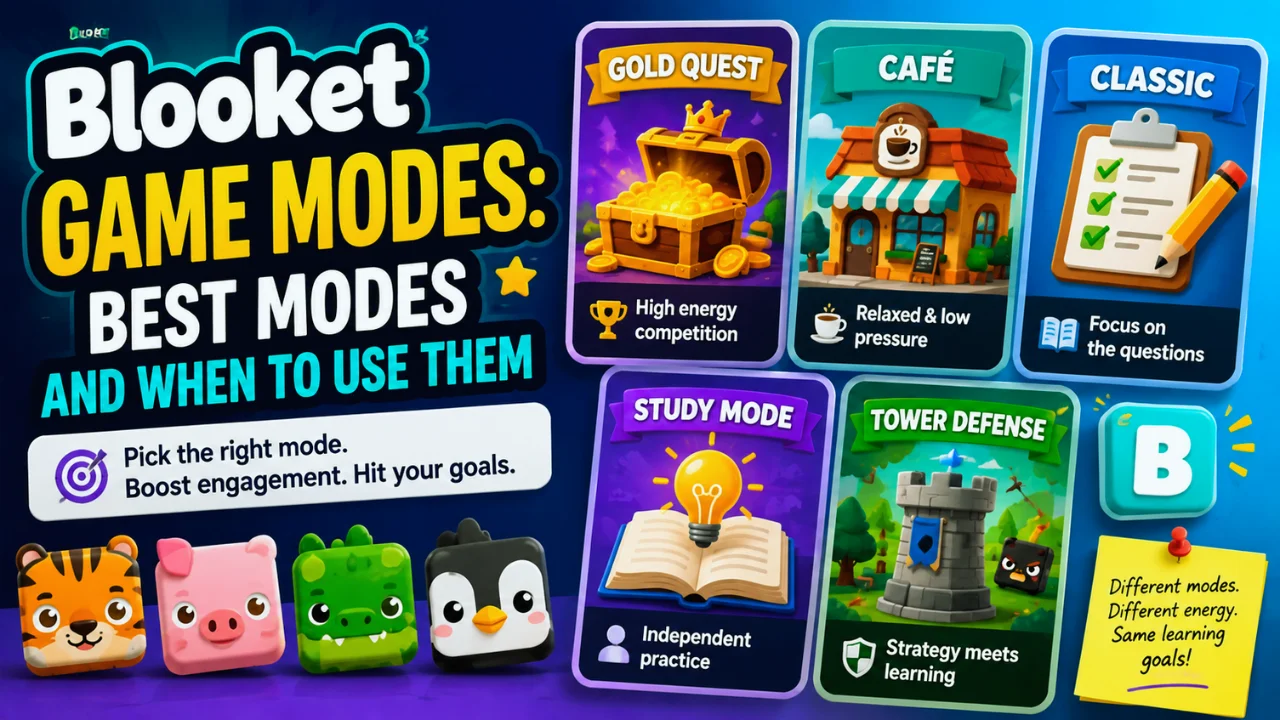
Blooket Game Modes: Best Modes and When to Use Them
Choosing a Blooket mode looks simple until you actually have a classroom waiting.
Two modes can use the same question set yet create completely different experiences. One can turn a quiet review session into a highly competitive game (similar to the live excitement in Kahoot). Another option is to let students work through the same material independently with much less pressure.
That is why understanding Blooket game modes matters.
Instead of asking which mode has the most entertaining theme, teachers should ask a more useful question: What do I want the room to feel like while students answer these questions?
Some modes are designed around competition. Others encourage strategy, independent practice, or straightforward question answering.
If you are new to the platform, check out our master Blooket guide. This guide breaks down the major modes by how they work and, more importantly, when they make sense in a real classroom.
Important: Blooket changes its game roster over time. Modes may be added, removed, restricted, or changed through seasonal updates. Always check the current mode picker in your account before planning a lesson around one specific game.
Quick Answer
The best Blooket game mode depends on your goal. Gold Quest works well for high-energy competition; Café suits calmer sessions; Classic keeps attention on the questions; Study Mode supports individual revision; and Tower Defense adds strategic gameplay. Choose the mode based on your students, lesson objective, available time, and desired classroom energy.
What Are Blooket Game Modes?
Blooket game modes are different gameplay formats that incorporate question sets into the experience.
Students may answer the same academic questions across multiple modes, but what happens around those questions changes.
For example, answering correctly might allow a student to:
- open a chest,
- earn resources,
- move forward in a race,
- develop a restaurant,
- build defenses,
- increase production, or
- receive immediate feedback.
This distinction is important because the game’s mechanics influence student behavior.
A highly competitive class may react very differently to Gold Quest than to Café, even when both sessions use the same questions.
Q: What is a Blooket game mode?
A: A Blooket game mode determines the gameplay students experience while answering a question set. Different modes introduce competition, strategy, resource management, racing, or straightforward study, allowing teachers to align the activity with their lesson objectives.
What Are the Main Ways to Play Blooket?
Before choosing individual games, it helps to understand the broader formats available.
Live
Live sessions are hosted games (see our step-by-step guide on how to host a Blooket game) in which students join and play together in real time.
This is the familiar classroom version of Blooket. A teacher starts the activity, students enter the session, and everyone participates during the same period.
Live sessions work particularly well when engagement and group participation matter.
Solo
Solo play allows a student to work through a game independently.
There is no classroom opponent or live host to worry about. That can make Solo play useful when students need genuine practice without the social pressure of a leaderboard.
Homework
Homework lets teachers assign question sets for students to complete independently by a deadline.
It is particularly useful when classroom time is limited, or students need additional practice outside the lesson.
Not every game necessarily supports every format, so teachers should check the mode picker before assigning one.
Which Blooket Modes Are Best for High-Energy Classes?
Some Blooket modes are built around direct competition. They can produce excellent engagement, but teachers should use them intentionally.
Gold Quest
Gold Quest is one of the most obviously competitive Blooket experiences.
Students answer questions to open chests. A chest might contain gold, but it can also introduce mechanics that affect another player’s total, such as stealing or swapping gold.
That unpredictability is a major reason students enjoy it.
It is also why the room can become loud very quickly.
Best for:
- Friday activities
- pre-holiday lessons
- class rewards
- energetic review sessions
- groups comfortable with competition
Gold Quest should exercise greater caution when there is already tension among students. A game mechanic that involves taking resources from named classmates can feel very different depending on the group’s social dynamics.
Q: Is Gold Quest the best Blooket game mode?
A: Gold Quest can be one of the best choices when the objective is excitement and participation, but it is not automatically the best educational choice. For focused revision or lower-pressure practice, Classic, Café, or Study Mode may fit the lesson better.
Crypto Hack
Crypto Hack introduces competition with a little more strategy.
Students build their balance while attempting to break into other players’ balances. Defensive decisions are part of the experience too, meaning the game is not based solely on attacking competitors.
It can therefore reward students who think ahead.
Best for:
- older students
- competitive groups
- classes that enjoy strategic decisions
Teachers working with groups that dislike direct competition may prefer a calmer Blooket alternative.
Battle Royale
Battle Royale is built around head-to-head elimination.
Students compete; correct answers allow players to progress, and the field gradually narrows until a winner remains.
The rules are easy to understand, making it suitable for short activities.
Its weakness is also obvious: eliminated students can end up watching rather than participating.
For a large class and a long session, that may leave too many students inactive.
Best for: short rounds and smaller groups.
Which Blooket Modes Are Better for a Calm Classroom?
Not every Blooket session needs to create maximum excitement.
Sometimes the class is already energetic enough.
Café
Café replaces direct attacks with resource management.
Students run a small restaurant. Correct answers help them earn resources to obtain ingredients and serve customers.
Students are essentially managing their own progress rather than taking something away from classmates.
This makes Café especially useful for younger learners or students who become uncomfortable with intense competition.
Best for:
- younger classes
- post-lunch lessons
- calmer review sessions
- students who dislike direct competition
Factory
Factory follows a similar lower-pressure pattern.
Students answer questions while managing a production system and improving their output. The numbers gradually increase as the game develops.
It is simple enough to understand, but it gives students something to manage beyond just answering questions.
Factory can be particularly appealing to students who enjoy incremental progress.
Best for: situations similar to Café, particularly with somewhat older students.
Tower Defense
Tower Defense is one of the more strategic options.
Students answer questions to obtain resources and use those resources to place towers that defend against advancing enemies.
The interesting part is that answering questions is only one component. Students also need to think about placement and resource allocation.
That makes the mode slower and more strategic than many alternatives.
Teachers should also consider device size. A game with more detailed controls can be less convenient on a small phone screen than on a Chromebook or laptop.
Q: Which Blooket mode requires the most strategy?
A: Tower Defense is a strong choice for strategic gameplay because students must think about tower placement and resource allocation alongside answering questions. It suits classes that enjoy longer-term decisions rather than only speed-based competition.
Which Blooket Modes Keep the Focus on Learning?
Game mechanics can increase participation, but sometimes they become the thing students remember most.
When the questions themselves need to remain central, simpler modes can be more useful.
Classic
Classic removes much of the extra game layer.
Students answer questions and work with a leaderboard without having to manage restaurants, defenses, production systems, or other mechanics.
That simplicity is valuable.
When a teacher wants students concentrating on academic content, fewer distractions can be an advantage rather than a limitation.
Best for:
- focused classroom review
- homework
- straightforward practice
- unfamiliar question sets
Racing
Racing uses an immediately understandable objective: answer correctly and move toward the finish.
Because the relationship between answering and progressing is simple, younger students can understand the game without a lengthy explanation.
Best for:
- younger learners
- short activities
- first-time Blooket users
Study Mode
Study Mode strips away competition even further.
There is no need for a leaderboard or elaborate gameplay. Students can concentrate on answering questions and receiving feedback.
That makes it particularly relevant before an assessment.
The lack of game mechanics may make it less exciting, but excitement and effective revision are not always the same thing.
Q: Which Blooket mode is best for test revision?
A: Study Mode is a strong option for individual test preparation because it removes much of the competitive pressure and keeps attention on questions and feedback. Classic is another useful choice when teachers want a simple review experience.
What Is Deceptive Dinos?
Deceptive Dinos adds a more social element to the Blooket experience.
Rather than focusing only on individual progress, it incorporates social deduction and requires students to pay attention to what others are doing.
That can create a memorable group activity, but it also requires more explanation than straightforward modes such as Racing or Classic.
Teachers should allow enough time to explain the rules and actually play.
Best for:
- longer classroom sessions
- groups that already work well together
- social and collaborative classroom experiences
Avoid choosing a relatively involved mode when only a few minutes remain in the lesson.
How Do the Major Blooket Modes Compare?
| Blooket Mode | Classroom Energy | Competition | Strategy | Best Use |
|---|---|---|---|---|
| Gold Quest | Very high | High | Moderate | Fun competitive review |
| Crypto Hack | High | High | Moderate | Older competitive groups |
| Battle Royale | High | Very high | Low-Moderate | Short head-to-head rounds |
| Café | Low-Moderate | Low | Moderate | Calm classroom practice |
| Factory | Moderate | Low | Moderate | Independent progression |
| Tower Defense | Moderate | Low-Moderate | High | Strategic learners |
| Classic | Moderate | Moderate | Low | Content-focused review |
| Racing | High | High | Low | Younger students and quick rounds |
| Study Mode | Low | None | Low | Individual revision |
| Deceptive Dinos | High | Social | Moderate-High | Longer group sessions |
How Should Teachers Choose the Best Blooket Game Mode?
There is no single mode that works best for every class.
A better approach is to start with the lesson objective.
| Classroom Situation | Recommended Mode |
|---|---|
| Friday afternoon and students need energy | Gold Quest |
| Class is already loud | Café |
| Younger students | Café or Racing |
| Serious test preparation | Study Mode |
| Want strategic thinking | Tower Defense |
| Questions should remain the main focus | Classic |
| Homework practice | Classic where Homework format is supported |
| Longer activity with a strong group dynamic | Deceptive Dinos |
| Older competitive students | Crypto Hack |
Consider the Class Before the Game
A teacher who knows the class well can often choose more effectively than someone simply following a list of popular modes.
Consider:
- Age: Younger learners usually benefit from simple mechanics.
- Classroom relationships: Direct competition can amplify existing tensions.
- Available time: Complicated modes need explanation and setup.
- Learning objective: Revision may need fewer distractions than a reward activity.
- Devices: Detailed interfaces are easier on larger screens.
- Student temperament: Some learners thrive on leaderboards while others disengage under public competition.
What Are Common Mistakes Teachers Make With Blooket Modes?
Choosing the Most Exciting Mode Every Time
High energy does not automatically mean better learning.
If students spend more time thinking about stealing gold than considering why an answer is correct, the game may be serving a different purpose than the lesson.
Ignoring Classroom Dynamics
Competitive mechanics can be harmless in one class and disruptive in another.
Teachers should consider existing relationships before selecting games involving direct attacks or resource stealing.
Using a Complicated Mode for a Five-Minute Activity
Some modes require students to understand an additional system.
For quick practice, Classic or Racing may provide a smoother experience.
Treating Every Student the Same
Some students enjoy public competition. Others perform better when they can work privately and at their own pace.
Using several different Blooket modes over the course of a term can help prevent any one personality type from dominating every activity.
Are All Blooket Game Modes Free?
A large portion of the core Blooket experience is available without requiring teachers to select every paid feature.
However, Blooket’s mode availability and account features can change.
Teachers considering an upgrade should therefore check the current plan comparison directly rather than relying on an old article or video.
The same principle applies to the mode roster itself.
What Happened to Older Blooket Modes?
Blooket’s game library is not permanent.
Older modes, such as Tower of Doom and Pirate’s Voyage, have been removed from the platform, even though they may still appear in older guides and videos.
This creates an important problem when searching for a current list of Blooket modes: an article can appear detailed yet still be outdated.
For the most reliable answer, use current planning guides, but confirm mode availability in your own Blooket account.
Should You Choose a Mode Based on Token Farming?
Probably not.
Search results and videos sometimes make very specific claims about which mode generates tokens fastest.
The problem is that game economies can be rebalanced.
A strategy that worked particularly well during one version may perform differently after an update.
Teachers should choose a mode primarily based on the learning activity and classroom experience, rather than relying on old tokens-per-minute calculations.
Expert Recommendations for Using Blooket Game Modes
The most effective approach is not to find one “best” mode and use it forever. It is matching the mode to the purpose of that particular lesson.
For focused assessment preparation, reduce unnecessary mechanics.
For a Friday reward session, higher-energy competition may be exactly what the class needs.
For students who dislike public competition, give them an option where individual progress matters more.
And when introducing Blooket to a new class, start simple. Students can learn the question-and-answer flow first before moving into modes with more strategy.
The game should support the learning objective, not determine it.
Final Takeaway
The best Blooket game modes are the ones that fit what you are trying to accomplish.
Choose Gold Quest for energy and competition. Try Café when the class needs something calmer. Use Tower Defense when students enjoy strategic thinking. Pick Classic when the questions need to remain central, and point students toward Study Mode when serious individual revision matters more than winning.
The biggest mistake is choosing purely by popularity.
Think about the students, the lesson objective, the available time, the classroom atmosphere, and the devices first. Then choose the game.
And because Blooket updates its roster over time, confirm the current availability of any specific mode before building an important lesson around it.
FAQ
What is the best Blooket game mode?
There is no universal best Blooket game mode. Gold Quest is useful for high-energy competition; Café works well for calmer sessions; Classic keeps students focused on questions; Tower Defense encourages strategy; and Study Mode is particularly suitable for independent revision.
Which Blooket game mode is best for learning?
For focused learning, Classic and Study Mode are strong options because they reduce distractions from extra gameplay. Study Mode is especially useful for independent revision, while Classic works well when teachers want a simple classroom or homework activity centered on the question set.
Which Blooket mode is best for younger students?
Café and Racing are useful options for younger students. Racing has an easy-to-understand objective, while Café offers a calmer experience without aggressive player-versus-player mechanics. The right choice depends on whether the teacher wants higher energy or quieter individual progression.
Is Gold Quest Blooket good for classrooms?
Yes, Gold Quest can be highly engaging in classrooms that respond well to direct competition. However, its stealing-and-swapping mechanics can make sessions noisy and may not suit groups with existing social friction. It works particularly well when engagement and entertainment are the primary objectives.
Can students play Blooket game modes on their own?
Many Blooket activities can support individual play, depending on the mode and current platform options. Solo-style practice removes the competition of live classroom practice, while Study Mode is particularly appropriate for students who want to concentrate on revision and immediate feedback.
Which Blooket mode is best for homework?
Classic is a practical choice when available in Blooket’s Homework format because its simple mechanics keep attention focused on answering questions. Teachers should check which modes currently support homework before creating an assignment, as platform features and mode availability can change.
Is Tower Defense a good Blooket mode?
Tower Defense is particularly useful for students who enjoy strategic gameplay. Correct answers provide resources that can be used to build defenses, so students have to think beyond just answering quickly. It generally works better when students have enough time and suitable devices to engage with the strategy.
How many Blooket game modes are there?
A fixed number can become outdated because Blooket adds, changes, and removes modes over time. Older modes have already disappeared from the platform. For that reason, the most accurate way to view the current list of Blooket modes is to check the mode picker in your account.

Table of Contents