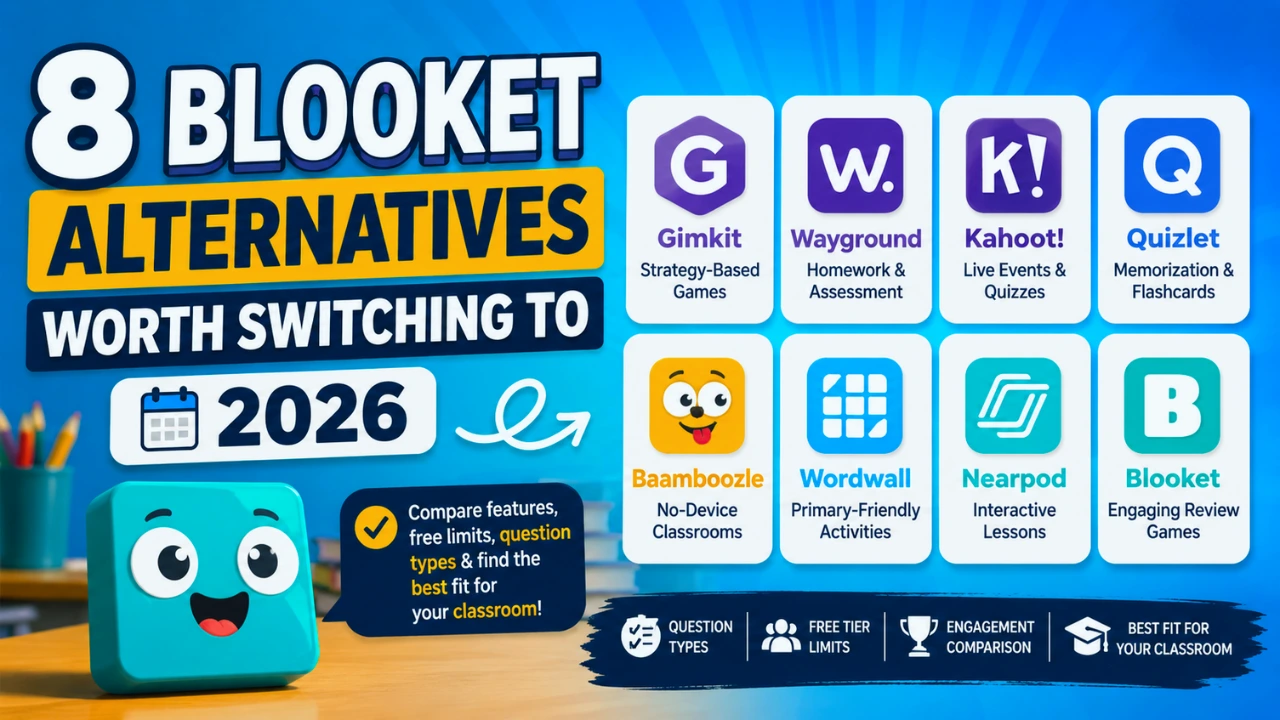
8 Blooket Alternatives Worth Switching To
Blooket is excellent at making repetitive review feel less repetitive. That does not mean it is the right tool for every lesson.
Maybe your students enjoy the games but get more interested in winning than answering accurately. Perhaps you need richer question formats. Or maybe the real problem is homework: you want something built around independent practice rather than a classroom game that only supports assignments.
That is where Blooket alternatives become useful.
The important thing is not finding a platform with more features. It is finding one whose strengths match the problem you are actually trying to solve.
And there is another point worth making before switching: Blooket’s free plan remains unusually practical. Blooket currently allows free users to create unlimited question sets and host games with up to 60 participants. Plus increases the general live-game limit to 300, although some modes have different limits.
So moving away from Blooket does not automatically mean getting a better free plan.
Quick Answer
The strongest Blooket alternative depends on what you need. Wayground offers richer assessment options and strong asynchronous learning; Gimkit emphasizes strategy and game mechanics; Kahoot suits synchronized live quizzes; Quizlet focuses on study and retrieval practice; Baamboozle works well for team play; Wordwall offers reusable activity templates; and Nearpod can power complete interactive lessons.
Blooket Alternatives at a Glance
| Platform | Particularly useful for | Free option | Main difference from Blooket |
|---|---|---|---|
| Blooket | Repeated classroom review | Yes, generally up to 60 players | Multiple Blooket game modes around question sets |
| Gimkit | Strategy-driven classroom games | Yes | More game strategy and 2D experiences |
| Wayground | Assessment and asynchronous work | Yes, up to 100 per session on Starter | Much broader question formats |
| Kahoot | Synchronized live quizzes | Yes, plan-dependent limits | Strong shared-room quiz experience |
| Quizlet | Flashcards and independent study | Yes, with feature limits | Study-first rather than game-first |
| Baamboozle | Team-based classroom activities | Free Basic plan | Simple teacher-led group play |
| Wordwall | Reusable activities and templates | Yes, up to 3 created activities | One content set can support varied activities |
| Nearpod | Interactive lessons | Yes, 40 joins on Silver | Combines instruction and assessment |
Feature availability can vary by plan, account type, and region. Check the platform’s current plan page before purchasing.
1. Wayground: For More Flexible Assessment
If the name Wayground is unfamiliar, you may know the platform by its previous name: Quizizz.
Quizizz officially became Wayground in 2025. The change was primarily a rebrand rather than the launch of an unrelated platform. Existing accounts, classes, and resources continued under the new name.
That matters because older comparisons may still describe Quizizz as though it were a separate competitor to Blooket.
Why choose Wayground over Blooket?
Question variety is the obvious advantage.
Wayground supports basic formats, including multiple-choice, multi-select, true/false, fill-in-the-blank, and open-ended responses. Depending on the plan, it also offers formats such as matching, reorder, categorization, graphing, labeling, hotspot, audio/video responses, and drawing.
That gives teachers considerably more flexibility when a lesson cannot be assessed effectively through simple answer selection.
Wayground also works for both teacher-paced and student-paced activities, making it useful when the same material needs to function during class and later as independent practice.
Its current Starter plan allows up to 100 participants per session, although question types, storage, reporting, and other functionality are limited compared with paid plans.
Choose Wayground if your main frustration with Blooket is assessment depth, or if you regularly assign independent work.
2. Gimkit: For More Game Strategy
Gimkit is one of the closest alternatives to Blooket because both platforms turn question answering into a larger game loop.
But they feel different.
Rather than making the questions themselves the entire experience, Gimkit frequently connects correct answers to resources, objectives, or in-game actions. Students therefore have decisions to make beyond simply choosing the correct response.
Its 2D modes push this even further by placing students inside interactive environments.
Is Gimkit’s free plan really limited to five students?
This is where older comparisons can be misleading.
Gimkit Basic does not simply restrict every free classroom game to five students. Basic users receive unlimited access to featured modes, while Gimkit rotates which modes are available for free.
Gimkit’s published hard limit is 500 students for regular live games and 60 for 2D modes. The five-player restriction applies to Pro-exclusive modes when accessed by Basic members, not every free Gimkit game.
Assignments, unrestricted access to Pro-exclusive modes, audio questions, and image uploads are among the features associated with Gimkit Pro.
That distinction makes Gimkit Basic considerably more usable than many outdated comparisons suggest.
Choose Gimkit if: students respond well to strategy, exploration, and longer game loops rather than straightforward quiz competition.
3. Kahoot: For Synchronized Live Quiz Energy
Kahoot remains one of the most recognizable names in classroom response games.
Its defining experience is simple: everyone receives the same question at roughly the same moment, answers under time pressure, and sees results or rankings as the activity progresses.
That synchronized structure creates a very different atmosphere from a self-paced Blooket mode.
Where does Kahoot make more sense?
Think about the difference between a weekly review routine and a special classroom event.
Blooket is particularly effective when you want to reuse question sets while changing the surrounding game.
Kahoot makes sense when you want the entire room focused on the same question at the same time.
That can work particularly well for:
- exam review sessions;
- lesson starters;
- whole-class knowledge checks;
- presentations;
- training sessions;
- larger shared activities.
Free and paid participant limits vary by account and plan, so do not rely on a single universal “Kahoot player limit.”
For a deeper head-to-head look, see our Blooket vs Kahoot comparison.
Choose Kahoot if: synchronized participation matters more than having multiple game environments around the same questions.
4. Quizlet: For Memorization and Independent Study
Quizlet is not really trying to be Blooket.
That is precisely why it belongs on this list.
Its foundation is flashcard-based studying rather than hosting classroom games. Students can find or create sets and use them to practice terminology, definitions, and concepts independently.
Quizlet also offers adaptive Learn functionality and testing tools, although access varies between free users, subscribers, and students studying sets through teacher-managed classes.
When is Quizlet better than a classroom game?
Consider a vocabulary test.
A 15-minute classroom game might persuade a student to answer the same material repeatedly. That is valuable.
But if the student needs to study independently over several days, Quizlet’s study-centered structure is a more natural fit.
It is particularly useful for vocabulary, languages, scientific terminology, historical facts, and other subjects involving repeated retrieval.
Choose Quizlet if: long-term study and memorization matter more than the excitement of the live classroom session.
5. Baamboozle: For Simple Team-Based Classroom Play
Baamboozle takes a different approach from platforms that expect every learner to interact with a game individually.
Its activities are well suited to teacher-led, team-based classroom play, making it useful when you want students looking up and interacting with the room rather than concentrating entirely on individual screens.
Baamboozle currently offers a free-forever Basic plan, with additional games and functionality available through Baamboozle+.
The trade-off is depth.
If you need sophisticated assessment analytics, individual student progress tracking, or detailed asynchronous workflows, another platform will probably make more sense.
But not every classroom activity needs a dashboard full of data.
Sometimes you want to project a game, split students into teams, and start.
Choose Baamboozle if: simple group participation matters more than detailed individual assessment.
6. Wordwall: For Reusing Content in Different Activities
Wordwall solves one of the least glamorous problems in teaching: recreating the same material in different formats.
Its system revolves around activity templates. Teachers can turn content into formats such as quizzes, matching activities, flashcards, spinning wheels, group sorts, and other interactive exercises.
That makes it particularly appealing for primary education, language learning, and short practice activities.
What is the catch?
The free Basic plan is genuinely restrictive for teachers who create a lot of original material.
As of 2026, Basic users can create up to three activities and access 12 activity templates. Paid plans remove the creation limit and add functionality.
So Wordwall is easy to test for free, but teachers who build a large personal resource library may hit the limit quickly.
Paid plans also support printing, giving Wordwall an advantage when you want both digital and offline versions of teaching resources.
Choose Wordwall if: you repeatedly teach the same material through different activity formats.
7. Nearpod: For Complete Interactive Lessons
Nearpod belongs on this list with an asterisk because it is broader than Blooket.
Blooket is primarily something you insert into a lesson.
Nearpod can become the environment in which you deliver that lesson.
Teachers can combine instructional material with interactive videos, activities, and formative assessment. Nearpod says its free Silver plan includes interactive lessons and videos, more than 20 formative-assessment and media features, synchronous or asynchronous delivery, reports, and access to its resource library.
The current Silver plan includes 300 MB of storage and up to 40 student joins per lesson.
That is enough for many individual classrooms but obviously less generous on participant capacity than Blooket’s general 60-player free limit.
Nearpod also requires more preparation if all you need is a five-minute revision game.
Choose Nearpod if: you want instruction, interaction, and formative assessment in one lesson-delivery platform.
8. Blooket Itself: When Switching Doesn’t Solve the Problem
One of the most overlooked Blooket alternatives is simply using Blooket differently.
Before migrating your resources, identify what is actually wrong.
If you are hitting participant limits, changing platforms might help.
If you need sophisticated open-ended assessment, Wayground or Nearpod makes more sense.
But if students are merely getting tired of one Blooket mode, moving your entire question library may be unnecessary. Rotating modes or changing how frequently you use game-based review may solve the problem.
The free Blooket plan supports unlimited question set creation and generally allows games with up to 60 participants. Plus adds enhanced reporting, folders, a question bank, audio questions, longer homework deadlines, and larger general live games.
Read our complete Blooket guide before deciding whether the platform itself is the problem.
You can also see the Blooket Plus review if your main limitation can potentially be solved by upgrading rather than migrating.
Which Blooket Alternative Should You Choose?
There is no useful universal winner because these tools solve different classroom problems.
| Your main requirement | Platform to investigate first |
|---|---|
| More assessment formats | Wayground |
| Strategy-heavy gameplay | Gimkit |
| Synchronized whole-class quizzes | Kahoot |
| Flashcards and independent study | Quizlet |
| Teacher-led team activities | Baamboozle |
| Reusable activity templates | Wordwall |
| Complete interactive lessons | Nearpod |
| Repeated gamified review | Blooket |
A secondary school science teacher preparing students for exams may reasonably use Quizlet for independent study, Blooket for Friday review, and Nearpod for interactive instruction.
These platforms do not have to replace one another.
How Should You Test an Alternative Before Switching?
Avoid migrating because another platform has a longer feature list.
Run a small classroom test instead.
Choose the two platforms that address your specific problem. Recreate one familiar activity on each and use them with the same class over two or three lessons.
Then evaluate four things:
- Setup time: Did creating the activity take noticeably longer?
- Student participation: Were students actually answering questions, or were they mainly interacting with the game mechanics?
- Learning evidence: Could you identify what students understood and where they struggled?
- Repeatability: Would you realistically use the platform every week?
The fourth question matters more than it sounds.
A tool can produce a fantastic demonstration lesson and still be a poor everyday teaching platform if preparing each activity takes 45 minutes.
Common Mistakes When Choosing Apps Like Blooket
The first mistake is treating the free plan as a permanent product policy. Edtech pricing and feature limits change frequently.
The second is comparing platforms purely by the number of game modes. Ten modes you never use are less valuable than one workflow that saves you 20 minutes every lesson.
Another mistake is assuming more excitement means more learning. Engagement can create practice opportunities, but students still need to process the material.
Finally, avoid choosing software without testing it with the students who will actually use it. Different age groups, and even different classes within the same year, can respond completely differently to the same activity.
Final Verdict
The useful question is not, “What is the best Blooket alternative?”
It is, “What does Blooket currently prevent me from doing?”
If the answer is richer assessment, investigate Wayground. If it is deeper game strategy, try Gimkit. If you want synchronized quiz events, Kahoot is built around that experience. For independent retrieval practice, look at Quizlet. For simple team activities, consider Baamboozle. Wordwall makes sense when reusable activity formats matter, while Nearpod is the more substantial step toward delivering complete interactive lessons.
And if none of those problems describes your classroom, staying with Blooket may be perfectly sensible.
Software should solve a teaching problem. Switching platforms simply because another has more features usually creates a new problem.
FAQ
What is the best free alternative to Blooket?
Wayground, Gimkit Basic, and Baamboozle all offer meaningful free access, but they serve different purposes. Wayground emphasizes assessments, Gimkit focuses on game-based learning, and Baamboozle works well for teacher-led group activities. Blooket itself remains competitive because its free plan generally supports up to 60 participants and unlimited question-set creation.
Is Gimkit better than Blooket?
Neither platform is universally better. Gimkit places more emphasis on strategy and interactive game mechanics, including 2D modes, while Blooket makes it particularly easy to reuse question sets across different game formats. Teachers should choose based on lesson goals, students’ ages, classroom behavior, and the free or paid features they actually need.
What happened to Quizizz?
Quizizz officially changed its product name to Wayground in 2025. Existing accounts, classes, and resources continued under the new branding, so Wayground should not be treated as a separate replacement for Quizizz. Older articles and resources may still use the Quizizz name, which can make comparisons confusing.
What are some games like Blooket for classroom use?
Gimkit and Kahoot are two obvious options for game-based classroom participation. Gimkit adds strategic mechanics and interactive environments, while Kahoot emphasizes synchronized questions and whole-room participation. Baamboozle offers another approach through teacher-led team games, particularly when you do not want every student focused on an individual device.
Which Blooket alternative is good for homework?
Wayground is particularly useful for asynchronous assignments because it supports student-paced delivery and a wider range of assessment formats. Quizlet is another strong option when homework involves memorization and retrieval practice. Gimkit also offers assignments, but that functionality is associated with Gimkit Pro rather than the standard Basic offering.
Which Blooket competitor has more question types?
Wayground offers considerably broader assessment formats than a conventional Blooket question set. Depending on the plan, teachers can use formats including multiple choice, multi-select, fill-in-the-blank, open-ended responses, matching, categorization, graphing, labeling, hotspot, drawing, and audio or video responses.
Is there a Blooket alternative for full lessons?
Nearpod is the clearest option when you need more than a standalone review game. It combines instructional material, interactive activities, videos, and formative assessment within complete lessons. Its free Silver plan currently supports up to 40 student joins per lesson, with higher limits and additional functionality available through upgraded plans.
Should I replace Blooket with another platform?
Only if another tool solves a specific problem in your teaching workflow. Test alternatives using one real lesson before moving large amounts of content. Blooket remains useful for repeated review, while other platforms may be more appropriate for variety in assessment, independent study, full lesson delivery, or particular styles of classroom interaction.

Table of Contents