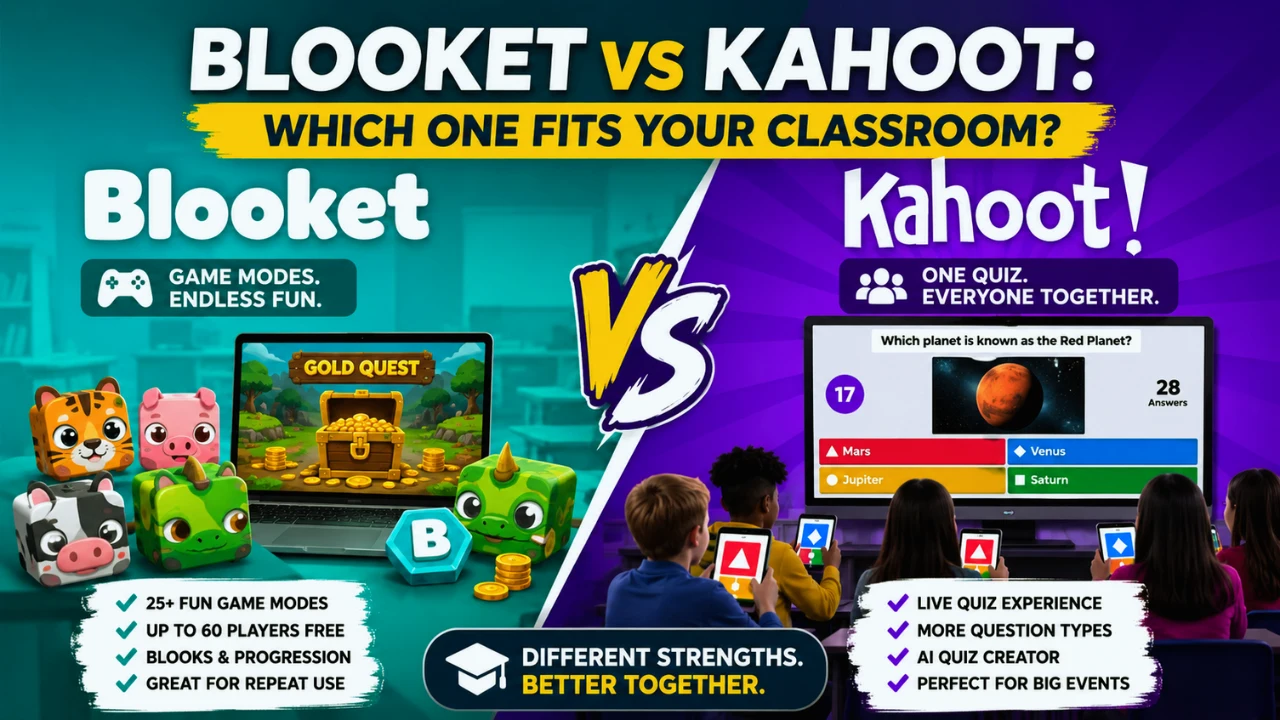
Blooket vs Kahoot: Which One Fits Your Classroom?
Put the same ten review questions into Blooket and Kahoot, and you can end up with two surprisingly different lessons.
Kahoot turns those questions into a shared event, whereas teachers can easily learn how to host a Blooket game with personalized pacing. The class moves together, answers together, and waits for the same leaderboard reveal.
Blooket takes a different approach. Students can work through the same question set while playing individual games involving cafés, towers, collectibles, racing, or other mechanics.
That difference matters more than declaring one platform universally “better.”
In a Blooket vs Kahoot comparison, Kahoot generally makes more sense when you want a synchronized whole-class quiz experience. Blooket becomes especially useful when you want to reuse review questions regularly while changing how the activity feels.
Here is how the two compare in real classroom situations.
Quick Answer
Blooket and Kahoot are both classroom quiz platforms, but they emphasize different experiences. Kahoot is particularly suited to synchronized, teacher-led quizzes and group events, while Blooket combines question sets with multiple game modes that can make repeated review sessions feel different. The better choice depends on your lesson, students, and assessment needs.
What Is the Main Difference Between Blooket and Kahoot?
The easiest way to understand the difference is to watch where students are looking.
During a typical Kahoot session, much of the class experience revolves around a shared presentation. Students answer from their devices, but the question sequence, countdown, results, and leaderboard create a common rhythm.
It feels a little like running a classroom game show.
Blooket is more distributed.
Students still answer educational questions, but those questions feed into game mechanics on their individual screens. Depending on the selected Blooket game mode, a student might manage a café, defend a tower, collect resources, race, or interact with another game system.
That creates a useful distinction:
Kahoot emphasizes the shared quiz. Blooket emphasizes a game-based approach to questions.
Neither approach works for every lesson.
Blooket vs Kahoot
| Feature | Blooket | Kahoot |
|---|---|---|
| Core experience | Questions inside game modes | Synchronized interactive quiz |
| Classroom feel | More individual/distributed | More whole-class/synchronized |
| Repeat review | Strong due to mode variety | Depends more on quiz variety |
| Game variety | Major part of platform | Quiz experience is more central |
| Question options | More limited | Broader activity/question options |
| Student collectibles | Blooks and collectible rewards | Different reward/engagement system |
| Homework/self-paced use | Available | Available |
| Teacher-led live use | Available | Core strength |
| Best fit | Recurring review and gamified practice | Shared quizzes, presentations, and events |
| Free access | Available | Available |
Important: Features, participant limits, plan names, and pricing can change. Check the current Blooket and Kahoot plan pages before choosing a paid subscription.
How Does Kahoot Work in a Classroom?
Kahoot’s biggest strength is synchronization.
A teacher launches an activity, students join, and the room moves through the experience together. That structure naturally creates moments when everyone is waiting for the same result.
This works especially well for activities such as:
- end-of-unit reviews
- exam preparation sessions
- classroom competitions
- icebreakers
- staff training
- school events
- quick formative checks
The format is also relatively easy to explain.
A student doesn’t need to understand an elaborate game economy before answering a question. That can be useful with younger students, new classes, or groups that have never used the platform before.
When Does Kahoot Make the Most Sense?
Kahoot is particularly useful when the shared experience itself is part of the lesson.
Imagine you have 25 students and want to check whether the class understands fractions before moving to a new topic.
You may want everyone to see the same problem, answer within the same period, and then discuss why a particular answer was correct.
That structure fits Kahoot naturally.
It also makes Kahoot useful for occasional larger events where the excitement comes from many people participating in the same activity.
How Does Blooket Work Differently?
Blooket starts with a familiar idea: a teacher creates or selects a set of questions.
The major difference comes after that.
Instead of making the quiz format itself the entire activity, Blooket can place those questions inside different games. Correct answers may help students progress, earn resources, unlock opportunities, or interact with the mechanics used by the selected mode.
That changes repeatability.
Suppose your class is learning vocabulary.
On Monday, students could practice the vocabulary using one mode. Later, the same underlying questions can be reused with another mode.
The educational material hasn’t necessarily changed.
The experience around it has.
That is one reason Blooket can work well as a recurring review activity.
Why Does Mode Variety Matter?
Students notice format repetition quickly.
If every Friday review follows the same rhythm, the novelty can disappear even when the questions change.
Blooket partially addresses that problem by allowing teachers to change the game rather than constantly rebuilding the educational content.
This doesn’t automatically make students learn more. A game mode is still only the delivery mechanism.
But from a classroom-management perspective, variety can help a familiar set of questions feel less repetitive.
Is Blooket Better Than Kahoot for Repeated Review?
For teachers planning frequent gamified review sessions, Blooket’s variety of modes is one of its clearest advantages.
You can build a useful question bank and then reuse it in different contexts instead of creating an entirely new activity each time.
Consider a language teacher with 30 vocabulary questions.
Rather than creating four separate sets, the teacher could reuse the same questions across several Blooket sessions by changing the game mode.
That can save preparation time while giving students some variation.
Kahoot can certainly be used repeatedly. The difference is that its recognizable whole-class quiz structure remains more central to the experience.
Q: Is Blooket better than Kahoot for weekly review?
A: Blooket can be particularly useful for recurring review because teachers can reuse question sets with different game modes. Kahoot also supports repeated classroom use, but its experience is more closely associated with synchronized quizzes and presentations.
Is Kahoot Better for Large Classroom Events?
Kahoot’s synchronized design is well-suited to situations where a teacher wants the whole room participating in a single shared event.
Think about:
- an exam review assembly
- a school quiz
- a training session
- a club event
- a large revision lesson
In these situations, the shared question and result sequence gives the room a clear focal point.
With Blooket, more of the activity can happen on each student’s own screen. That can be excellent for individual engagement but creates a different atmosphere.
So the real question isn’t simply how many people can technically join.
It is how you want those people to participate.
Which Platform Has Better Question Options?
This is an area teachers should consider before getting distracted by the games.
Blooket is strongly centered around relatively straightforward question-set structures. That works well for vocabulary, recall, definitions, basic calculations, factual review, and similar activities.
Kahoot offers a broader ecosystem of interactive presentation and question experiences, with specific options depending on the account and plan in use.
That can matter when a lesson needs more than straightforward question-and-answer practice.
For example, a teacher building a more varied formative assessment may find Kahoot’s broader content and presentation options useful.
A teacher who mainly needs quick multiple-choice-style retrieval practice may not care.
Q: Which is better for complex assessments?
A: Neither platform should automatically replace a dedicated assessment system. Kahoot generally offers a broader range of interactive question and presentation options, while Blooket is especially focused on turning relatively simple question sets into games.
Blooket vs Kahoot for Student Engagement
Both platforms are designed to make classroom participation more engaging, but they create engagement differently.
Kahoot Creates Shared Excitement
Kahoot builds anticipation around timing, answers, results, and competition.
The room experiences those moments together.
This can create a strong burst of energy, particularly when Kahoot isn’t being used every lesson.
Blooket Creates Individual Progression
Blooket adds another layer: students aren’t only answering questions.
Depending on the mode, they are also trying to progress within a game.
The platform’s Blooks and other game-related systems add a collectible element that can give students something to care about beyond a single quiz result.
This can be powerful, but teachers should keep the learning objective visible.
A student becoming deeply invested in winning is not necessarily the same thing as a student understanding the material.
Which Is Better for a Calm Classroom?
This depends heavily on how the activity is configured and how a particular class responds to competition.
Both platforms can generate noise.
A synchronized leaderboard can make Kahoot highly energetic. Competitive Blooket modes can do the same thing.
The useful difference with Blooket is that its modes do not all create precisely the same kind of pressure. Teachers can experiment with different formats to find something that fits the class.
For an excitable group, don’t choose a mode simply because students request it.
Choose the format that supports the purpose of the lesson.
That may occasionally mean not using a game at all.
Which Is Better for Homework: Blooket or Kahoot?
Both platforms have options beyond traditional teacher-paced live games.
Blooket can be used for self-paced assignments, allowing you to turn an existing question set into work students complete outside the live classroom.
Kahoot also provides self-paced learning and assignment functionality.
The practical choice comes down to what you want students doing.
If the goal is repeated question practice wrapped in gameplay, Blooket is appealing.
If you already build lessons and interactive activities within the Kahoot ecosystem, keeping homework there may be simpler.
Q: Can Blooket and Kahoot be used for homework?
A: Yes. Both platforms support forms of self-paced or assigned learning. Teachers should compare the current assignment, reporting, deadlines, and account-level features, as these can change as platforms update their products.
Blooket vs Kahoot Free Plans and Pricing
(Read our Blooket Plus review for a complete feature breakdown.)
Both Blooket and Kahoot operate with free and paid access, but this is the section of any comparison article most likely to become outdated.
Participant limits, premium features, subscription names, billing structures, and education packages can change.
For that reason, don’t choose between the platforms based on an old screenshot or a third-party pricing table.
Instead, ask three practical questions:
- How many students need to participate at once?
- Which specific features do I actually need?
- Are those features included in the account I plan to use?
A free account may be perfectly adequate for a teacher who needs basic classroom review.
A paid subscription becomes relevant when a teacher or school needs features that are specifically restricted by the current free tier.
Don’t Pay for Features You Won’t Use
Gamified education platforms can have long premium feature lists.
That doesn’t mean every classroom needs them.
Try the free version first. Run several genuine lessons, note the limitations you actually encounter, and then evaluate whether those restrictions justify an upgrade.
That’s more useful than comparing plans feature by feature before you have taught a single lesson with either platform.
What Are the Pros and Cons of Blooket vs Kahoot?
| Platform | Advantages | Limitations to Consider |
|---|---|---|
| Blooket | Multiple game modes, strong replay value, gamified progression, reusable question sets | Simpler question structure; game mechanics can sometimes distract from learning. |
| Kahoot | Strong shared-class experience, familiar format, broad interactive ecosystem, useful for presentations and events | Repeated use can feel familiar; competition and timing may not suit every learner. |
The important phrase here is “limitations to consider.”
A limitation in one classroom can be irrelevant in another.
If you only teach straightforward vocabulary recall, for example, Blooket’s simpler question structure may never cause a problem.
Common Mistakes Teachers Make With Both Platforms
1. Choosing the Game Before the Learning Goal
Start with what students need to retrieve, understand, or demonstrate.
Then choose the platform.
Not the other way around.
2. Treating Engagement as Evidence of Learning
Noise, laughter, competition, and requests to “play again” tell you students enjoyed an activity.
They don’t automatically tell you what students learned.
Look at student responses and follow up on misconceptions.
3. Overusing the Same Format
Even a good classroom game eventually becomes routine.
Rotate gamified review with discussion, retrieval practice, written work, collaborative tasks, and other assessment methods.
4. Making Speed Too Important
Fast answers can be useful for simple recall.
They are less appropriate when students need time to reason through a problem.
Make sure the mechanics don’t accidentally reward speed more than understanding.
5. Ignoring Accessibility and Student Differences
Not every learner enjoys public competition.
Some students become more engaged when a leaderboard appears. Others become anxious or disengaged.
Classroom context matters more than platform popularity.
Blooket or Kahoot: Which Should You Choose?
There isn’t one answer for every classroom.
Consider Kahoot when:
- you want the whole class focused on one shared activity
- you’re running an occasional quiz or review event
- you need broader interactive presentation options
- you want a format students can understand quickly
- synchronized discussion between questions is important
Consider Blooket when:
- gamified review is part of your routine
- you want to reuse question sets without every session feeling identical
- students respond well to progression and game mechanics
- you want multiple ways to present straightforward review questions
- self-paced game-based practice fits your lesson
And there is no rule saying a teacher must choose only one.
A practical classroom might use Kahoot for a major pre-exam review and Blooket for shorter recurring practice sessions.
If neither platform provides the assessment flexibility you need, explore these 8 Blooket alternatives before paying for a subscription.
Expert Recommendation: Match the Tool to the Lesson
The most useful way to approach Kahoot vs Blooket is not to ask which platform has the longest feature list.
Ask what you want the room to look like.
If you want 30 students watching the same question, answering at roughly the same moment, and discussing the result together, Kahoot’s structure fits naturally.
If you want those same students repeatedly practicing a familiar question bank while the game around those questions changes, Blooket offers a different advantage.
Most importantly, neither tool should become the lesson itself.
The quality of questions, feedback, discussion, and follow-up determines whether a classroom game produces useful learning rather than simply a lively ten minutes.
FAQ
Is Blooket better than Kahoot?
Blooket isn’t universally better than Kahoot. Blooket is particularly useful for recurring gamified review because question sets can be paired with different game modes. Kahoot is especially suited to synchronized quizzes, presentations, and shared classroom events. The better option depends on how frequently you use it and what students need to practice.
Which is better for students, Blooket or Kahoot?
It depends on the students and the lesson. Learners who enjoy game mechanics, progression, and varied formats may respond strongly to Blooket. Kahoot works well when students enjoy participating in one shared quiz experience. Teachers should also consider learners who find timers, competition, or public rankings stressful.
Is Blooket or Kahoot better for teachers?
Kahoot can suit teachers seeking synchronized quizzes, interactive presentations, and a broad range of activities. Blooket can suit teachers who frequently reuse question sets for gamified practice. Preparation time also depends on whether you create questions yourself, reuse existing content, or use creation and import tools.
Can you use Blooket and Kahoot for free?
Both platforms offer free access, though features, participant limits, game options, and premium restrictions may change. Teachers should check the platforms’ current plan pages before relying on a particular participant limit or paid feature. Testing the free versions in real lessons is usually the easiest way to identify which premium features actually matter.
Is Blooket good for homework?
Blooket can be used for self-paced assignments, making it useful for practice outside a teacher-led live session. This is particularly helpful when teachers already have question sets they want students to revisit. However, teachers should still check completion data and understanding rather than treating game participation alone as evidence that students mastered the material.
Which is easier for younger students: Blooket or Kahoot?
Kahoot’s basic synchronized quiz format is easier to explain because students mainly need to understand how to select answers and follow along with the class activity. Blooket can also work well with younger learners, but some game modes include additional mechanics that may require explanation before students can fully concentrate on the questions.
Can I move Kahoot questions to Blooket?
Existing quiz material can often be reused, but transferring it may require adapting the questions to Blooket’s supported format or using available import methods. Before moving a large question library, test a small set first. Formatting, images, specialized question types, and platform-specific features may not transfer exactly between the two systems.
What are the best alternatives to Blooket and Kahoot?
The best alternative depends on why neither platform fits your classroom. Teachers may want richer assessment options, different game mechanics, stronger homework features, or less competitive activities. Rather than choosing another platform solely on popularity, compare its question types, free-plan restrictions, reporting, accessibility, and classroom workflow. See our Blooket guide and list of Blooket alternatives for more options.

Table of Contents