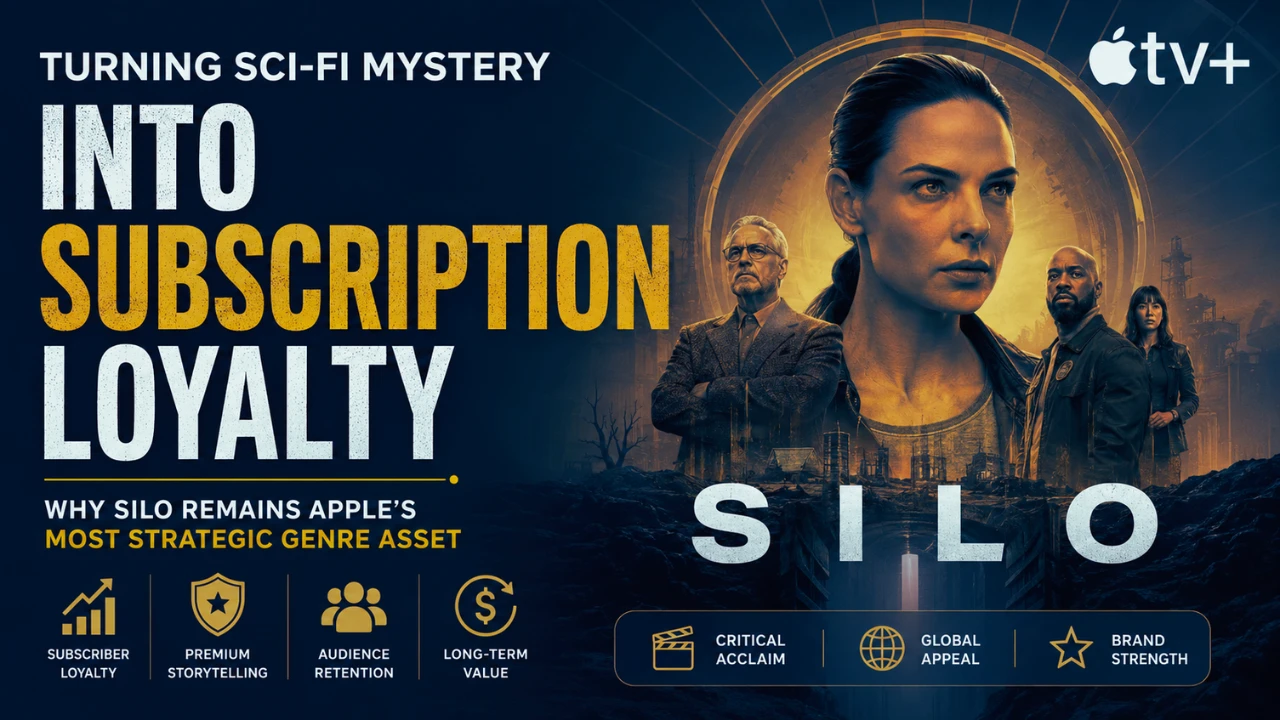
How Silo Helps Apple TV Plus Build Subscriber Loyalty
Not every hit television series becomes a strategic business asset. Some generate headlines for a few weeks before disappearing into crowded streaming libraries. Others quietly become the foundation of an entire platform’s identity.
That is exactly why Turning Sci-Fi Mystery Into Subscription Loyalty has become such an interesting case study. Rather than chasing blockbuster franchises with massive budgets alone, Apple TV+ has built a reputation around carefully selected prestige series that encourage long-term viewing. Among them, Silo stands out as one of the strongest examples of how compelling science fiction can become a subscription engine rather than simply another TV show.
Based on Hugh Howey’s bestselling novels, Silo has earned critical praise while helping reinforce Apple’s reputation for high-quality original programming. Apple’s decision to renew the series through a planned fourth and final season demonstrates confidence in the franchise’s long-term value and commitment to telling the complete story.
Why This Entertainment Business Trend Matters Now?
Streaming competition has shifted dramatically over the past few years.
The biggest challenge is no longer attracting first-time subscribers. It is convincing existing customers to stay month after month.
That makes subscriber retention one of the most valuable metrics in modern entertainment.
Shows like Silo excel because they encourage viewers to return every week, discuss theories online, and remain invested over multiple seasons. A mystery that unfolds gradually creates anticipation, making cancellation feel less attractive while new episodes keep arriving.
Unlike one-time blockbuster films, serialized science fiction extends audience engagement across months or even years.
For Apple TV+, whose library is smaller than some competitors, each premium original carries greater strategic importance.
The Business Model Behind the Money
Apple’s investment in Silo represents much more than production spending.
The show supports several business objectives simultaneously.
- Subscriber acquisition
- Subscriber retention
- Premium brand positioning
- International audience growth
- Intellectual property expansion
Instead of relying heavily on advertising revenue, Apple TV+ primarily earns recurring subscription income. Every successful original series helps justify the monthly subscription fee while strengthening the overall value of the Apple ecosystem.
Industry observers often point to Apple’s emphasis on quality over quantity as one reason prestige dramas have become central to its streaming strategy.
Salary Versus Ownership
Actors, writers, directors, and producers are typically paid upfront for their work.
Some may also receive:
- Performance bonuses
- Executive producer compensation
- Residual payments where applicable
- Backend participation if contract terms include it
Ownership works differently.
Apple controls distribution through Apple TV+, while the underlying intellectual property originates from Hugh Howey’s bestselling novels, licensed for television adaptation.
Long-term value often comes from owning distribution rights or valuable intellectual property rather than simply collecting production salaries.
Brand Equity and Audience Trust
Successful streaming platforms are built on trust.
When viewers associate Apple TV+ with thoughtful science fiction like Silo, Severance, and Foundation, the platform develops recognizable brand equity.
That reputation becomes a competitive advantage.
Subscribers begin expecting premium storytelling, making future launches easier to market.
In this way, every successful series strengthens not only its own audience but also Apple’s overall entertainment brand.
Why Traditional Net Worth Estimates Often Miss the Full Picture?
Entertainment headlines often focus on celebrity net worth.
Those estimates rarely tell the complete financial story.
Modern entertainment wealth may include:
| Wealth Driver | How It Works | Why It Matters |
|---|---|---|
| Salary | Upfront payment for acting or production | Immediate income |
| Residuals | Payments from qualifying reuse | Can provide ongoing earnings |
| Royalties | Income tied to underlying creative rights | Supports long-term revenue |
| Licensing Deals | Rights granted for adaptations or merchandise | Expands intellectual property value |
| Equity Deals | Ownership in companies or projects | Potential long-term growth |
| Business Ventures | Investments outside entertainment | Diversifies income sources |
Public estimates also cannot fully account for taxes, agent commissions, management fees, undisclosed investments, private business ownership, or confidential contract terms.
That is why publicly reported celebrity wealth should always be viewed as an estimate rather than a verified financial statement.
That Shows How This Works
Streaming history offers several examples where prestige storytelling became more valuable than immediate ratings alone.
Netflix benefited enormously from series such as Stranger Things, which evolved into merchandise, licensing opportunities, live experiences, and global brand recognition.
HBO transformed Game of Thrones into one of television’s most valuable franchises through international licensing, merchandise, and spinoff development.
Apple appears to be pursuing a different but equally strategic path.
Rather than flooding viewers with content, it is investing in fewer premium franchises capable of defining its brand identity.
Silo fits that strategy particularly well because its layered storytelling encourages repeat viewing and sustained engagement. Apple has also committed to adapting the complete story across four seasons rather than ending prematurely, reinforcing viewer confidence.
The Risks Behind Streaming Business Investments
Premium television is expensive.
Even critically acclaimed series face meaningful business risks.
These include:
- Rising production costs
- Subscriber fatigue
- Changing audience preferences
- Competition from larger streaming libraries
- Delays caused by production schedules
- Difficulty maintaining storytelling quality across multiple seasons
Mystery-based series carry another challenge.
If audiences lose confidence that questions will eventually receive satisfying answers, engagement can decline rapidly.
Apple appears aware of this risk.
Its decision to announce a planned ending through season four helps reassure viewers that the complete narrative will be told rather than indefinitely extended.
What This Reveals About Modern Celebrity Wealth andthe Entertainment Business?
Modern Hollywood success is no longer measured only by opening weekend revenue.
Today’s entertainment economy increasingly rewards intellectual property, recurring subscriptions, global distribution, and long-term audience relationships.
For actors like Rebecca Ferguson, executive producer credits can expand creative influence beyond acting alone, although specific compensation arrangements remain private. Publicly available information confirms her executive producer role, but not the financial details.
For Apple, the value extends well beyond a single television series.
A successful franchise strengthens platform loyalty, enhances brand perception, and increases the likelihood that subscribers remain engaged with future originals.
That is a different kind of entertainment economics.
Instead of chasing one massive payday, the goal is building durable customer relationships through exceptional storytelling.
Conclusion
Silo demonstrates that the strongest streaming investments are not always the loudest or the most expensive. They are the series that consistently convince audiences to keep watching, keep talking, and keep subscribing.
Apple’s long-term commitment to the franchise highlights how premium science fiction can become a strategic business asset rather than simply another television production. As streaming competition continues to evolve, ownership of compelling intellectual property and sustained audience trust may prove even more valuable than short-lived viewing spikes.
FAQs
Why is Silo considered strategically important for Apple TV+?
Because it helps attract and retain subscribers while reinforcing Apple’s reputation for premium original storytelling.
Does Apple own the Silo story?
Apple distributes the television adaptation through Apple TV+, while the series is based on Hugh Howey’s novels under licensed adaptation rights.
How do streaming platforms make money from shows like Silo?
Primarily through recurring subscription revenue, subscriber retention, brand differentiation, and long-term intellectual property value.
Do actors earn more from ownership than salaries?
Sometimes. Executive producer roles, royalties, backend participation, or ownership interests can create additional income, but contract details are often confidential.
Why are celebrity net worth estimates often inaccurate?
They usually rely on public information and cannot fully account for private investments, taxes, licensing agreements, management costs, confidential contracts, or debt.
Interested in how Hollywood’s biggest franchises generate long-term wealth? Explore more entertainment business breakdowns, celebrity wealth analysis, and streaming industry insights to understand where the real money is made.

Table of Contents