The Business Behind Box Office Success and Streaming Popularity
A decade ago, becoming a movie star usually meant one thing: selling tickets. Today, an actor can dominate Netflix’s weekly charts or become a social media phenomenon without ever opening a film to £100 million at the global box office.
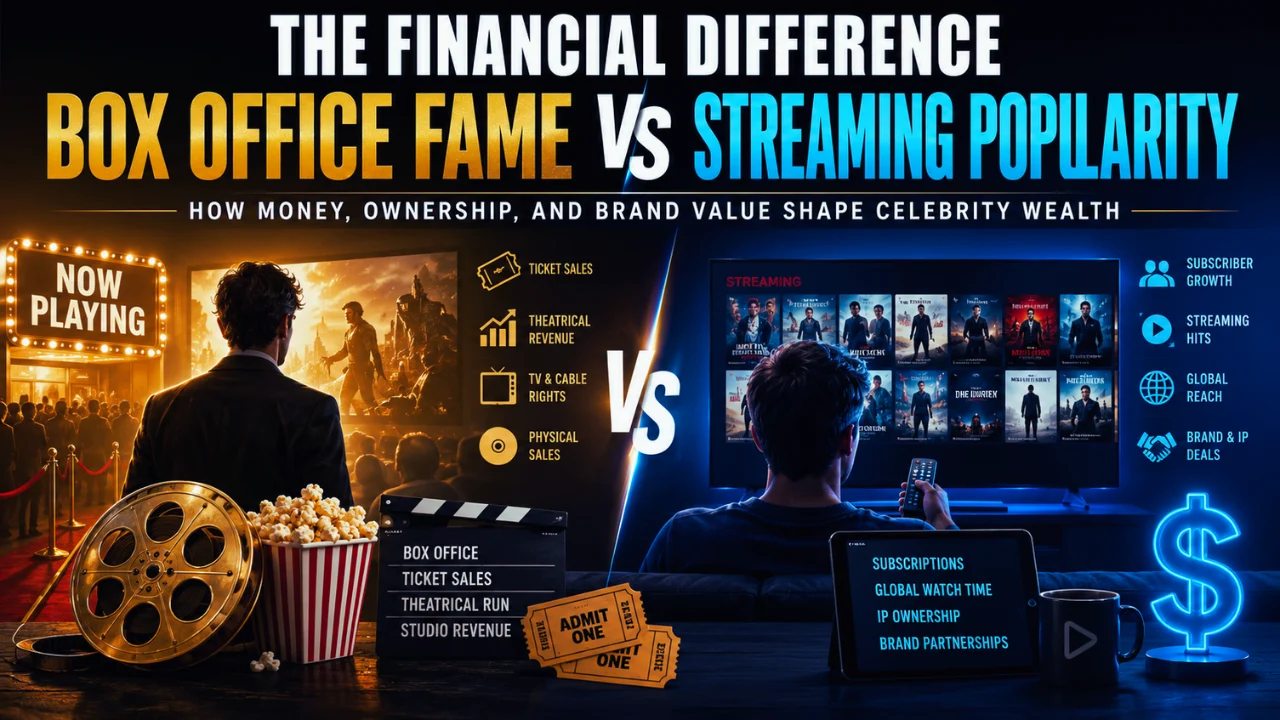
That shift has created an important question for fans, investors, and entertainment observers alike: what is the financial difference between box office fame and streaming popularity?
The answer is more complicated than many celebrity net worth headlines suggest. Box office success and streaming popularity generate value in very different ways. One is built around measurable ticket sales and backend participation. The other revolves around subscriptions, platform strategy, audience retention, and increasingly opaque economics.
Understanding that distinction reveals a bigger truth about modern celebrity wealth. Fame still matters, but ownership, deal structures, and long-term intellectual property rights matter even more.
Why This Celebrity Wealth Trend Matters Now?
Hollywood is going through one of its biggest economic transitions since television arrived in living rooms.
Streaming platforms changed how audiences consume entertainment. Instead of waiting in line at cinemas, millions watch new releases from their sofas. That convenience has created a new type of celebrity. Some stars are household names despite having little traditional box office history.
At the same time, studios have become less transparent about what success looks like. Box office revenue is public. Streaming performance is not.
This matters because celebrity wealth increasingly comes from what happens behind the scenes. A star attached to a successful theatrical franchise may benefit from backend compensation, merchandising opportunities, and decades of licensing value. Meanwhile, a streaming hit might deliver a large upfront payday but less long-term upside.
The entertainment business is no longer just about who is most famous. It is about who controls the most valuable assets.
The Business Model Behind the Money
The economics of theatrical releases remain relatively straightforward. A film sells tickets. Revenue is split among cinemas, distributors, and studios. If a movie performs exceptionally well, actors, producers, and directors with profit participation clauses can earn substantial additional compensation.
Streaming changes that equation.
Platforms like Netflix, Disney+, and Apple TV+ are not selling individual tickets. They are selling subscriptions. That means a show’s popularity contributes to broader business goals such as customer retention, subscriber growth, and brand positioning.
As a result, the financial value of a streaming hit is often difficult to quantify publicly.
Salary Versus Ownership
For decades, many of Hollywood’s biggest fortunes were built through ownership.
Actors such as Tom Cruise and producer-driven stars have benefited from backend deals tied to theatrical performance. A successful franchise can create earnings through sequels, licensing agreements, and syndication years after release.
Streaming platforms often prefer buying out future upside with larger upfront payments. That arrangement reduces uncertainty for talent but can also limit long-term wealth creation.
An actor who earns £20 million upfront for a streaming project may ultimately make less over time than someone who accepted a smaller salary plus profit participation on a blockbuster film.
Ownership remains one of the most powerful wealth-building tools in entertainment.
Brand Equity and Audience Trust
Streaming popularity still has enormous value.
A performer who consistently attracts viewers becomes attractive to advertisers, luxury brands, publishers, and investors. Their name becomes an asset.
Brand equity can lead to:
- Endorsement deals
- Production company partnerships
- Podcast and media ventures
- Consumer product launches
- Equity investments
- Licensing opportunities
Audience trust travels across industries. A celebrity who can convince millions to watch a series may also convince them to buy skincare, spirits, or tickets to a live event.
That is why streaming fame increasingly feeds the creator economy, even when direct entertainment earnings remain unclear.
| Wealth Driver | How It Works | Why It Matters |
|---|---|---|
| Salary | Upfront payment for acting or producing | Creates immediate income |
| Residuals | Payments tied to reuse of content | Supports long-term earnings |
| Equity Deals | Ownership stakes in companies | Can significantly increase wealth |
| Licensing Deals | Use of a celebrity’s name or image | Creates passive income opportunities |
| Backend Participation | Percentage of profits from projects | Rewards commercial success |
| Brand Partnerships | Sponsored campaigns and endorsements | Converts fame into business value |
| Intellectual Property | Ownership of characters or productions | Builds generational wealth potential |
Why Traditional Net Worth Estimates Often Miss the Full Picture?
Celebrity net worth estimates make for compelling headlines, but they rarely tell the entire story.
Public estimates often cannot account for:
- Private investments
- Equity stakes in businesses
- Tax obligations
- Management fees
- Real estate holdings
- Licensing income
- Unannounced ownership agreements
- Future royalty streams
Two actors with similar public profiles can have dramatically different financial outcomes.
One may own a production company and retain intellectual property rights. Another may rely primarily on salary income. From the outside, they can appear equally successful.
The gap becomes even wider when private investments enter the equation. Publicly available information rarely reveals the full extent of an individual’s business portfolio.
That Shows How This Works
Recent years have offered several examples of how theatrical and streaming economics differ.
The cast of legacy sitcoms such as Friends continues to benefit from traditional licensing arrangements tied to decades of syndication value. Meanwhile, streaming-era actors have frequently spoken about receiving comparatively modest residual payments despite appearing in highly viewed content.
Similarly, stars such as Tom Cruise have become closely associated with theatrical success, where audience demand directly translates into measurable box office performance.
On the streaming side, actors including Mark Wahlberg have demonstrated that popularity across multiple platforms can create leverage for premium salaries and production opportunities, even if success is measured differently.
Neither path is inherently better.
Theatrical fame tends to provide clearer financial benchmarks. Streaming popularity can offer stability, visibility, and broader business opportunities beyond entertainment itself.
The Risks Behind Celebrity Business Ventures
Celebrity wealth stories often focus on success, but entertainment history is filled with cautionary tales.
Not every streaming star successfully launches a brand. Not every box office actor builds lasting wealth.
Common risks include:
- Expanding too quickly
- Weak product-market fit
- Poor management decisions
- Audience fatigue
- Reputation damage
- Licensing disputes
- Shifts in consumer trends
- Overreliance on one platform
Streaming also presents a unique challenge. Platforms control access to audiences.
An actor may become synonymous with a hit series, but if that show disappears from cultural conversation, rebuilding momentum can be difficult.
By contrast, theatrical franchises often create longer-lasting intellectual property ecosystems that include merchandise, theme parks, publishing, and gaming partnerships.
What This Reveals About Modern Celebrity Wealth?
Modern celebrity wealth is increasingly disconnected from traditional measures of fame.
A blockbuster actor can generate extraordinary earnings through profit participation and franchise ownership. A streaming star can leverage audience attention into businesses, investments, and media ventures.
Both paths can create substantial wealth. The difference lies beneath the headlines.
Today’s entertainment economy rewards leverage. Ownership matters. Intellectual property matters. Timing matters.
The celebrities building the most durable fortunes are often the ones quietly accumulating assets while everyone else focuses on opening weekends and streaming rankings.
The future of Hollywood money may not belong exclusively to the biggest stars. It may belong to those who understand how to turn attention into ownership.
Conclusion
The financial difference between box office fame and streaming popularity ultimately comes down to economics, not visibility.
Box office success remains one of the clearest indicators of commercial demand, with opportunities for backend earnings and long-term franchise value. Streaming popularity offers scale and cultural relevance but often operates within less transparent financial structures.
As entertainment continues to evolve, celebrity wealth will increasingly be shaped by intellectual property, ownership deals, residual income, and business strategy. The stars who thrive over the next decade are likely to be the ones building companies and controlling assets alongside their careers.
FAQs
1. What is the financial difference between box office fame and streaming popularity?
Box office fame is tied to ticket sales and often includes profit participation opportunities, while streaming popularity is usually linked to subscriptions, audience retention, and upfront compensation.
2. Do streaming actors receive royalties?
Actors typically receive residual payments rather than royalties. The amount depends on union agreements and the distribution model.
3. Why are celebrity net worth estimates often inaccurate?
Many estimates cannot include private investments, taxes, undisclosed ownership stakes, or confidential business arrangements.
4. Can streaming stars become wealthy outside entertainment?
Yes. Many leverage their visibility into endorsement deals, celebrity brands, production companies, and other business ventures.
5. Is box office success still important in Hollywood?
Absolutely. Box office performance remains one of the most transparent measures of audience demand and can significantly increase long-term earning potential.
Enjoyed this breakdown? Explore more celebrity wealth stories, entertainment business analysis, and behind-the-scenes looks at how Hollywood’s biggest names build lasting fortunes.

Table of Contents