How Musicians Get Rich Beyond Master Recordings
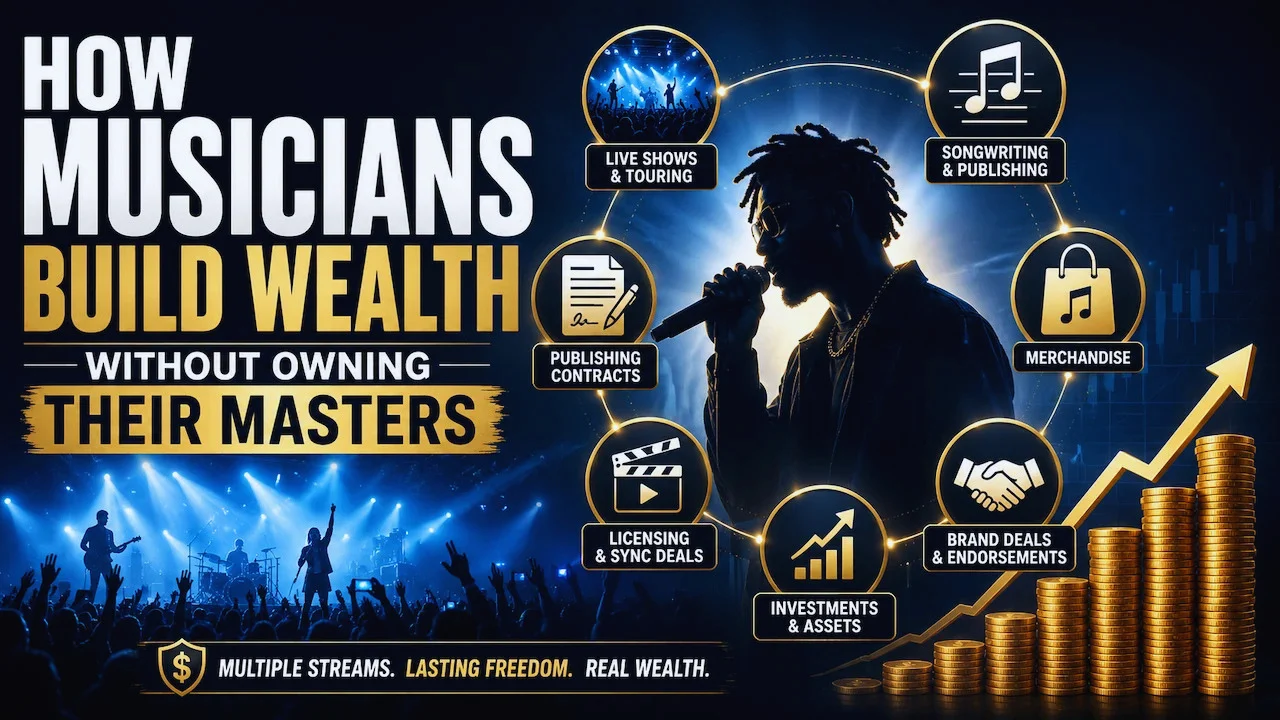
This article explains how musicians can build significant wealth even without owning the master recordings of their songs. It breaks down royalties, touring, licensing deals, brand equity, endorsement income, private investments, and business ventures that often shape modern celebrity wealth more than music sales alone.
A master recording can be one of the most valuable assets in music. It controls the specific recorded version of a song, which means ownership can affect streaming revenue, licensing control, and long-term catalog value.
But here is the part many fans miss: how musicians build wealth without owning their masters is often a bigger business story than the masters debate itself.
Some artists may not control their early recordings. Others may share rights with labels, publishers, investors, or estates. Yet many still build major celebrity wealth through touring, songwriting royalties, merchandise, brand equity, endorsement deals, acting, licensing, equity deals, and private investments.
That is why celebrity net worth estimates can be misleading. A musician’s fortune is not always sitting inside Spotify streams or album sales. Sometimes, the real money comes from the audience they built, the businesses they attach their name to, and the rights they still control.
Why This Celebrity Wealth Trend Matters Now?
The music industry has changed from a sales business into a rights, attention, and distribution business.
Streaming now drives recorded music revenue globally. IFPI reported that global recorded music revenue reached $31.7 billion in 2025, with streaming accounting for about 70% of industry income. Paid subscription streaming alone represented more than half of total recorded music revenue.
That growth matters, but it does not mean every artist gets rich from streams. Revenue is split across labels, distributors, publishers, songwriters, featured performers, producers, managers, lawyers, and tax obligations. The artist’s final share depends on contracts, recoupment, rights ownership, and whether they wrote the song.
So when fans ask why a famous musician is not automatically wealthy, the answer is usually simple: fame and ownership are not the same thing.
A hit song can create attention. Ownership decides how much of that attention becomes long-term income.
The Business Model Behind the Money
Musicians who do not own their masters can still earn from several other income streams. Some are music-based. Others are built on celebrity entrepreneurship.
Salary Versus Ownership
A singer may receive an advance from a record label, a fee for a performance, or a guaranteed payment for a brand campaign. That money can be meaningful, but it is usually transactional.
Ownership is different.
Ownership can mean publishing rights, equity in a company, a share of merchandise sales, a stake in a fashion label, or control over a touring company. While salary pays once, ownership can keep paying if the asset grows.
That is why musicians increasingly think like founders. They are not only asking, “How much is the check?” They are asking, “What do I own after the campaign, tour, or product launch is over?”
Publishing Royalties Still Matter
Not owning masters does not always mean an artist has no music rights. If a musician writes or co-writes songs, they may still earn publishing income.
Publishing covers the underlying composition, meaning the melody and lyrics, rather than a specific recording. The Mechanical Licensing Collective explains that it collects digital audio mechanical royalties from eligible streaming and download services in the U.S. and pays songwriters, publishers, administrators, and related rightsholders.
Performance royalties are another layer. ASCAP says it licenses businesses that play music and distributes royalties to members when their works are performed. ASCAP also notes that royalties are split between writer and publisher shares, which is why artists who control publishing can capture more value.
For artist-songwriters, publishing can become a quiet engine of residual income. It may not be as visible as a stadium tour, but it can matter for decades.
Digital Performance Royalties
There are also royalties connected to the sound recording side, even when the master owner receives a major share.
SoundExchange collects digital performance royalties for sound recordings in the United States. Under its stated structure, 45% of certain digital performance royalties are paid directly to featured artists, 5% goes to a fund for non-featured artists, and 50% goes to the sound recording rights owner.
That does not replace master ownership, but it shows why the money picture is more layered than “owns masters” or “does not own masters.”
Brand Equity and Audience Trust
A musician’s name can become a financial asset.
Brand equity is the value attached to reputation, style, cultural influence, and fan trust. In the entertainment business, it is what allows a musician to sell more than just songs.
A loyal fan base can support tours, documentaries, fragrance lines, fashion collaborations, beauty products, books, podcasts, restaurants, and licensing deals. But the strongest celebrity brands do not work just because the celebrity is famous. They work when the product feels believable.
That is why Rihanna’s Fenty Beauty is such a strong example. Forbes reported in 2021 that the bulk of her estimated billionaire fortune came from Fenty Beauty, not from recorded music alone, and said she owned 50% of the company at the time.
The lesson is not that every musician should launch a beauty brand. The lesson is that fame can become equity when it is matched with product-market fit, distribution, quality, and timing.
Helpful Table: Wealth Drivers Beyond Master Ownership
| Wealth Driver | How It Works | Why It Matters |
|---|---|---|
| Touring | Artists earn from ticket sales, guarantees, VIP packages, and sometimes merchandise. | Can create major cash flow even without master ownership |
| Publishing | Songwriters earn from compositions through mechanical and performance royalties. | Helps musicians earn from songs they wrote or co-wrote |
| Licensing | A song, name, image, or brand is licensed for ads, film, TV, games, or products. | Converts cultural value into paid usage |
| Merchandise | Fans buy apparel, collectibles, vinyl, tour items, and limited drops | Strengthens fan connection and adds direct revenue |
| Endorsements | Brands pay artists to promote products or campaigns | Turns celebrity attention into marketing income |
| Equity Deals | Artists receive or buy ownership in companies | Can grow far beyond a one-time endorsement fee |
| Business Ventures | Musicians launch brands, labels, restaurants, media companies, or consumer products. | Builds assets outside the recording contract |
Why Traditional Net Worth Estimates Often Miss the Full Picture?
Celebrity net worth sites often simplify a messy financial reality.
They may track touring revenue, public sale prices, real estate records, and major brand deals. But they usually cannot see private investments, debt, taxes, management fees, family trusts, undisclosed equity deals, royalty splits, catalog advances, or contract recoupment.
That means two musicians with the same level of fame can have very different financial lives.
One may have a large catalog but little ownership. Another may have fewer hits but strong publishing rights, a profitable touring operation, and smart private investments. A third may earn more from a liquor brand, beauty company, or tech stake than from recorded music.
This is why celebrity wealth is better understood as a portfolio, not a scoreboard.
Examples That Show How This Works
Dr. Dre is a classic example of a musician whose wealth expanded through consumer products. Apple announced in 2014 that it would acquire Beats Music and Beats Electronics, co-founded by Dr. Dre and Jimmy Iovine, for a total of $3 billion.
Jay-Z has also built wealth through a wider business ecosystem, including Roc Nation, spirits, art, sports, and technology. In 2021, Square announced plans to acquire a majority ownership stake in TIDAL and said Shawn “JAY-Z” Carter would join Square’s board. Reuters later reported that Block, formerly Square, paid $237.3 million after adjustments for an 86.2% stake.
Taylor Swift offers a different lesson. Her public battle over masters helped educate fans about recording ownership, and in 2025, she announced that she had bought back the masters to her first six albums, according to reports covering her public statement.
Swift’s story shows why masters matter. But it also shows something else: touring, publishing, fan loyalty, merchandise, film rights, and brand control can create enormous leverage while ownership issues are being negotiated.
The Risks Behind Celebrity Business Ventures
Celebrity business ventures can fail. Fame gets attention, but it does not guarantee repeat customers.
A musician-backed fashion line may struggle if sizing, pricing, quality, or distribution is weak. A restaurant can fail because hospitality is operationally difficult. A beauty brand can fade if the market becomes crowded. A liquor brand can lose momentum if it depends too heavily on celebrity hype rather than product loyalty.
There are also personal risks. Public image can change quickly. A controversy can damage partnerships. Overexposure can make fans tired. Bad licensing deals can give away too much control. And equity can be less valuable than expected if the business never reaches profitability or cannot find a buyer.
The strongest celebrity entrepreneurs usually understand one thing: the audience may open the door, but the business must stand on its own.
What does this reveal about modern celebrity wealth?
Modern celebrity wealth is no longer just about album sales, radio hits, or record advances.
The bigger picture includes intellectual property, brand equity, audience data, live events, licensing deals, streaming rights, residual income, private investments, and distribution power. For musicians, masters are important, but they are only one part of the wealth map.
A musician who does not own their masters may still own publishing, a touring brand, merchandise rights, a consumer company, a production company, or equity in a startup. Those assets can be harder to track, but powerful.
That is why the smartest artists think beyond the song. They think about leverage.
Conclusion
Musicians build wealth without owning their masters by turning fame into a wider business engine. They earn through publishing, touring, merchandise, licensing, endorsements, equity deals, and ventures that can outgrow the original recording contract.
Master ownership still matters. It can affect control, long-term royalties, and catalog value. But celebrity wealth is rarely built on a single-income stream.
The future belongs to musicians who understand both creativity and ownership. The most valuable artist is no longer just a performer. They are a brand, a rights holder, a founder, and a business strategist.
FAQs
How do musicians build wealth without owning their masters?
Musicians can build wealth through touring, publishing royalties, merchandise, licensing deals, endorsements, equity stakes, business ventures, and private investments. Master ownership helps, but it is not the only path to long-term celebrity wealth.
Can musicians still earn royalties if they do not own their masters?
Yes. They may earn publishing royalties if they wrote or co-wrote songs. They may also receive certain performer royalties, depending on the country, platform, and royalty system. The exact amount depends on contracts and rights registration.
Why are masters so valuable in music?
Masters control the specific recorded version of a song. That can affect streaming revenue, sync licensing, catalog sales, and long-term control over how recordings are used.
What is brand equity in celebrity wealth?
Brand equity is the financial value of a celebrity’s reputation, audience trust, cultural relevance, and public image. It helps musicians sell products, attract partnerships, and launch businesses beyond music.
Why do celebrity net worth estimates often miss the real picture?
Many estimates do not fully account for private investments, taxes, debt, management fees, undisclosed equity deals, royalty splits, licensing terms, or business valuations. Public fame is easier to measure than private wealth.
Want clearer breakdowns of celebrity wealth, entertainment business models, and how stars turn fame into ownership? Explore more net worth and Hollywood money stories for deeper insight.

Table of Contents