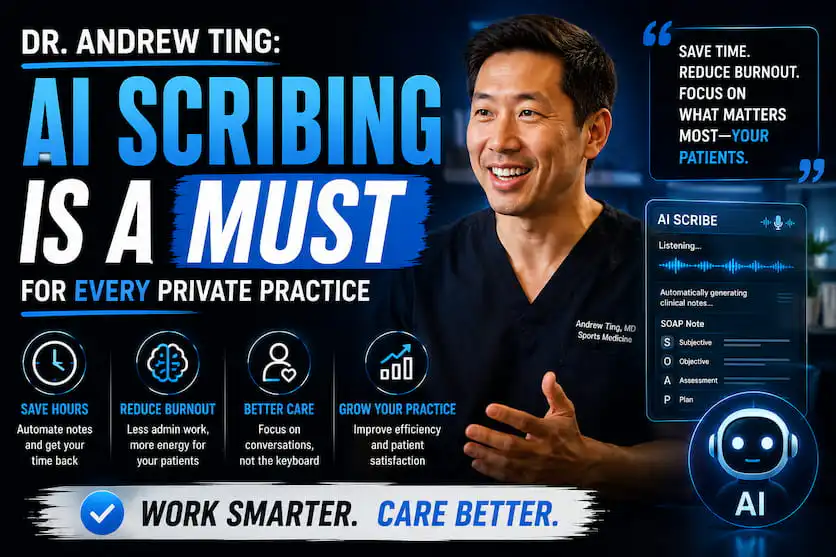
Why Andrew Ting Recommends Every Private Practice Should Be Using AI Scribing Technology Right Now
Running an independent private practice has always required balancing two distinct roles: delivering compassionate patient care and managing a demanding business. In recent years, however, the administrative side of medicine has increasingly overshadowed the clinical side. Independent practitioners now spend hours every day wrestling with documentation, completing electronic health records, and managing compliance paperwork. This administrative burden limits patient volume and contributes significantly to clinical burnout. According to Andrew Ting, implementing ambient AI scribing technology is no longer a luxury or a speculative experiment for independent clinics; it is a critical operational necessity for protecting patient outcomes and practice longevity.
Restoring the Human Connection in Care
The most immediate change noticed after introducing an AI scribe happens right there, during the face-to-face consultation. In a typical modern clinical setting, a physician spends a large portion of the appointment looking at a computer screen, typing notes while the patient is talking. That digital wall can make patients feel sidelined, and it kind of messes up the natural back-and-forth of communication.
AI scribing technology removes that wall entirely. With a patient’s explicit consent, the software securely listens in the background. It filters out casual small talk and then reshapes the clinical conversation into a clear, comprehensive progress note. Then the provider can actually sit face-to-face, maintain eye contact, and concentrate on the physical exam and the clinical reasoning that matters most. Bringing back that human connection can improve patient satisfaction, reinforce clinical trust, and help ensure critical diagnostic details don’t quietly slip away during multitasking.
Overcoming the Documentation Bottleneck
There’s also what’s widely known as “pajama time,” where physicians spend their evenings catching up on medical charting at home. It has, unfortunately, become a normal expectation in modern medicine. That constant administrative load drains morale, lowers job satisfaction, and can directly affect clinical focus.
AI scribes kind of remove this bottleneck by producing very accurate, neatly organized clinical notes within seconds right after an encrypted consultation ends. That means providers can take a look, tweak, and sign off on the chart pretty much as soon as the patient leaves, instead of letting the documentation pile up until the end of the day. You can see it in how the clinical experience of Dr Andrew Ting points out that modern, intelligent tools can blend into everyday routines with almost no friction. So the mechanical stuff in charting gets handled automatically, and private practices can claw back hours every day. That gives physicians more genuine personal time and helps shield them from the usual systemic burnout pressure.
Enhancing Financial Sustainability and Efficiency
On the practical side, a private practice is basically running a business. If charting is delayed, medical billing is delayed too, which translates into cash flow inefficiencies. Also, when a physician is tired or rushing, the notes may not include the exact, fine-grained detail needed for correct medical coding. Then you end up with claim denials or a slowdown in coding, which nobody wants.
AI scribing tools are trained to capture highly specific clinical language, the normal variability across cases, and the coding justifications that are actually required. With more complete and consistent documentation, initial coding tends to be more accurate, insurance denials decrease, and reimbursement cycles move faster. Plus, because the time spent on admin work per patient drops significantly, independent clinics can streamline their daily workflow. Even safely absorbing one or two extra patient visits per day can noticeably increase a practice’s gross revenue while keeping overall administrative overhead lower.
Elevating Data Accuracy and Continuity
Human memory is inherently imperfect, especially at the end of a long, demanding shift. When a clinician attempts to chart an appointment hours after it occurred, subtle details regarding a patient’s symptom progression, specific history, or lifestyle variables can easily be forgotten or simplified.
Ambient AI tools eliminate this reliance on delayed memory by capturing information in real time. Since the algorithm reads the actual dialogue as it happens, the resulting progress notes are surprisingly detailed, precise, and context-specific. That helps make a very accurate, complete longitudinal medical record for the patient. With higher documentation accuracy, clinical continuity improves too; future decision-making feels less tangled, and you end up with a solid, compliant medical record that also protects the practice against potential liability.
Conclusion
Moving toward automated clinical documentation is a big step for modern practice management. Private practices are under constant pressure to tighten operations while still maintaining high standards of patient-focused, compassionate care. Using ambient AI technology is likely the most effective way to balance these competing demands because the software can handle repetitive administrative tasks, allowing clinicians to focus on healing. As Andrew Ting has highlighted, prioritizing the integration of AI scribing tools is a practical step an independent clinic can take to preserve operational efficiency and clinical excellence.

Table of Contents