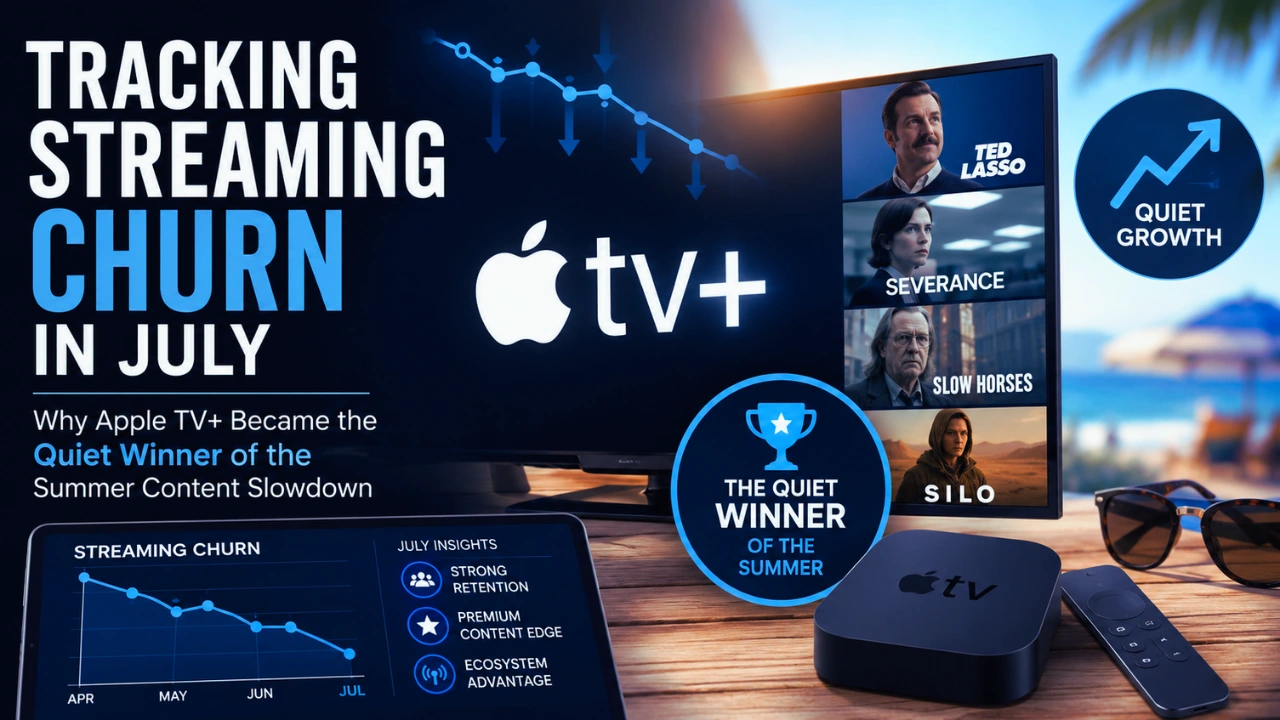
Tracking Streaming Churn in July and Apple TV+
Every summer tells a story in streaming.
July is traditionally a difficult month for subscription platforms. Families travel, viewers spend more time outdoors, and many consumers begin trimming monthly expenses. Streaming executives have a name for it: churn.
This year, however, tracking streaming churn in July revealed an interesting pattern. While larger platforms fought to keep audiences engaged through volume, Apple TV+ quietly benefited from doing the opposite. With a smaller library, a reputation for prestige originals, and the financial backing of one of the world’s most valuable companies, Apple TV+ appeared to navigate the summer slowdown more effectively than many expected.
The result says less about a single month and more about where the streaming business may be heading next.
Why This Entertainment Business Trend Matters Now?
Streaming has entered a new phase.
For years, success was measured primarily by subscriber additions. Today, retention matters as much. Keeping an existing subscriber is often cheaper than acquiring a new one.
Industry research increasingly shows that user experience, content quality, and perceived value play major roles in churn decisions. A July 2026 report from Hub Entertainment Research found that poor app experiences alone influenced many cancellation decisions among younger viewers.
At the same time, audiences have become more selective. Consumers are comfortable subscribing for one or two months, binge-watching a hit series, and canceling immediately afterward.
That makes Apple TV+’s recent momentum noteworthy. Public market-share data from JustWatch indicated that Apple TV+ posted some of the strongest annual growth among major US streaming services during Q2 2026.
Apple’s advantage extends beyond entertainment. Unlike many competitors, streaming is only one piece of a much larger ecosystem that includes hardware, cloud services, and subscription bundles.
Tracking Streaming Churn in July
July’s slowdown created a natural stress test for the industry.
Consumers had fewer must-watch releases across platforms, and many households reconsidered their monthly subscriptions. Yet Apple TV+ entered the month with a lineup that included returning titles and highly anticipated originals, reinforcing its premium positioning.
Interestingly, Apple TV+ does not compete on quantity.
Instead, it has spent years building a reputation around carefully selected series such as Severance, Slow Horses, Ted Lasso, and Silo. Those shows have become valuable intellectual property assets that continue generating subscriber interest long after their initial release windows.
That strategy resembles luxury branding more than traditional television.
Netflix built scale. Apple built perceived prestige.
The Business Model Behind the Money
Apple TV+ remains a fascinating business case because profitability is not necessarily its primary objective.
Public reporting has suggested that Apple TV+ continues to operate at a loss, with estimates indicating annual losses exceeding US$1 billion in recent years. Apple has not publicly confirmed those figures.
For Apple, the calculation is broader.
A customer who subscribes to Apple TV+ may also pay for iCloud, Apple Music, AppleCare, or purchase additional hardware. The lifetime value of that customer extends far beyond one streaming subscription.
Salary Versus Ownership
Hollywood has increasingly shifted toward ownership.
Actors, producers, and creators working with streaming platforms often negotiate backend participation, production credits, or intellectual property arrangements rather than relying solely on upfront compensation.
A successful streaming franchise can create value across multiple categories:
| Wealth Driver | How It Works | Why It Matters |
|---|---|---|
| Salary | Upfront payment for creative work | Provides immediate income |
| Royalties | Payments tied to ongoing use | Supports long-term earnings |
| Equity Deals | Ownership interests in ventures | Creates upside potential |
| Licensing | Monetizing intellectual property | Extends revenue opportunities |
| Residual Income | Contract-based recurring payments | Builds durable earnings |
| Production Ownership | Control of underlying content | Generates future monetization |
For creators, ownership increasingly matters more than salary. One successful series can produce licensing opportunities, merchandise, international distribution agreements, and future adaptations.
Brand Equity and Audience Trust
Apple TV+ has benefited from brand equity.
Consumers associate Apple with premium products. That perception carries into entertainment.
Brand equity does not appear on balance sheets in the same way as physical assets, yet it remains enormously valuable. Audience trust helps reduce friction when consumers decide whether a subscription feels worthwhile.
The same principle applies to celebrity wealth.
Many entertainers build fortunes not from salaries but from leveraging trust into business ventures, endorsement deals, licensing agreements, and private investments.
Why Traditional Net Worth Estimates Often Miss the Full Picture?
Entertainment wealth is notoriously difficult to measure.
Public net worth estimates rarely account for taxes, management fees, debt obligations, undisclosed investments, or private ownership structures.
The same issue exists in streaming.
Subscriber counts only tell part of the story.
Apple TV+ may never match Netflix in total subscribers, but its strategic value to Apple could be significantly larger than standalone metrics suggest. A subscriber who remains inside Apple’s ecosystem for years generates value across multiple revenue streams.
Similarly, a celebrity attached to a streaming hit might benefit through future production opportunities, speaking engagements, equity deals, or increased negotiating power.
The financial picture is usually bigger than headlines suggest.
That Shows How This Works
Apple’s approach is not unique, but it is particularly visible.
- Ted Lasso became a cultural phenomenon that expanded beyond television into merchandise and licensing opportunities.
- Severance strengthened Apple TV+’s reputation for premium storytelling and awards recognition.
- Apple’s partnership with Major League Soccer demonstrated how exclusive rights can drive subscription engagement beyond scripted programming.
Meanwhile, competitors continue pursuing different strategies.
Netflix focuses heavily on scale and global reach.
The Walt Disney Company leverages decades of intellectual property.
Apple Inc. treats streaming as part of a broader services strategy.
Each model can work. The key difference lies in what success actually means to each company.
The Risks Behind Streaming Business Ventures
Winning quietly does not eliminate risk.
Apple TV+ still faces significant challenges:
- High production costs.
- Dependence on a limited catalog.
- Growing competition.
- Subscriber fatigue.
- Pressure to justify content spending.
Public reports have also noted increased scrutiny around Apple’s entertainment investments following several expensive film releases that struggled to achieve widespread audience traction.
The broader entertainment industry faces similar problems.
Celebrity brands fail when audiences lose interest. Streaming services struggle when content pipelines weaken. Ownership alone is not enough. Execution still matters.
Timing matters, too.
A strong summer slate can reduce churn. A weak one can accelerate cancellations almost immediately.
What This Reveals About Modern Celebrity Wealth?
Modern entertainment wealth is increasingly tied to ownership, distribution, and intellectual property.
That applies to celebrities, production companies, and streaming platforms alike.
The biggest winners are often those who control assets rather than simply participating in them. Whether it is a production credit, a licensing agreement, a sports rights package, or a subscription ecosystem, ownership creates leverage.
Apple TV+’s July performance illustrates this perfectly.
The company does not need streaming to dominate quarterly earnings. It needs streaming to strengthen the larger Apple ecosystem. That distinction changes how success is measured.
For celebrities, the lesson is similar.
A salary may create wealth today. Ownership can create wealth for decades.
Conclusion
Tracking streaming churn in July offered an unexpected reminder that entertainment economics rarely follow simple narratives.
Apple TV+ did not become the quiet winner of the summer slowdown because it suddenly transformed into the largest platform. It succeeded because its strategy was built around retention, premium positioning, and ecosystem value rather than sheer volume.
As streaming matures, investors, creators, and audiences are beginning to recognize that the future belongs not only to companies with the biggest libraries, but to those that understand how ownership, intellectual property, and audience trust compound over time.
FAQs
1. What is streaming churn?
Streaming churn refers to subscribers canceling their subscriptions during a given period. It is one of the most important metrics used to evaluate customer retention.
2. Why did Apple TV+ perform well during July?
Publicly available industry data suggests Apple TV+ benefited from strong originals, brand positioning, and growth in consumer engagement during the summer slowdown.
3. Is Apple TV+ profitable?
Apple has not publicly disclosed Apple TV+’s profitability. Multiple reports have suggested the service operates at a loss as part of Apple’s broader services strategy.
4. Why are subscriber numbers not the only metric that matters?
Subscriber counts do not capture ecosystem value, customer lifetime spending, retention, or broader business benefits generated by streaming platforms.
5. How do celebrities build wealth from streaming projects?
Celebrities may earn income through salaries, royalties, licensing deals, production ownership, residual income, and related business ventures.
Interested in the business behind fame? Explore more celebrity wealth stories, streaming economics breakdowns, and entertainment industry analyses to see how modern fortunes are really built.

Table of Contents