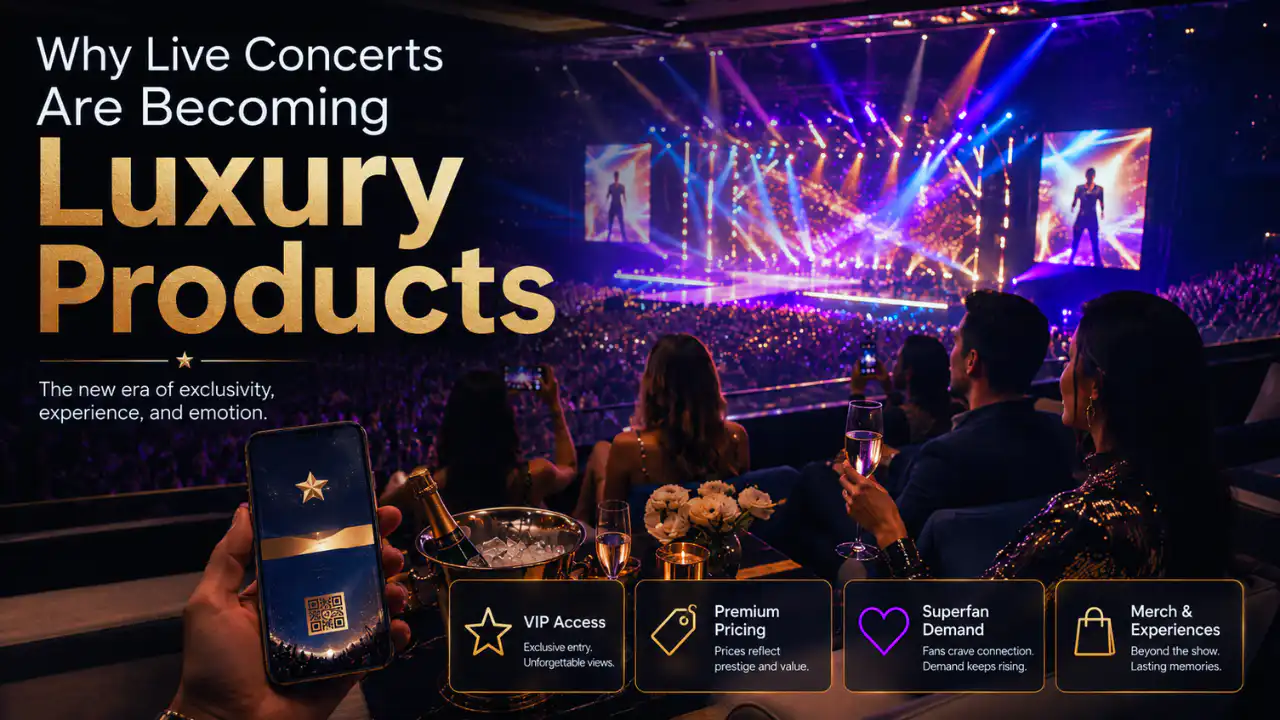
Why Live Concerts Are Becoming Luxury Products Now
This article explains why live concerts are shifting from casual entertainment into premium experiences built around superfans, scarcity, VIP access, and high-value touring economics. It also explores how this trend affects celebrity wealth, brand equity, royalties, licensing deals, ownership deals, and why celebrity net worth estimates often miss the bigger financial picture.
A concert ticket used to feel like a night out. Now, for many fans, it feels closer to booking a luxury vacation.
Between premium seats, VIP lounges, resale markups, travel costs, merch drops, and debates over dynamic pricing, live concerts and luxury products have become among the clearest examples of how modern fame turns emotional loyalty into serious revenue. For superstar artists, the stage is no longer just a place to perform. It is a distribution engine, a branding platform, a merchandise showroom, a content pipeline, and sometimes the biggest wealth driver in their entire career.
This matters because celebrity wealth is changing. Music sales still count. Streaming rights still matter. Royalties, publishing, and residual income still matter. But live entertainment has become the place where fan demand, scarcity, pricing power, and brand equity collide in public.
Why This Celebrity Wealth Trend Matters Now?
The live music business has become one of the strongest pieces of the entertainment business because it sells something streaming cannot fully replace: presence.
A fan can stream a song thousands of times, but they can only attend one specific concert on one specific night. That scarcity gives artists, promoters, venues, ticketing platforms, and sponsors real pricing power.
Live Nation reported that its concerts segment generated $20.9 billion in revenue in 2025 and hosted about 159 million fans across 55,000 shows globally. The company also said average U.S. stadium grosses grew by double digits, partly helping artists offset rising production costs.
That is why the phrase “concert economy” now means much more than ticket sales. A major tour can pull money from tickets, VIP packages, merchandise, sponsorships, hospitality, food and beverage, parking, streaming rights, filmed content, and local tourism.
Goldman Sachs Research has also pointed to superfans, video content, streaming price models, and new monetization tools as growth drivers for the global music industry, which it expects to grow from $105 billion in 2024 to nearly $200 billion by 2035.
For artists with global fan bases, live concerts are becoming luxury products because the most devoted fans are willing to pay for access, proximity, memories, and identity.
The Business Model Behind the Money
A superstar tour is not just a singer stepping on stage. It is a mobile business operation.
The money usually flows through several layers: the artist, manager, promoter, venue, ticketing platform, crew, insurers, travel vendors, merchandise partners, sponsors, and sometimes film or streaming distributors. A sold-out arena can look wildly profitable from the outside, but production costs can be enormous.
Large tours require stage design, lighting, sound, dancers, musicians, trucks, private security, rehearsal space, insurance, travel, hotels, union labor, and local staffing. That is before marketing and ticketing costs come into play.
For top-tier artists, the business upside comes from scale. One stadium show can serve tens of thousands of fans. A global tour can repeat that model across cities. The bigger the fan demand, the easier it becomes to add premium tiers, exclusive packages, branded lounges, special merch, and partner activations.
Salary Versus Ownership
Upfront pay and ownership are not the same.
A performance fee or guaranteed tour payment creates immediate income. That helps an artist earn now, but it may not capture the full value of the brand they helped build.
Ownership can be more powerful over time. That might include owning publishing rights, master recordings, a merchandise operation, a production company, a concert film, or other business ventures connected to the tour. When artists retain control over intellectual property, licensing deals, and content rights, they may benefit long after the lights go down.
This is why discussions of celebrity net worth can get blurry. A singer’s reported tour gross is not the same as personal profit. A $1 billion tour does not mean the artist personally earned $1 billion. Promoters, venues, crew, taxes, agents, managers, and production vendors all take part in the economics.
Brand Equity and Audience Trust
Live concerts become luxury products when fans believe the event is culturally important.
That belief is brand equity.
An artist’s name, image, voice, catalog, story, fashion, public persona, and fan community all become assets. The most valuable concerts are not just about selling songs. They are selling belongings.
That is why superfans matter so much. MarketWatch, citing Bernstein analysis, reported that superfans spend about 66 percent more on live shows than average fans and that a small share of top concerts accounts for a large portion of U.S. live sales.
For celebrities, this is where fame becomes financial leverage. A strong fan base can support ticket demand, merch sales, endorsement deals, creator economy partnerships, licensing deals, and equity deals. But loyalty is not automatic. Fans can also reject pricing they see as unfair.
Helpful Table
| Wealth Driver | How It Works | Why It Matters |
|---|---|---|
| Ticket Sales | Fans pay to attend concerts | Creates major tour revenue |
| VIP Packages | Premium seats, lounges, early entry, extras | Turns access into high-margin value |
| Merchandise | Apparel, posters, collectibles, vinyl, tour exclusives | Converts fan identity into spending |
| Sponsorships | Brands pay to appear near the tour or artist | Adds revenue beyond fans’ wallets |
| Streaming Rights | Concert films or live specials are licensed to platforms | Extends tour value after the show |
| Royalties | Payments from music use, publishing, or recordings | Supports long-term celebrity wealth |
| Ownership | Control of IP, production, merch, or business ventures | Can build wealth beyond salary |
| Endorsement Deals | Paid brand partnerships | Converts fame into marketing power |
Why Traditional Net Worth Estimates Often Miss the Full Picture?
Celebrity net worth estimates often look clean, but the real finances are messy.
Public websites may count reported tour grosses, real estate, endorsements, catalog sales, or business ventures. But they often cannot see private investments, debt, taxes, management fees, equity vesting schedules, licensing terms, divorce settlements, loans, insurance costs, or ownership percentages.
This is especially true in live music. A tour gross is public-facing. The profit split is not always public. Some artists may have strong ownership positions in their creative assets. Others may rely more on guarantees, advances, or promoter deals.
That is why careful wording matters. Publicly available data can suggest that touring is a major driver of wealth, but exact personal earnings are rarely fully verified.
Examples That Show How This Works
Taylor Swift’s Eras Tour is the clearest modern example of live concerts as luxury products. Pollstar estimated the tour’s final gross at about $2.2 billion, with more than 10 million tickets sold across 149 shows. It also described the tour as the highest-grossing tour of all time.
That does not mean every dollar became personal income. But it shows how a powerful catalog, storytelling, scarcity, global routing, premium demand, merch, and filmed content can turn a tour into a massive entertainment business.
The Weeknd has also shown the strength of global touring. AP reported that his After Hours Til Dawn Tour passed $1 billion in gross revenue, according to Live Nation, with millions of tickets sold across more than 150 dates.
These examples reveal the same pattern. The biggest artists are not just selling music. They are packaging memory, access, fandom, status, and community into experiences that fans treat as once-in-a-lifetime purchases.
The Risks Behind Celebrity Business Ventures
The luxury concert model has real risks.
First, fans can feel priced out. When concerts become too expensive, the artist may gain short-term revenue but lose goodwill. Ticketing backlash can spread quickly, especially when fans believe pricing lacks transparency.
Second, regulation is rising. The FTC’s rule on unfair or deceptive fees, effective May 12, 2025, targets tactics that obscure total prices and fees for live-event tickets and short-term lodging.
Third, ticketing power is under scrutiny. The U.S. Department of Justice sued Live Nation and Ticketmaster in 2024, alleging monopolistic control in live concert markets and arguing that the system harmed fans, artists, smaller promoters, and venues.
Fourth, not every artist has superfan pricing power. Social media followers do not guarantee sold-out arenas. Streaming popularity does not always translate into premium ticket demand. A celebrity can be famous online and still struggle to move expensive seats.
Overexpansion is another problem. Too many tour dates, weak routing, high production costs, bad timing, poor management, and audience fatigue can turn a promising tour into a financial headache.
What does this reveal about modern celebrity wealth?
Live concerts are becoming luxury products because celebrity wealth is no longer built solely on salary, box-office income, record sales, or sports contracts.
The new model is about leverage.
An artist with cultural relevance can turn attention into premium experiences. That can lead to higher ticket revenue, bigger brand deals, stronger merchandising, valuable content rights, licensing opportunities, and long-term brand equity.
But the smartest money is not always the biggest headline gross. It is the structure behind the deal. Who owns the rights? Who controls the merch? Who benefits from the concert film? Who carries the costs? Who keeps the upside if the tour exceeds expectations?
That is the part traditional celebrity net worth estimates often miss.
Conclusion
Live concerts are becoming luxury products because fans are not just paying to hear songs. They are paying for access, identity, scarcity, emotion, and cultural participation.
For superstar artists, that shift can create enormous business value. For fans, it can make concerts feel more exclusive and less accessible. For the entertainment business, it proves that live experiences remain one of the strongest forms of Hollywood money and celebrity wealth creation.
The next stage of celebrity entrepreneurship will not be defined only by who sells the most tickets. It will be shaped by who owns the experience, protects fan trust, and turns cultural moments into lasting financial assets.
FAQs
Why are live concerts becoming luxury products?
Live concerts are becoming luxury products because demand for top artists is high, supply is limited, and fans are willing to pay more for premium seats, VIP access, merch, travel experiences, and exclusive memories.
How do celebrities make money from concerts beyond ticket sales?
Celebrities can earn from merchandise, sponsorships, VIP packages, filmed concert rights, licensing deals, streaming rights, brand partnerships, and sometimes ownership of related business ventures.
Do artists keep all the money from a tour gross?
No. Tour gross is total revenue before expenses and splits. Promoters, venues, crews, agents, managers, production vendors, taxes, insurance, and travel costs can all reduce what an artist personally keeps.
Why do celebrity net worth estimates miss concert wealth?
Celebrity net worth estimates often miss private investments, ownership deals, royalties, licensing terms, taxes, debt, management costs, and undisclosed equity. Public tour grosses do not reveal exact personal profit.
Can high concert ticket prices hurt an artist’s brand?
Yes. If fans feel exploited or priced out, premium pricing can damage trust. Strong brand equity depends on balancing revenue with fairness, transparency, and long-term fan loyalty.
For more sharp breakdowns on celebrity wealth, entertainment business models, royalties, ownership deals, and modern fame economics, explore our latest celebrity net worth and Hollywood money stories.
Table of Contents