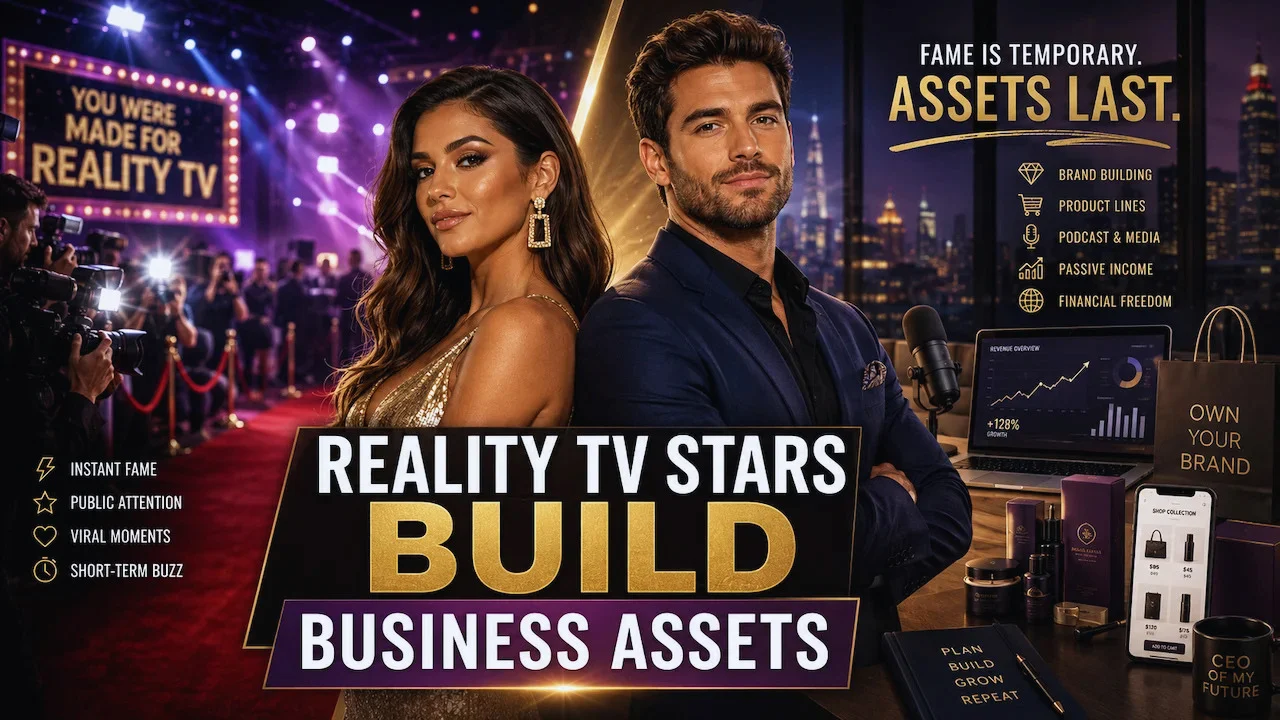
How Reality TV Stars Turn Fame Into Business Assets
This article explains how reality TV stars turn short bursts of fame into long-term business assets through brand ownership, licensing deals, equity, endorsements, and audience trust. It also explains why celebrity net worth estimates often miss private business interests, royalties, taxes, debt, management costs, and deal structures.
Reality TV fame can be loud, messy, and short-lived. One season can turn an unknown contestant into a household name, then the spotlight can move on just as quickly. But the smartest stars understand something important: attention is not the asset. What they build with that attention is.
That is why the phrase how reality TV stars turn fame into business assets has become more relevant in the modern entertainment business. A reality show can create the first spark, but long-term celebrity wealth often comes from ownership deals, licensing rights, product partnerships, private investments, and brand equity.
The money story is not just about appearance fees or reunion episodes. It is about converting public attention into something that can keep earning after the cameras stop rolling.
Why This Celebrity Wealth Trend Matters Now?
Reality TV used to be treated as disposable entertainment. Networks got low-cost programming, cast members got exposure, and the audience got drama. That model still exists, but the business around fame has changed.
Social media, direct-to-consumer brands, podcasts, streaming platforms, and online retail have given reality stars more ways to monetize attention. A cast member no longer has to wait for a network to offer another season. They can launch a product, sell subscriptions, build a podcast audience, license their name, partner with a retailer, or invest in a company that matches their public identity.
This matters because celebrity wealth is no longer built only through salaries. In many cases, the greater upside comes when a star owns a stake in a business tied to their fame. Kim Kardashian’s Skims is a major example. Reuters reported in November 2025 that Skims raised $225 million in new capital at a $5 billion valuation, showing how a reality TV profile can become part of a much larger consumer brand story.
The same shift explains why investors, retailers, rs and brand partners pay attention to reality stars. They are not only buying celebrity visibility. They are buying access to communities, social proof, personal storytelling, and a built-in marketing engine.
The Business Model Behind the Money
Reality TV fame becomes valuable when it is attached to a business model. The star’s name may open the door, but the money depends on what sits behind that name.
A reality star might earn from show salaries, paid appearances, sponsored posts, product collaborations, book deals, podcasts, live events, restaurants, beauty brands, fashion lines, or alcohol brands. But not all income is equal.
A sponsored post may pay quickly, then disappear. A licensing deal may generate recurring income if the product continues to sell. An equity stake may become far more valuable if the company grows or sells. A royalty arrangement can pay over time, but only if the contract is strong and the product has staying power.
That is the difference between fame as income and fame as an asset.
Salary Versus Ownership
Salary is the cleanest kind of entertainment income. A reality star gets paid to appear on a show, host a reunion, make a cameo, or film a branded video. It generates immediate cash, but it usually does not create long-term wealth on its own.
Ownership is different. When a celebrity owns equity in a company, owns intellectual property, controls a brand name, or keeps licensing rights, they may benefit from future growth. That upside can be much larger than the original paycheck.
Bethenny Frankel’s Skinnygirl story is often used as a case study. Forbes and Business Insider have reported on the 2011 sale of Skinnygirl Cocktails to Beam Global, with public reporting often describing the deal as worth around $100 million. Reports have also noted that Frankel retained rights to use the Skinnygirl name in categories outside alcohol, helping her extend the brand beyond a single product line.
That is the business lesson. The show created visibility, but the brand rights created leverage.
Brand Equity and Audience Trust
Brand equity is the value attached to a name, image, reputation, and the relationship with the audience. For reality TV stars, it often comes from familiarity. Viewers feel they know the person. They have watched the arguments, relationships, style choices, homes, habits, and personal reinventions.
That familiarity can be powerful, but it is not automatic trust.
A star with millions of followers still needs the right product, the right price, the right distribution,n and a credible reason to sell it. Fans can support a launch, but repeat customers come from quality. That is why some celebrity brands last while others disappear after the first wave of hype.
Kylie Jenner’s Kylie Cosmetics is a useful example of celebrity brand equity meeting a major corporate partner. Coty announced in 2019 that it would acquire a 51 percent stake in the Kylie Beauty Partnership for $600 million, valuing the business at $1.2 billion and positioning Coty to leverage its global beauty infrastructure for expansion.
The celebrity’s name created demand. The corporate partner brought distribution and manufacturing expertise, as well as category expansion.
Helpful Table
| Wealth Driver | How It Works | Why It Matters |
|---|---|---|
| Salary | Upfront payment for appearing on shows, specials, or campaigns | Creates immediate income but may not last |
| Royalties | Ongoing payment from sales or use of creative work | Can create repeat income when contracts are favorable |
| Equity | Ownership stake in a company or brand | Can grow if the business increases in value |
| Licensing | Paid use of a celebrity name, image, or brand identity | Allows income without running every part of the business |
| Residual Income | Payments from reuse, reruns, or distribution, where applicable | Can support long-term earnings, though reality TV often has weaker structures |
| Endorsement Deals | Paid brand partnerships or sponsored campaigns | Converts fame into marketing value |
| Private Investments | Stakes in startups, real estate, or other businesses | May build wealth, but are often hard to verify publicly |
Why Traditional Net Worth Estimates Often Miss the Full Picture?
Celebrity net worth estimates are popular because they make fame look measurable. The problem is that wealth is rarely simple.
A reality TV star may have business ownership, private investments, real estate, licensing income, brand debt, tax obligations, legal costs, staff expenses, and management fees. Many of those details are not public. Even when a company valuation is reported, it does not mean the celebrity can put that full amount in the bank.
Equity value can rise or fall. A brand may be valued highly during a funding round, but the founder’s actual liquidity depends on ownership percentage, investor terms, debt, taxes, and whether any shares have been sold. A person can look richer on paper while still having much of that wealth locked inside a private company.
Reality TV also has a special issue: residuals. Scripted actors, writers, and performers may receive residual payments under a certain union agreement. Still, many unscripted stars have publicly argued that reality TV contracts do not provide comparable long-term compensation. Variety reported in 2023 that Bethenny Frankel called for reality stars to receive residual payments when shows become hits and are replayed by networks or streamers.
That is one reason net worth sites can miss the bigger picture. They may count fame, but not the structure behind it.
Examples That Show How This Works
Kim Kardashian is one of the clearest modern examples of reality TV fame turning into a business infrastructure. Her television visibility helped build cultural reach, but Skims became valuable because it moved beyond celebrity merchandise. It developed products, raised outside capital, expanded categories, and built a serious consumer brand. Reuters reported that Skims was valued at $5 billion in a 2025 funding round, underscoring how far a reality-driven public profile can go when paired with product execution and investor confidence.
Kylie Jenner shows a related but slightly different path. Her beauty brand leveraged social media, demand, scarcity, direct sales, and personal branding before partnering with Coty. The Coty transaction showed how a celebrity founder can trade part of a company for capital, distribution, and scale.
Bethenny Frankel shows the power of category rights and sharp positioning. Skinnygirl was not just a product shown on TV. It was a brand idea that could extend to drinks, food, apparel, and lifestyle products. The important part was not only the sale, but also the reported ability to continue using the Skinnygirl name outside the alcohol category.
Lauren Conrad offers a quieter version of the same playbook. After Laguna Beach and The Hills, she leaned into fashion, lifestyle, and talent partnerships rather than chasing constant TV drama. Her official site notes that LC Lauren Conrad launched exclusively at Kohl’s in 2009 and expanded into categories including apparel, jewelry, accessories, handbags, bedding, and bath.
These examples are different, but the pattern is similar. The reality show creates awareness. The business asset creates staying power.
The Risks Behind Celebrity Business Ventures
Celebrity entrepreneurship can look easy from the outside. A famous name, a large following, and a viral launch may seem like enough. They are not.
Many celebrity brands fail because the product is weak, the pricing is wrong, the market is crowded, or the star’s involvement feels superficial. Some fail because they expand too quickly. Others run into trademark disputes, supply chain problems, poor retail sell-through,h or backlash tied to the celebrity’s public image.
Restaurants can struggle with high operating costs. Fashion lines can suffer from inventory risk. Beauty brands can face ingredient scrutiny, copycat accusations, or consumer fatigue. Alcohol brands need distribution strength and regulatory discipline. Podcasts and streaming projects need consistent audience retention, not just launch day curiosity.
There is also the risk of overexposure. Reality TV audiences enjoy access, but too much selling can make a star feel less authentic. When every personal moment becomes a product pitch, fans may start to question the relationship.
The smartest reality stars treat fame as a door opener, not a business plan. They hire operators, protect brand rights, choose categories carefully,y and understand that public attention can fade faster than a bad product review.
What does this reveal about modern celebrity wealth?
The bigger lesson is simple: modern celebrity wealth is increasingly shaped by ownership, timing, distribution, and brand leverage.
A reality star can earn money from television, but the greater financial upside often comes when fame is converted into something scalable. That might be a beauty company, a clothing brand, a licensing portfolio, a podcast network, a restaurant group, a book deal, a production company, or an investment portfolio.
This is why conversations about celebrity net worth need more nuance. Salary is visible. Business ownership is harder to measure. Royalties and licensing can be hidden inside private contracts. Equity can be valuable but illiquid. A large company valuation may not equal personal cash.
Reality TV fame may start as a short-term spotlight, but the stars who build lasting wealth usually do three things well. They understand their audience, attach their name to products that make sense, and negotiate for ownership rather than settle for exposure alone.
Conclusion
Reality TV can make someone famous quickly, but fame alone is fragile. The real wealth building begins when that attention is turned into assets with staying power.
That is why the business side of reality TV matters. The most successful stars are not just personalities. They are founders, licensors, investors, storytellers, and brand builders. Some will succeed, some will fail, and many numbers will remain difficult to verify.
Still, the direction is clear. In modern entertainment, the biggest money often belongs to celebrities who do more than appear on screen. They own part of what their fame helps create.
FAQs
Why do reality TV stars start businesses?
Reality TV stars start businesses because fame can fade quickly. A product, brand, licensing deal,l or equity stake can turn short-term attention into long-term income if the business performs well.
How do reality TV stars make money outside of television?
They can earn through endorsements, sponsored posts, podcasts, books, beauty brands, fashion lines, restaurants, product licensing, appearance fees, production deals, and private investments.
What is brand equity in celebrity wealth?
Brand equity is the financial value of a celebrity’s name, reputation, audience trust, and cultural relevance. It helps a star sell products, attract partners,s and negotiate better business deals.
Why do some celebrity brands fail?
Celebrity brands fail when the product is weak, the market is too crowded, the pricing is wrong, operations are poor, or the star’s audience does not trust the brand connection.
Do reality TV stars make more from ownership than endorsements?
Sometimes they do, but not always. Endorsements offer quick income, while ownership can create a larger upside if the company grows. Ownership also carries more risk and may not produce immediate cash.
Explore more celebrity wealth stories and entertainment business breakdowns to understand how fame, ownership, and smart dealmaking shape modern net worth.

Table of Contents