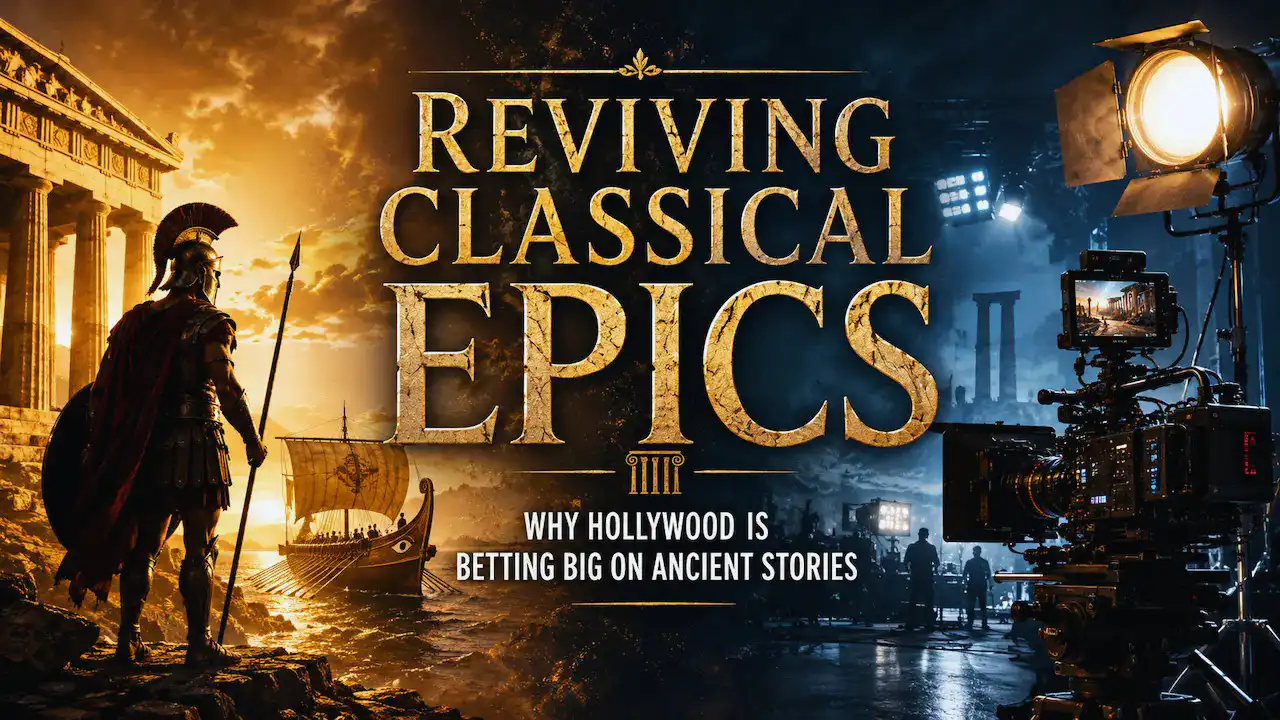
Reviving Classical Epics as Hollywood Bets Big on Ancient Stories
This article explains why Hollywood is returning to ancient stories and classical epics at a time when franchises dominate studio strategy. It breaks down the money behind these projects, including theatrical revenue, streaming rights, brand equity, licensing, celebrity value, and why traditional celebrity net worth estimates often miss the bigger business picture.
A story written thousands of years ago should not feel like one of Hollywood’s boldest modern bets. Yet that is exactly what is happening.
From Roman arenas to Greek voyages, ancient stories are finding new life in a franchise-heavy era where studios are hungry for familiar worlds that still feel fresh. Reviving Classical Epics is no longer just an artistic choice. It is a business strategy built around recognizable intellectual property, premium theatrical experiences, global casting, streaming value, and celebrity brand power.
Christopher Nolan’s upcoming The Odyssey is the clearest signal. Universal Pictures announced the film for July 17, 2026, describing it as a mythic action epic shot across the world with new IMAX technology. The Associated Press also reported that it will be the first adaptation of Homer’s saga to play on IMAX film screens.
For Hollywood, the question is not simply whether audiences still care about ancient stories. The bigger question is whether classical epics can become assets in the modern entertainment business.
Why Reviving Classical Epics Matters Now?
Hollywood is under pressure from every direction. Streaming changed viewing habits. Theatrical windows have become more selective. Production costs remain high. Audiences are more cautious about which movies deserve a paid cinema trip.
That is why ancient stories are attractive again. They offer familiarity without always feeling like another superhero sequel. A title like The Odyssey already carries cultural weight. A Roman epic like Gladiator II connects to a proven film brand. A mythic science-fiction saga like Dune shows how old storytelling structures can be adapted for premium screens.
This matters for celebrity wealth and Hollywood money because these films are not just acting jobs. They can influence salaries, backend negotiations, residual income, endorsement deals, streaming value, and long-term brand equity.
When a major actor joins a prestige epic, they are not only chasing box office attention. They may be protecting their reputation, expanding their global audience, and positioning themselves for future ownership deals, producer credits, or business ventures.
The Business Model Behind the Money
Classical epics are expensive because they usually require scale. Sets, costumes, locations, visual effects, action sequences, large casts, and premium format production all raise the financial stakes.
But the potential upside is broader than ticket sales alone.
A successful epic can generate revenue through domestic and international box office, premium large-format tickets, digital rentals, streaming licensing, television rights, soundtrack income, merchandise, awards campaigns, library value, and future franchise extensions.
The money does not arrive in one clean stream. It moves through many windows.
First comes theatrical revenue. Then: premium video-on-demand, digital purchases, streaming rights, pay TV, international licensing, and long-tail library income. For studios, a film that looks risky at release can still become valuable if it keeps earning across platforms for years.
Universal’s handling of Oppenheimer showed why this matters. Reuters reported that the film received a 100-plus day exclusive theatrical run before home viewing and reached $958 million in global ticket sales. That success strengthened the case for director-led spectacle in theaters.
Salary Versus Ownership
A salary is the cleanest form of entertainment income. An actor, writer, director, or producer gets paid for the job. It is immediate and easier to report.
Ownership is different. It can include producer participation, backend points, profit participation, first-dollar gross arrangements, equity in a production company, or rights connected to future projects.
That is why celebrity net worth estimates can be misleading. A performer may earn a large salary but have little long-term upside. Another may accept less upfront pay but gain a better backend position if the film succeeds.
For classical epics, ownership matters because these projects can live for decades. A film based on a public-domain story may not require the same underlying book rights as a newer novel. Still, the new screenplay, character designs, performances, music, and the film itself can become valuable intellectual property.
Brand Equity and Audience Trust
Brand equity is the financial value of a reputation. In entertainment, it comes from trust.
Christopher Nolan has built trust with audiences who see his films as theatrical events. That trust can sell tickets before reviews arrive. Actors such as Matt Damon, Zendaya, Tom Holland, Anne Hathaway, and other globally recognized stars can also bring diverse audience groups together in the same project.
Still, fame is not a guarantee. Social media followers do not automatically become ticket buyers. A celebrity name can create awareness, but the product must still feel worth the money.
That is the difference between attention and conversion.
Wealth Drivers in Epic Entertainment Projects
| Wealth Driver | How It Works | Why It Matters |
|---|---|---|
| Salary | Upfront payment for acting, directing, writing, or producing | Creates immediate income |
| Royalties | Ongoing payments from music, books, or certain rights usage | Can support long-term earnings |
| Residuals | Payments from reuse, reruns, or distribution under eligible contracts | Helps extend income beyond release |
| Backend Deals | Compensation tied to box office or profit performance | It can be highly valuable when a film overperforms |
| Licensing Deals | Paid use of characters, images, music, or branding | Turns intellectual property into repeat income |
| Streaming Rights | Platform payments for distribution access | Adds value after theatrical release |
| Brand Equity | Reputation, fan trust, and cultural relevance | Can increase negotiating power |
| Ownership Deals | Producer stakes, company equity, or rights participation | Can build wealth beyond salary |
Why Traditional Net Worth Estimates Often Miss the Full Picture?
Celebrity net worth estimates are popular because they are simple. The real entertainment business is not.
Public salary reports rarely show taxes, agent commissions, manager fees, legal costs, debt, lifestyle spending, investment losses, or delayed payments. They also may not capture private investments, undisclosed equity deals, producer participation, real estate holdings, royalties, or licensing income.
This is especially true in the era of celebrity entrepreneurship. A star’s wealth may come from a beauty brand, tequila company, production banner, restaurant group, fashion partnership, documentary deal, or private investment portfolio.
Ancient epics add another layer. A star may not own the underlying myth, but they may gain status from being attached to a prestige project. That status can later improve their ability to negotiate endorsement deals, producer credits, equity deals, and international campaigns.
So when readers ask how much a celebrity is “worth,” the honest answer is often complicated. Publicly available data can suggest a range, but exact wealth is rarely confirmed.
Examples That Show How This Works
Dune: Part Two is not a classical Greek or Roman epic, but its mythic scale is useful for understanding the current market. AP reported that the film opened with $81.5 million in North America and $178.5 million globally, with premium large-format screens accounting for 48% of its opening weekend business.
That is the model Hollywood wants. A film becomes more than content. It becomes an event.
Gladiator II also showed that legacy epics can still create theatrical urgency. Reuters reported that Wicked and Gladiator II generated a combined $270.2 million worldwide in one weekend, giving cinemas a much-needed boost amid streaming pressure and uneven box-office recovery.
Then there is The Odyssey. Because Homer’s ancient work is part of the cultural commons, Hollywood can reinterpret the story without the same kind of author estate negotiation required for many modern books. Under U.S. copyright rules, modern works generally receive protection for the life of the author plus 70 years, while much older works can enter the public domain after copyright expires.
That gives studios a useful creative advantage. They can adapt ancient material, then build new copyrighted versions around scripts, visuals, performances, music, and film branding.
The Risks Behind Celebrity Business Ventures and Epic Films
Big stories bring big risk.
Classical epics can fail if they feel outdated, too expensive, too serious, or too disconnected from modern audiences. A famous cast may drive curiosity, but it cannot fix weak storytelling. An expensive production design may look impressive, but it cannot guarantee an emotional connection.
There are also business risks.
A film can underperform if marketing costs climb too high, international audiences do not connect, premium screens are crowded, reviews are weak, or release timing is poor. Streaming can help later, but it may not fully repair a theatrical disappointment.
For celebrities, the risk is reputational as well as financial. Joining a major epic can raise prestige, but a poorly received project can stall momentum. The same applies to celebrity brands, licensing deals, fashion lines, restaurants, tequila companies, and beauty ventures. Fame can open doors, but operations, product quality, timing, pricing, and management decide whether the business lasts.
That is why smart celebrity wealth is built on more than visibility. It depends on ownership, discipline, partners, distribution, and patience.
What does this reveal about modern celebrity wealth?
Modern celebrity wealth is no longer only about salaries, box-office bonuses, album sales, or sports contracts.
The new formula is fame plus ownership plus distribution plus timing. A celebrity who controls part of the asset has a different financial future from one who only gets paid to appear in it.
Classical epics fit this shift because they sit at the crossroads of old stories and new monetization. A myth can become a theatrical event. A theatrical event can become a streaming asset. A streaming asset can keep feeding cultural relevance. Cultural relevance can increase the value of the people attached to it.
That does not mean every ancient story will become a hit. Hollywood history is full of expensive failures. But the current interest in epics shows that studios still believe audiences want scale when the story feels worth leaving home for.
Conclusion
Reviving Classical Epics is really about Hollywood searching for a new kind of familiar. Ancient stories offer built-in recognition, emotional themes, global reach, and public domain flexibility, while modern filmmaking adds premium formats, celebrity branding, streaming value, and long-tail monetization.
For studios, the appeal is clear. For celebrities, the upside goes beyond a paycheck. These projects can shape brand equity, increase negotiating power, and create new paths into producer roles, licensing deals, and business ownership.
The future of Hollywood may still be crowded with franchises, but ancient stories are proving they have one advantage no algorithm can manufacture: they have already survived for centuries.
FAQs
Why is Hollywood reviving classical epics?
Hollywood is reviving classical epics because ancient stories offer familiar themes, global recognition, and big-screen spectacle. They can feel fresh while still giving studios recognizable material to market.
How do classical epics make money for studios?
They can earn revenue from box office, premium-format tickets, digital rentals, streaming rights, international licensing, television deals, merchandise, soundtrack sales, and long-term library value.
Do actors make more from salary or ownership?
It depends on the deal. Salary provides immediate income, while ownership, backend participation, or producer credits can create larger long-term upside if the project succeeds.
Why do celebrity net worth estimates miss entertainment wealth?
Many estimates miss private investments, taxes, fees, debt, royalties, residuals, licensing income, undisclosed equity, and complex deal structures. Exact celebrity wealth is rarely publicly confirmed.
Are ancient stories cheaper for Hollywood to adapt?
They can be cheaper from a rights perspective when the original work is in the public domain. However, production costs can still be high because epics often require major sets, locations, effects, costumes, and marketing.
Explore more celebrity wealth stories, entertainment business breakdowns, and net worth analysis articles to see how fame turns into long-term financial power.

Table of Contents