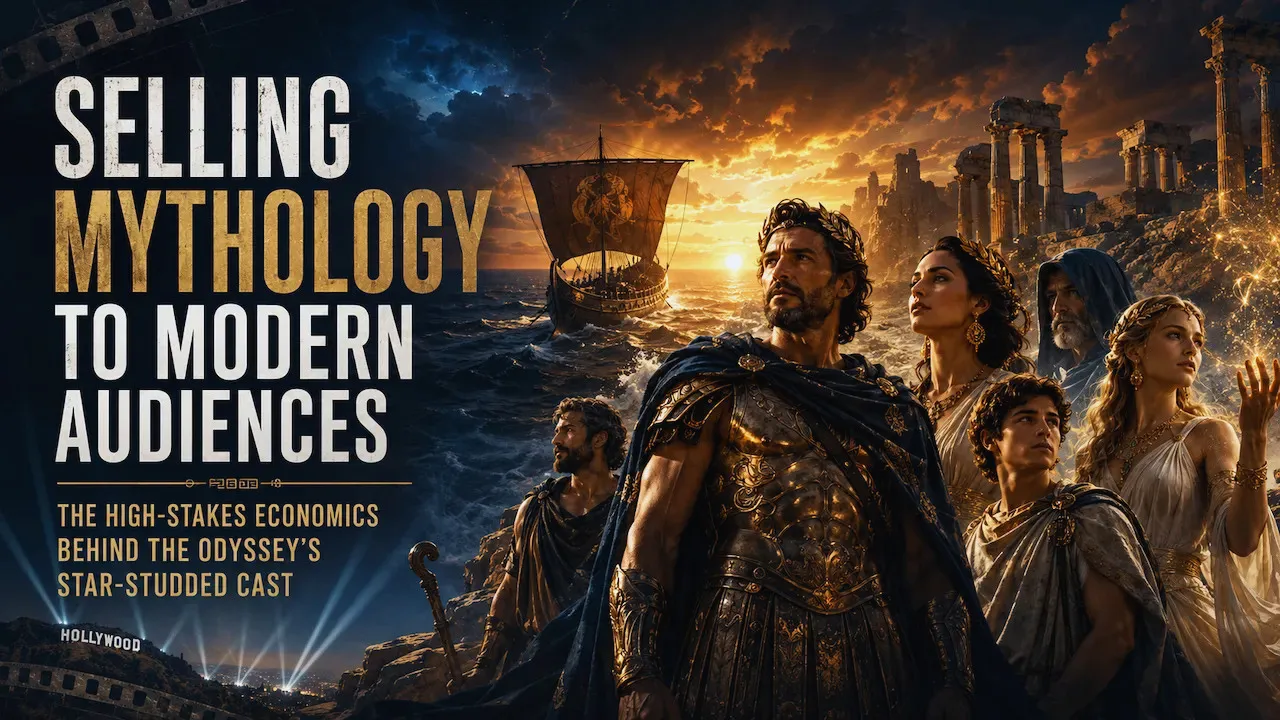
The Odyssey Star-Studded Cast and Hollywood Money Strategy
This article explains why Christopher Nolan’s The Odyssey is more than a mythological film adaptation. It breaks down how star power, brand equity, premium theatrical formats, licensing, backend economics, and audience trust shape the modern entertainment business.
A 3,000-year-old poem does not automatically become a modern box office event. It needs scale, trust, timing, and the kind of cast that makes audiences feel a movie is worth leaving the house for.
That is why the star-studded cast of The Odyssey matters so much. Christopher Nolan’s adaptation of Homer’s epic is being positioned not only as a film, but as a major theatrical product built around prestige, mythology, IMAX spectacle, and celebrity brand power. Universal’s official movie site lists the film for theaters on July 17, 2026, and promotes it as shot entirely with IMAX film cameras.
The business question is simple: can mythology, director loyalty, and celebrity attention turn an ancient story into a modern entertainment asset?
Why The Odyssey Star-Studded Cast Matters Now?
Hollywood is still searching for the next reliable model after years of franchise fatigue, streaming disruption, and uneven superhero returns. A film like The Odyssey is interesting because it combines old intellectual property with modern movie marketing.
The story itself is in the public domain. No studio needs to buy Homer’s brand. But turning that story into a global event requires a different type of value creation. That value comes from Nolan’s reputation, Universal’s theatrical strategy, premium formats, and a cast capable of reaching different audience segments.
Reuters reported that Nolan’s The Odyssey stars Matt Damon as Odysseus and follows his Oscar-winning blockbuster Oppenheimer. Nolan also said the adaptation had to work for both viewers who know Homer deeply and people who know nothing about the poem.
That is the commercial challenge. The movie has to satisfy literature fans, Nolan loyalists, premium-format moviegoers, younger fans following Zendaya or Tom Holland, and global audiences who may want a large-scale adventure.
In the entertainment business, the cast is not just decoration. It is the distribution power before distribution begins.
The Business Model Behind the Money
The money behind a project like The Odyssey does not come from a single source. It comes from a stack of revenue opportunities that start with theatrical release and continue through later windows.
The first layer is the box office. A premium theatrical run can generate higher average ticket prices, especially when IMAX and other large formats are involved. Nolan’s audience has already shown an unusual willingness to seek out special formats. Oppenheimer grossed about $975.8 million worldwide, according to Box Office Mojo, with much of the attention tied to its theatrical and IMAX presentation.
The second layer is the downstream value. After theaters, a major film can earn through digital rentals, home entertainment, streaming rights, television licensing, international deals, airline packages, and catalog value. Those windows do not always make headlines, but they matter.
The third layer is talent economics. Top actors may earn upfront salaries, backend participation, bonuses, or negotiated perks depending on the deal. Exact terms are rarely public. That is why responsible coverage of celebrity wealth should not pretend to know every private contract.
Salary Versus Ownership
Salary is simple. An actor gets paid to perform a role. It creates immediate income, but once the work is done, the upside may be limited unless the contract includes bonuses, backend points, or residual income.
Ownership is different. Ownership can mean a stake in a production company, control of intellectual property, equity in a related business, or participation in long-term revenue. For filmmakers and producers, ownership-style arrangements can be far more powerful than a single paycheck.
Nolan’s recent business reputation is partly tied to how his films perform as director-led theatrical events. Reports about Oppenheimer described a lucrative performance-based arrangement for Nolan, with Business Insider citing Forbes’ reporting that his Universal deal included a percentage of first-dollar gross. That does not tell us the private terms for The Odyssey, but it shows why director-led cinema can become a wealth-building machine when the creator has leverage.
Brand Equity and Audience Trust
Brand equity is the financial value of a reputation. For celebrities, it comes from audience trust, cultural relevance, fan loyalty, and perceived quality.
Matt Damon brings familiarity and credibility with adult audiences. Anne Hathaway brings prestige and mainstream recognition. Zendaya and Tom Holland bring younger global awareness. Robert Pattinson, Lupita Nyong’o, and Charlize Theron add different layers of critical respect, genre history, and international appeal.
That mix matters because ancient mythology can feel distant to modern viewers. A strong cast makes it feel immediate. The actors become the bridge between Homer and today’s box office.
Helpful Table
| Wealth Driver | How It Works | Why It Matters |
|---|---|---|
| Salary | Upfront payment for acting, writing, directing, or producing | Creates immediate income |
| Backend Deals | Extra compensation tied to box office or performance | Can increase upside if the film succeeds |
| Residuals | Payments from reuse, reruns, or later distribution windows | Supports long-term entertainment income |
| Licensing | Paid use of content, music, images, or brand elements | Extends revenue beyond theaters |
| Streaming Rights | Value from platform distribution after theatrical release | Adds another monetization window |
| Brand Equity | Audience trust is attached to a celebrity or director | Helps sell attention before release |
| Endorsement Deals | Paid partnerships connected to fame and visibility | Converts public image into marketing value |
| Business Ventures | Investments or companies outside entertainment | Can build wealth beyond salary |
Why Traditional Net Worth Estimates Often Miss the Full Picture?
Celebrity net worth estimates are popular because readers want simple numbers. The problem is that celebrity wealth is rarely simple.
Public estimates often focus on visible income sources such as salaries, box-office bonuses, endorsements, real estate, and known business ventures. They usually cannot fully verify private investments, taxes, management fees, debt, family office structures, royalty flows, or equity deals.
For actors in a film like The Odyssey, the public may see red carpets, trailers, and headlines. What remains hidden is the contract structure. Did someone accept lower upfront pay for upside? Did another actor take a flat fee? Are there bonuses based on box office milestones? Those details are usually private unless reported by reliable outlets or disclosed by the people involved.
This is why celebrity net worth coverage should be careful. A famous actor can look less wealthy on paper than they are if private investments perform well. Another celebrity can appear richer than they are if estimates ignore taxes, expenses, failed ventures, or shared ownership.
Examples That Show How This Works
The clearest recent example around Nolan is Oppenheimer. It was not based on superheroes, toys, or a modern franchise universe, yet it became one of 2023’s biggest global films. Box Office Mojo lists Oppenheimer at more than $975 million worldwide.
Its success changed the business conversation. It proved that audiences could still turn out for a serious, director-led film when the positioning felt like an event. It also showed how premium formats can become part of the brand. Variety reported that Oppenheimer was IMAX’s biggest earner in 2023, with $183.2 million from IMAX screens.
That matters for The Odyssey because the new film is being sold as a large-screen experience from the beginning. Universal’s official site emphasizes that it was shot entirely with IMAX film cameras.
The cast adds another layer. A mythological epic can be marketed through spectacle, but stars give the campaign faces, interviews, social reach, fan communities, magazine covers, and global recognition. That does not guarantee sales. It does improve the number of ways a studio can create awareness.
The Risks Behind Celebrity-Driven Epics
A star-studded cast can open doors, but it cannot solve every business problem.
The first risk is budget pressure. Large-scale films need strong theatrical results because marketing costs, distribution expenses, and revenue sharing with theaters can reduce what studios actually keep. A film can make headlines for a huge gross and still face complicated profitability math.
The second risk is audience mismatch. Fans of a celebrity may not automatically buy a ticket to a mythological epic. Social media attention is not the same as conversion. Likes, trailer views, and trending topics can help, but they do not equal box office revenue.
The third risk is creative balance. With a cast this recognizable, the film has to avoid feeling like a celebrity showcase instead of a story. Viewers still need emotional stakes, clarity, and momentum.
The fourth risk is timing. A premium theatrical film depends on release date, competition, reviews, word of mouth, and global market conditions. Even strong brands can underperform if the window is crowded or the audience mood shifts.
Celebrity business ventures face similar issues. Beauty brands, tequila companies, restaurants, fashion lines, memoirs, and streaming projects can all fail when their products do not match their audiences. Fame can create the first sale. It cannot guarantee repeat business.
What does this reveal about modern celebrity wealth?
The bigger lesson is that celebrity wealth is no longer only about salary. It is increasingly shaped by ownership, timing, leverage, distribution, and brand equity.
A star in The Odyssey may benefit from salary, visibility, awards,s attention, future deal leverage, and a stronger global profile. A director like Nolan can strengthen his brand as one of the few filmmakers able to sell original or non-franchise material as a theatrical event. A studio like Universal can use the film to reinforce its position in premium cinema.
This is where Hollywood money has changed. The most valuable celebrities are not always the ones with the biggest upfront paycheck. They are often the ones who turn attention into durable assets.
That might mean production companies, licensing deals, equity deals, streaming rights, publishing deals, or private investments. It might also mean becoming a trusted creative brand whose name reduces marketing risk.
Conclusion
The Odyssey is not just a mythological adventure with famous actors. It is a test of how Hollywood sells cultural memory to modern audiences.
The star-studded cast gives the film reach. Nolan gives it trust. IMAX gives it a premium positioning. Homer gives it timeless intellectual property. Universal’s job is to turn all of that into a theatrical event that feels urgent enough for audiences to pay for.
For readers interested in celebrity wealth, the real story is not simply who earns the biggest salary. It is how fame, brand equity, ownership-style deals, residual income, and long-term career leverage combine to shape modern Hollywood money.
The future of celebrity wealth will belong to the people who understand that attention is only the start. The real value comes from what they build with it.
FAQs
Why does The Odyssey’s star-studded cast matter financially?
The cast matters because recognizable actors help reduce marketing friction. Their names bring fan attention, media coverage, global awareness, and trust. That can support ticket sales, but it does not guarantee success without strong storytelling and audience demand.
How do celebrities make money from major films?
Celebrities can earn through upfront salary, bonuses, backend deals, residuals, endorsements, and future career leverage. Some may also benefit indirectly if a successful film helps them secure better roles, brand deals, or business opportunities later.
What is brand equity in celebrity wealth?
Brand equity is the financial value attached to a celebrity’s reputation. It includes trust, fan loyalty, public image, cultural relevance, and the ability to influence attention. Strong brand equity can lead to better deals and business opportunities.
Why are celebrity net worth estimates often incomplete?
They often miss private investments, undisclosed equity, taxes, debt, management costs, royalty streams, and complex deal structures. Many financial details are not publicly available, so estimates should be treated as rough guesses rather than confirmed facts.
Can celebrities make more from ownership than salary?
Yes, but only when the ownership performs well. Salary is immediate and safer. Ownership, equity, royalties, and backend deals can create larger long-term upside, but they also carry more risk if the project or business fails.
Explore more entertainment business breakdowns, celebrity wealth stories, and net worth analysis articles to understand how fame becomes long-term financial power.

Table of Contents