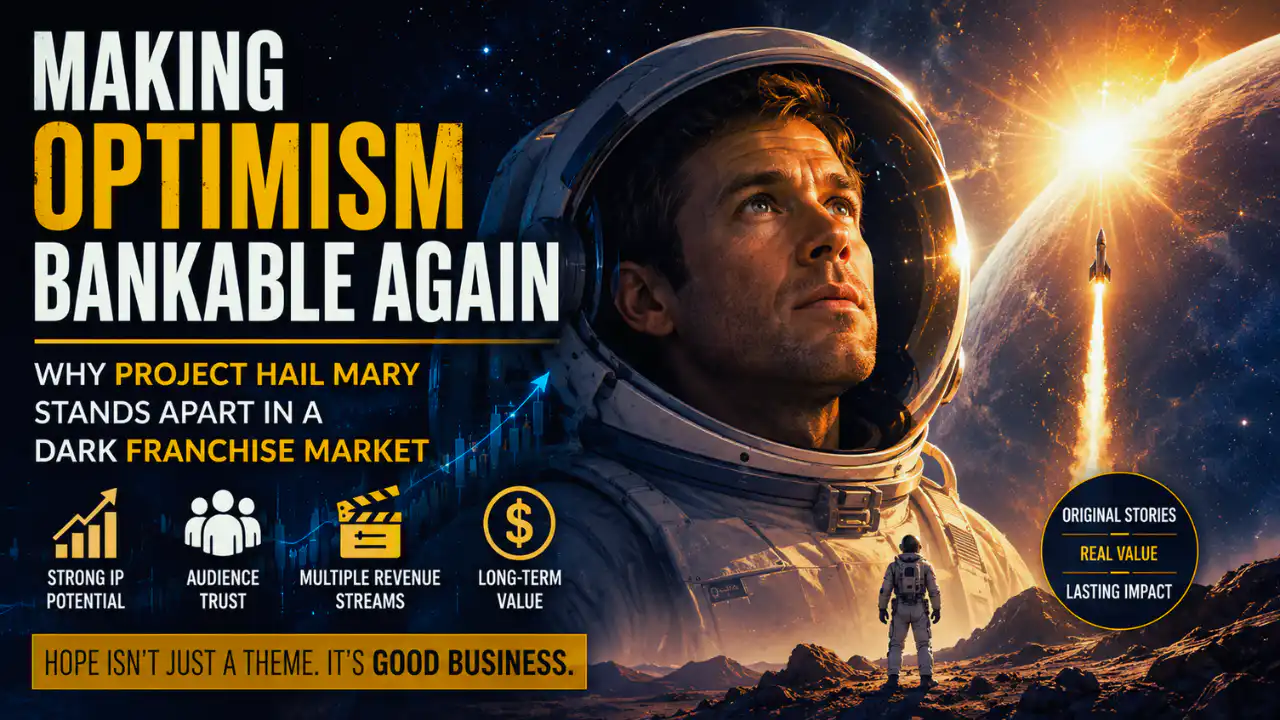
Making Optimism Bankable Again with Project Hail Mary
For much of the past decade, Hollywood has leaned heavily into darker worlds, morally conflicted heroes, and franchise universes built around constant conflict. Those stories have generated billions, but they have also created a marketplace where optimism often feels like a commercial risk.
That is why Making Optimism Bankable Again: Why Project Hail Mary Stands Apart in a Dark Franchise Market has become such an interesting business story. Rather than chasing another dystopian blockbuster, the adaptation of Andy Weir’s bestselling novel signals that major studios may once again see hopeful science fiction as a valuable long-term investment.
The conversation is not simply about one film. It is about intellectual property, audience trust, licensing potential, streaming value, and how optimism itself can become part of an entertainment company’s financial strategy.
Why This Entertainment Business Trend Matters Now?
Hollywood rarely spends hundreds of millions on projects based only on creative ambition. Every major release is also an investment in future revenue streams.
For years, studios have relied on established franchises because familiar brands reduce financial uncertainty. Existing fan communities increase merchandising opportunities, international sales, streaming rights, and licensing deals.
Yet audience fatigue has become increasingly visible. Several recent franchise films have struggled to match earlier box office expectations despite enormous marketing budgets. Industry observers have noted that viewers increasingly reward stories that offer emotional freshness rather than simply larger spectacles.
That creates an opportunity for projects like Project Hail Mary.
Instead of selling darkness, the film sells curiosity, scientific problem-solving, humor, and hope. Those qualities may also strengthen brand equity by appealing to families, educators, science enthusiasts, and international audiences.
Optimism becomes more than a creative choice. It becomes part of the product positioning.
The Business Model Behind the Money
Every successful studio release generates revenue from multiple sources beyond ticket sales.
For a project like Project Hail Mary, the financial picture includes:
- Global theatrical distribution
- Premium video-on-demand
- Streaming rights
- Television licensing
- Home entertainment
- International sales
- Publishing interest
- Merchandise opportunities
- Future franchise expansion if successful
Unlike many existing franchises, an original science fiction property also offers room for entirely new licensing opportunities rather than relying on decades of existing continuity.
Salary Versus Ownership
Actors, directors, and producers may receive upfront compensation, but that is often only one part of their earnings.
Some talent negotiates backend participation tied to box office performance or streaming success. Others receive producer credits or ownership interests that create additional long-term income.
Studios, meanwhile, benefit from owning or controlling valuable intellectual property that can continue generating revenue for years through licensing, adaptations, and distribution agreements.
That distinction explains why headline salaries rarely tell the complete financial story.
Brand Equity and Audience Trust
Optimism has become part of a film’s brand identity.
Andy Weir previously built enormous audience trust through The Martian, a science-driven story that balanced tension with humor and optimism. That reputation gives audiences confidence that another adaptation of his work may deliver a similar experience.
Brand equity is not limited to celebrities.
Authors, directors, production companies, and even storytelling styles can become valuable commercial brands that influence consumer purchasing decisions.
When audiences trust a creative brand, marketing costs can become more efficient because positive word of mouth often performs part of the promotional work.
Why Traditional Net Worth Estimates Often Miss the Full Picture?
Entertainment headlines frequently focus on celebrity net worth, but those estimates often overlook how wealth is actually built.
Publicly available information rarely captures:
- Private investments
- Equity deals
- Undisclosed production agreements
- Licensing income
- Royalties
- Backend participation
- Intellectual property ownership
- Tax obligations
- Management fees
For producers involved in successful film adaptations, long-term ownership rights may eventually become more valuable than an initial salary.
Likewise, production companies may benefit from sequel opportunities, international remakes, television adaptations, and streaming agreements that unfold over many years.
That complexity explains why publicly reported wealth figures should always be viewed as estimates rather than confirmed financial statements.
That Shows How This Works
Hollywood already offers several examples of optimistic science fiction creating lasting commercial value.
The Martian demonstrated that intelligent, hopeful storytelling could succeed both critically and commercially while extending Andy Weir’s publishing profile.
Christopher Nolan’s Interstellar continues generating value through streaming, premium home entertainment, educational interest, and ongoing cultural relevance long after its theatrical release.
Pixar has repeatedly shown that emotionally optimistic storytelling often supports stronger merchandising and family licensing opportunities than darker, adult-focused properties.
These examples suggest that positive storytelling can strengthen long-term commercial ecosystems rather than simply opening weekend revenue.
The Risks Behind Entertainment Business Ventures
Optimism alone does not guarantee profitability.
Large-budget science fiction remains expensive to produce.
Studios still face risks including:
- Rising production costs
- International market uncertainty
- Audience expectations
- Marketing expenses
- Competition from streaming platforms
- Franchise fatigue
- Economic slowdowns affecting cinema attendance
There is also the challenge of balancing accessibility with scientific authenticity.
If a film becomes too technical, mainstream audiences may disengage.
If it oversimplifies the source material, existing fans may feel disappointed.
Finding that balance is one of the biggest commercial challenges.
What This Reveals About Modern Celebrity Wealth?
Today’s entertainment economy increasingly rewards ownership over visibility.
Actors still earn salaries.
Creators still receive royalties.
Celebrities continue signing endorsement deals.
Yet long-term wealth increasingly comes from controlling intellectual property, participating in production, securing equity deals, and building valuable creative brands.
Films like Project Hail Mary highlight another important lesson.
Audiences themselves influence investment decisions.
When viewers reward original, optimistic storytelling, they reshape how studios allocate billions in production budgets.
Optimism, once viewed as a creative gamble, can become a commercially valuable market signal.
Wealth Drivers Behind Modern Entertainment
| Wealth Driver | How It Works | Why It Matters |
|---|---|---|
| Salary | Upfront payment for creative work | Immediate earnings |
| Royalties | Ongoing payments from continued use | Builds long-term income |
| Equity Deals | Ownership interests in projects or companies | Can appreciate significantly over time |
| Licensing Deals | Rights granted for merchandise or adaptations | Expands revenue beyond cinemas |
| Streaming Rights | Revenue from digital distribution agreements | Extends commercial life |
| Residual Income | Payments from certain reuse arrangements | Supports ongoing earnings where applicable |
| Brand Equity | Audience trust built over time | Reduces marketing friction and increases commercial appeal |
Conclusion
Project Hail Mary represents something larger than another science fiction adaptation. It reflects Hollywood’s willingness to test whether hopeful storytelling can once again become a dependable commercial strategy.
The real business story lies in intellectual property, audience trust, distribution rights, and long-term ownership rather than opening weekend headlines alone.
If audiences continue embracing optimistic, original stories, studios may discover that the next generation of valuable franchises is built not on darker worlds, but on ideas that leave viewers inspired to imagine a better future.
FAQs
Why is Project Hail Mary considered important for Hollywood?
It represents a major investment in optimistic original science fiction at a time when many studios rely heavily on darker franchise properties.
How do films like Project Hail Mary make money?
Revenue can come from theatrical releases, streaming rights, television licensing, home entertainment, international distribution, and merchandising where appropriate.
Why are celebrity net worth estimates often incomplete?
Many estimates cannot fully account for private investments, equity deals, royalties, licensing agreements, taxes, or confidential production contracts.
What is brand equity in entertainment?
Brand equity refers to the value created through audience trust, recognition, and reputation, which can increase future earning potential across multiple projects.
Why are studios interested in original intellectual property?
Successful original IP can become long-term assets that support sequels, adaptations, licensing opportunities, and recurring revenue for many years.
Interested in the business behind Hollywood’s biggest success stories? Explore more of our entertainment business analysis, celebrity wealth insights, and franchise economics to understand how modern fame creates lasting financial value.

Table of Contents