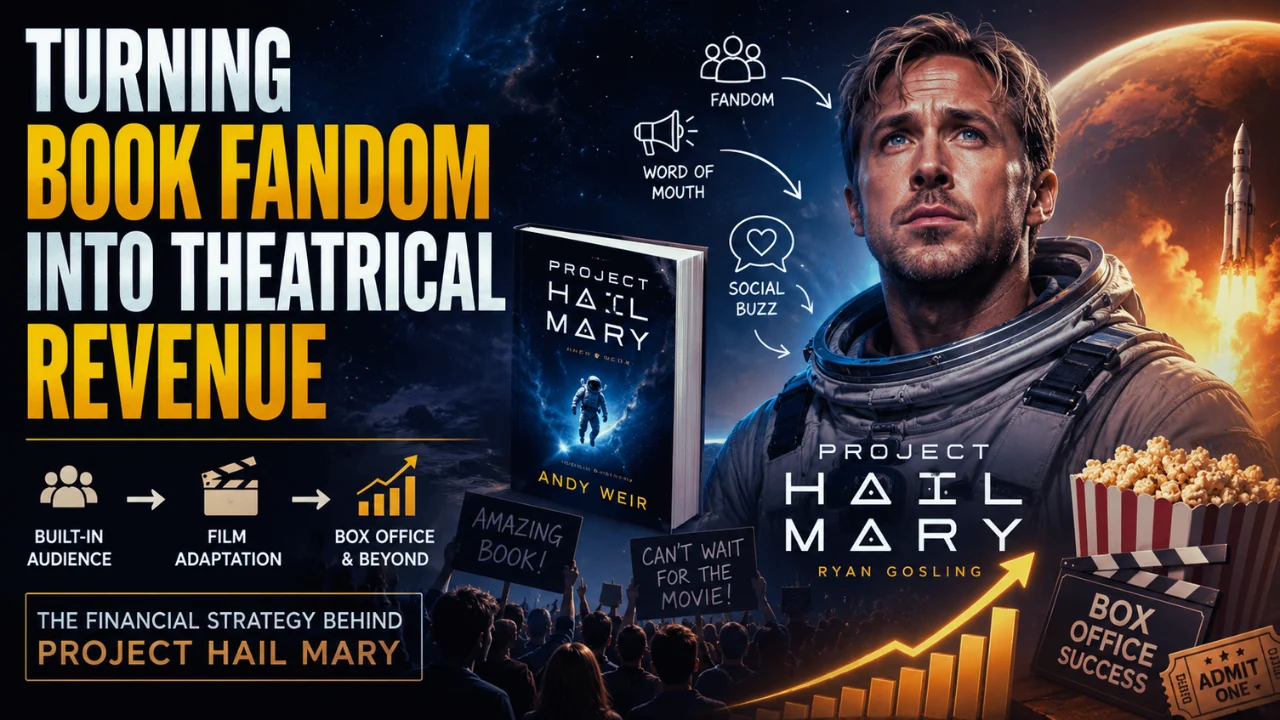
Project Hail Mary and the Business of Book Fandom
Long before audiences bought cinema tickets for Project Hail Mary, many had already invested something just as valuable: their attention.
Andy Weir’s bestselling novel created a passionate community of readers who championed the book across social media, podcasts, Reddit discussions, and recommendation lists. By the time Ryan Gosling, Phil Lord, Christopher Miller, and Drew Goddard joined the adaptation, Hollywood wasn’t simply betting on a science fiction story. It was betting on an existing customer base.
That is the central idea behind Turning Book Fandom Into Theatrical Revenue: The Financial Strategy Behind Project Hail Mary. In an era when original films struggle to stand out, studios increasingly view successful books as low-risk intellectual property that can generate ticket sales, streaming value, merchandising opportunities, and long-term brand equity.
Project Hail Mary offers a fascinating look at how modern entertainment companies transform readership into revenue.
Why This Celebrity Wealth Trend Matters Now?
Hollywood’s relationship with books is hardly new. Harry Potter, The Hunger Games, and The Martian demonstrated that audiences often follow beloved stories across formats.
What has changed is the economics.
Studios today face rising production budgets, fragmented audience attention, and intense competition from streaming platforms. As a result, intellectual property has become one of the industry’s most valuable assets.
Project Hail Mary arrived with several advantages:
- A bestselling novel by Andy Weir.
- A built-in science fiction fanbase.
- Ryan Gosling’s star power.
- Phil Lord and Christopher Miller’s reputation for audience-friendly storytelling.
- Drew Goddard’s experience adapting The Martian.
Public reporting indicates MGM acquired film rights to the novel before its publication for approximately $3 million, illustrating how aggressively studios pursue promising IP.
This trend matters because entertainment wealth increasingly begins with ownership of ideas rather than simply participation in productions.
The Business Model Behind the Money
At its core, Project Hail Mary demonstrates Hollywood’s IP flywheel.
A successful book creates readers. Readers create anticipation. Anticipation drives theatrical attendance. The film then creates additional opportunities through digital rentals, streaming rights, home entertainment sales, international licensing, and future exploitation of the property.
| Wealth Driver | How It Works | Why It Matters |
|---|---|---|
| Book Sales | Revenue from novel purchases | Establishes audience demand |
| Film Rights | Studio acquires adaptation rights | Creates monetizable IP pipeline |
| Theatrical Revenue | Ticket sales worldwide | Primary revenue source |
| Streaming Rights | Licensing to platforms | Extends earning window |
| Merchandise | Branded products and collectibles | Expands audience engagement |
| International Distribution | Regional release partnerships | Increases global reach |
| Home Entertainment | Digital and physical sales | Generates residual revenue |
Salary Versus Ownership
One of Hollywood’s biggest misconceptions is that stars make their fortunes solely from acting salaries.
Ryan Gosling reportedly also served as a producer on Project Hail Mary. Producer credits can mean additional compensation structures, although specific terms remain private. Meanwhile, Andy Weir benefits from retaining authorship of the underlying work and receiving adaptation-related compensation tied to publicly disclosed agreements.
Ownership generally creates more upside than a one-time pay cheque.
Authors own stories. Studios own distribution rights. Producers may negotiate backend participation. Over time, these arrangements can prove more valuable than upfront compensation.
Brand Equity and Audience Trust
Book fandom operates as a form of brand equity.
Readers who loved The Martian trusted Andy Weir’s ability to deliver another compelling science fiction experience. Ryan Gosling brought his own audience, while Lord and Miller contributed credibility built through previous successes.
Audience trust is difficult to quantify, but Hollywood spends billions attempting to create it.
Project Hail Mary effectively combined multiple brands into one package:
- Andy Weir
- Ryan Gosling
- Lord & Miller
- Science fiction fandom
- Premium theatrical spectacle
Together, they reduced marketing friction and increased audience awareness before release.
Why Traditional Net Worth Estimates Often Miss the Full Picture?
Celebrity net worth discussions tend to focus on visible income.
Yet entertainment wealth is rarely that simple.
Traditional estimates often overlook:
- Royalties
- Backend participation
- Licensing arrangements
- Producer fees
- Intellectual property rights
- Private investments
- Taxes and management costs
- Real estate holdings
An author with adaptation rights may generate income for decades. A producer can benefit from multiple revenue windows. Studios monetize theatrical runs, streaming agreements, and international distribution separately.
Publicly available information rarely reveals the entire financial structure behind these deals.
That is why celebrity wealth figures should be viewed as approximations rather than definitive statements.
That Shows How This Works
Hollywood has repeatedly demonstrated the financial value of passionate fandom.
Consider these examples:
- The Martian transformed Andy Weir from a self-published author into a major Hollywood property.
- Dune leveraged decades of literary fandom into a premium theatrical franchise.
- Harry Potter evolved from books into one of entertainment’s largest licensing ecosystems.
- The Hunger Games built a multi-film franchise supported by publishing success.
Project Hail Mary sits comfortably within this tradition.
The difference is timing. Modern fan communities organize online, creating anticipation years before release. Reddit threads discussing trailers and casting decisions demonstrate how fandom itself has become a marketing engine.
Studios increasingly rely on these communities to reduce customer acquisition costs.
The Risks Behind Celebrity Business Ventures
Built-in audiences help, but they do not guarantee success.
Hollywood history is full of adaptations that failed despite recognizable brands.
Common risks include:
- Poor adaptation choices.
- Audience fatigue.
- Budget overruns.
- Weak marketing campaigns.
- Negative reviews.
- Shifts in theatrical habits.
- Overestimating fandom size.
Science fiction presents additional challenges because production costs tend to be high. According to public reporting, Project Hail Mary carried a substantial production budget, increasing pressure to perform theatrically.
There is also the danger of assuming online enthusiasm equals ticket sales.
Fans may love a book while remaining selective about film adaptations. Studios must still deliver a compelling cinematic experience.
What This Reveals About Modern Celebrity Wealth?
The entertainment economy increasingly rewards leverage.
Actors seek producer credits. Authors negotiate adaptation rights. Studios compete for intellectual property. Creators expand into business ventures and licensing deals.
- Ownership.
- Distribution.
- Timing.
- Audience trust.
- Intellectual property.
- Global scalability.
Project Hail Mary highlights an important reality: entertainment companies are no longer just selling movies. They are monetizing communities.
A reader who buys a novel may later purchase a cinema ticket, subscribe to a streaming service, recommend the film to friends, and engage with related content online. Each interaction adds value to the ecosystem.
That is why Hollywood continues to pay premiums for recognizable stories.
The future of entertainment wealth belongs to those who own audiences before opening weekend ever arrives.
Conclusion
Project Hail Mary is more than a science fiction adaptation. It is a window into Hollywood’s evolving financial playbook.
Studios increasingly view books as acquisition targets, authors as intellectual property creators, and fandom as a measurable business asset. While salaries remain important, the larger story revolves around ownership, licensing, and long-term monetization.
As entertainment companies compete for attention in an increasingly crowded market, the ability to transform readers into moviegoers may become one of Hollywood’s most valuable skills.
FAQs
1. Why are studios adapting more bestselling books?
Books offer built-in audiences, reducing marketing risk and improving awareness before release.
2. How do authors make money from film adaptations?
Authors may receive payments for adaptation rights and can benefit from increased book sales and related licensing opportunities.
3. Does celebrity net worth include royalties and licensing income?
Not always. Public estimates frequently exclude private agreements, royalties, taxes, and undisclosed investments.
4. Why is intellectual property so valuable in Hollywood?
Strong intellectual property comes with audience recognition, which can increase revenue across films, streaming, merchandise, and international markets.
5. Can book fandom guarantee box office success?
No. Audience enthusiasm helps, but factors such as reviews, marketing, competition, and film quality still play major roles.
Interested in the business behind fame? Explore more entertainment industry breakdowns, celebrity wealth stories, and Hollywood money analysis on our site.

Table of Contents