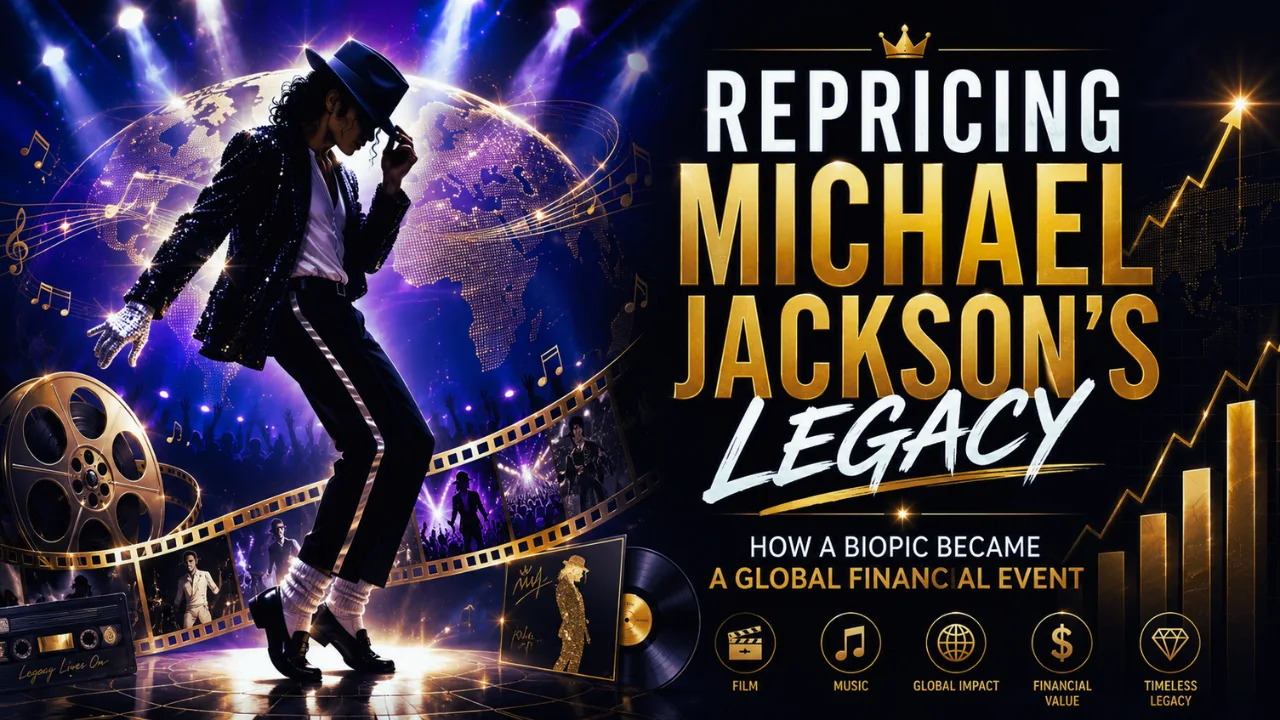
How Michael Jackson’s Legacy Biopic Became a Financial Event
This article explains how Michael turned the Michael Jackson legacy biopic into more than a movie release. It looks at box office revenue, music catalog value, estate management, licensing, royalties, brand equity, and the risks that come with monetizing a complicated celebrity legacy.
A music biopic is usually sold as a nostalgia trip. Michael became something bigger.
The Michael Jackson legacy biopic arrived as a test of how far one artist’s intellectual property can still travel across theaters, streaming rights, music catalogs, licensing deals, and global fan demand. By July 2026, Box Office Mojo listed Michael at more than $991 million worldwide, with international markets making up most of that total. The film also carried a reported $155 million budget and a $97 million domestic opening, showing why Hollywood money is still fascinated by legacy music brands.
But the real story is not only about the box office. It is how a controversial, heavily managed, estate-backed celebrity brand can be repriced for a new generation. For readers interested in celebrity net worth, the entertainment business, royalties, licensing, and ownership deals, Michael is a case study in modern celebrity wealth.
Why the Michael Jackson Legacy Biopic Matters Now?
Michael Jackson’s name has always carried two forces at once: huge cultural value and serious reputational risk. That tension is exactly why Michael matters as a financial event.
The film was not released into an empty market. Music biopics had already become proven Hollywood products, with Bohemian Rhapsody, Elvis, and Rocketman showing that catalog-driven storytelling can move both ticket sales and music consumption. What made Michael different was scale.
The movie opened globally with a reported $217 million weekend, including $97 million in North America and $120.4 million internationally. That launch beat the previous biopic opening record and showed that Jackson’s fan base remained unusually global.
That global footprint matters because celebrity wealth is no longer measured only by domestic fame. A legacy artist can generate value through international box office, streaming demand, soundtrack exposure, merchandise, theatrical formats, documentary interest, and renewed licensing conversations.
In simple terms, Michael did not just sell a film. It reopened the market around Michael Jackson’s commercial ecosystem.
The Business Model Behind the Money
A biopic like Michael creates value through several layers.
First comes theatrical revenue. Studios, exhibitors, distributors, and financiers all participate in the box office chain. A film’s headline gross is not the same as profit because cinemas keep a share, marketing costs can be high, and distribution structures vary by territory.
Second comes music activity. A successful music biopic can push listeners back to the artist’s catalog. That can increase streaming, downloads, playlist placement, publishing income, and master recording revenue.
Third comes licensing. A film based on a major artist’s life needs access to music, image rights, name rights, archival elements, and estate approvals. These rights are not decorative. They are the financial engine.
Fourth comes long-tail revenue. After theaters, the movie can keep earning through digital rental, purchase, streaming rights, TV licensing, soundtrack releases, physical media, and possible sequels.
That is why Michael was not only a film project. It was a brand equity event.
Salary Versus Ownership
Salary is simple. An actor, director, writer, or producer receives payment for work. Ownership is different.
Ownership can mean rights participation, producer points, control over intellectual property, music publishing, master recordings, or backend participation. Exact deal terms around Michael are not fully public, so it would be misleading to claim who received what percentage.
Still, the distinction matters. Upfront fees create immediate income. Ownership and rights control can create residual income long after release. That is why estates, studios, labels, and music publishers care deeply about biopics. They can activate existing assets.
Brand Equity and Audience Trust
Brand equity is the value attached to a name. With Michael Jackson, that value is unusually powerful because his songs, dance style, videos, fashion, and visual identity are instantly recognizable across generations.
That recognition lowers marketing friction. A new original drama must explain itself from scratch. A Michael Jackson biopic starts with decades of awareness.
But brand equity is not the same as trust. Jackson’s legacy remains contested because of long-running abuse allegations, which Jackson denied and his estate has continued to reject. He was acquitted in his 2005 criminal trial. The Guardian also reported that the film faced criticism for avoiding later controversies and for its estate involvement.
That is the risk side of celebrity brands. Attention can sell tickets, but it can also bring scrutiny.
Helpful Table
| Wealth Driver | How It Works | Why It Matters |
|---|---|---|
| Box Office | Ticket sales from theaters worldwide | Creates the first public measure of demand |
| Music Royalties | Income from streaming, sales, publishing, and recordings | Can rise when a film renews catalog interest |
| Licensing Deals | Paid use of name, image, songs, visuals, or trademarks | Turns legacy into controlled commercial access |
| Distribution Rights | Studios sell or manage territories, streaming, and home media | Spreads risk and expands revenue channels |
| Brand Equity | The commercial value of fame and recognition | Helps market films, products, and partnerships |
| Residual Income | Long-term earnings from reuse or later releases | Keeps value moving after the opening weekend |
Why Traditional Net Worth Estimates Miss the Full Picture?
Celebrity net worth estimates often flatten complex business structures into a single number. That is especially risky with someone like Michael Jackson.
A website may count real estate, catalog value, reported earnings, or past deals, but it may miss debt, taxes, legal claims, management fees, estate structures, royalties, private agreements, and restricted assets. Some assets are also difficult to value because their value depends on future use.
Jackson’s estate shows how complicated this can get. In a major tax dispute, the U.S. Tax Court had to evaluate the value of Jackson’s image and likeness at the time of death, not based on the later success of the estate. ACTEC summarized that the estate initially valued the right of publicity at about $2,000, while the IRS initially asserted about $435 million, and the court landed around $4 million.
That gap explains why celebrity wealth is not always what it appears to be. A name can be worth little in one legal context and become hugely valuable later through management, timing, licensing, and public demand.
Examples That Show How This Works
The strongest public example is Jackson’s music catalog.
In 2024, Variety reported that Sony Music acquired a major stake in Michael Jackson’s music catalog, with the overall catalog valued at more than $1.2 billion. That deal showed the market’s appetite for proven music rights before Michael reached theaters.
The biopic then added another layer. It turned the catalog from a financial asset into a mainstream cultural event. Songs that already had value became part of a renewed story. Younger audiences got an entry point. Older fans got nostalgia. Studios got a global movie. The estate got a major legacy platform.
A similar pattern has appeared before. Bohemian Rhapsody helped Queen’s music reach new listeners, while also proving that a familiar catalog can carry a film across international markets. The difference with Michael is the size of the Jackson brand and the intensity of the debate around it.
The Risks Behind Celebrity Business Ventures
Celebrity business is not magic. Fame can open doors, but it cannot erase weak execution.
For a legacy biopic, the risks are specific. Production costs can rise. Rights issues can complicate scripts. Critics may reject the framing. Family members may object. Audiences may split between celebration and skepticism. Legal restrictions can shape what the film can and cannot show.
Michael faced exactly that kind of pressure. The Guardian reported that reshoots followed legal complications tied to references to Jordan Chandler, and that the film’s production cost came close to $200 million. At the same time, Lionsgate sold international rights to Universal to help manage exposure.
That is the hidden side of Hollywood money. A famous name can make a movie easier to sell, but harder to control.
The same logic applies to celebrity restaurants, fashion lines, tequila companies, beauty brands, memoir deals, and streaming projects. If the product does not fit the audience, or if management is weak, even a famous name can fail. Public image can also change quickly.
What does this reveal about modern celebrity wealth?
The bigger lesson is that celebrity wealth is moving from labor income to asset leverage.
Old celebrity wealth was built on salaries, concert tickets, album sales, and endorsement deals. Modern celebrity wealth still includes those streams, but the real upside often comes from ownership, licensing, equity deals, catalog rights, and intellectual property control.
Michael shows how a deceased artist can remain part of the creator economy without posting, touring, or doing interviews. The estate, catalog partners, studios, distributors, and rights holders can keep building business ventures around the artist’s identity.
That does not mean every legacy should become a product. The ethical questions matter. The audience’s trust matters. Accuracy matters. But from a business perspective, Michael proves that a celebrity legacy can be repriced when film, music rights, global fandom, and brand management all meet at the right moment.
Conclusion
Michael turned the Michael Jackson legacy biopic into a global financial event by connecting several money engines at once: theatrical demand, music catalog value, licensing, streaming potential, estate management, and worldwide nostalgia.
The film also shows why celebrity net worth is harder to measure than a headline estimate. The value is not just in cash earned today. It is in who controls the rights, how the story is packaged, where distribution reaches, and whether the public is willing to engage again.
For Hollywood, the message is clear. Legacy IP is not just history. Managed carefully, it can become one of entertainment’s most powerful financial assets.
FAQs
Why did the Michael Jackson legacy biopic become such a major business story?
It became a major business story because Michael combined box office demand, music catalog value, estate-controlled rights, global distribution, and renewed fan interest. It showed how a biopic can generate multiple revenue streams simultaneously.
How do celebrities make money outside of their salary?
Celebrities can earn from royalties, licensing deals, endorsement deals, equity deals, business ventures, real estate, streaming rights, residual income, and private investments. Salary is only one part of the wider celebrity wealth picture.
What is brand equity in celebrity wealth?
Brand equity is the financial value attached to a celebrity’s name, image, reputation, audience loyalty, and cultural relevance. Strong brand equity can help sell films, products, partnerships, and licensing deals.
Why do celebrity net worth estimates change?
Celebrity net worth estimates change because many assets are private or hard to value. Taxes, debt, royalties, catalog valuations, ownership deals, legal costs, and management fees can all affect the real number.
Do celebrities make more from ownership than endorsements?
Sometimes they do, but not always. Endorsements provide paid marketing income, while ownership can grow if the business or intellectual property becomes more valuable. Ownership also carries more risk.
Explore more entertainment business breakdowns to understand how celebrity wealth, net worth estimates, music catalogs, ownership deals, and Hollywood money really work.
Table of Contents