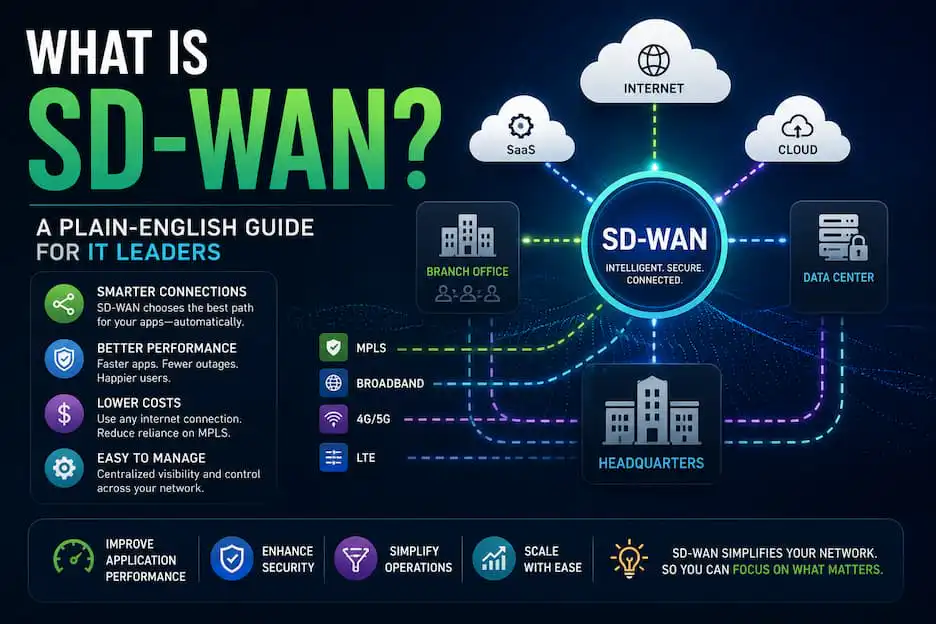
What Is SD-WAN? A Plain-English Guide for IT Leaders
Every IT leader has heard the term SD-WAN. Analysts talk about it at conferences, vendors promote it relentlessly, and the internal pressure to modernize aging network infrastructure has never been higher. But cutting through the buzzwords to understand what SD-WAN actually does, and why it matters for your organization specifically, requires stepping back from the marketing language and looking at the practical reality of how enterprise networks have evolved.
The Problem SD-WAN Was Built to Solve
To understand SD-WAN, it helps to understand what came before it. For decades, the backbone of enterprise wide area networking was Multiprotocol Label Switching, a private circuit technology that gave organizations reliable, high-performance connectivity between their offices and data centers. MPLS earned its place: it was dependable, came with service level agreements, and kept sensitive traffic off the public internet.
But MPLS has real limitations. Provisioning a new MPLS circuit can take weeks or even months. The cost is substantial, particularly as bandwidth demands have grown. And critically, MPLS was designed for a world where applications lived in corporate data centers and users worked from fixed locations. That world no longer exists for most organizations.
When a branch office employee opens a video call on a SaaS platform, that traffic has to travel from the branch, back through the corporate data center for security inspection, and then out to the internet. This detour, called backhauling, adds latency and degrades performance. It was acceptable when occasional cloud use was the exception. It becomes a serious problem when cloud and SaaS applications are the primary way work gets done.
What SD-WAN Actually Is
SD-WAN, short for software-defined wide area network, is a technology that uses software to manage and optimize connectivity across multiple network links from a central control plane. Instead of hard-coded routes through fixed circuits, SD-WAN continuously monitors all available connections, including broadband internet, LTE, 5G, and existing MPLS, and makes intelligent decisions about which path each application should take. The architecture has three key layers that work together.
At the edge, physical or virtual appliances sit at each location and enforce traffic policies locally. A centralized controller coordinates those edge devices, distributing policies and monitoring performance across the entire network. An orchestration layer provides the single management interface through which IT administrators configure, monitor, and troubleshoot everything. What is SD-WAN for enterprise networks is explained in depth, covering architecture, deployment models, and security considerations relevant to organizations evaluating software-defined networking.
The Four Things IT Leaders Care About
When IT leaders evaluate SD-WAN, they are generally trying to solve four interconnected challenges.
Network Performance at Scale
Traditional WAN management becomes exponentially harder as an organization grows. Each new site requires manual configuration. Troubleshooting a performance issue means working through disparate systems with limited visibility. SD-WAN solves this with application-aware routing, the system automatically identifies traffic by type and steers it across the best-performing available path. Voice and video calls get routed over low-latency links. Bulk file transfers take lower-cost paths. When a link degrades, traffic fails over automatically without the user even noticing.
Cost Control
One of the most compelling arguments for SD-WAN is the financial case. Organizations that have replaced MPLS circuits with a hybrid model, combining broadband internet with SD-WAN, consistently report meaningful reductions in their WAN spending. Even where MPLS is retained for critical traffic, supplementing it with cheaper broadband for lower-priority workloads lowers the overall cost. The operational savings from centralized management also add up: deploying a new site through zero-touch provisioning takes hours instead of days, without requiring a network engineer on-site.
Cloud and SaaS Optimization
SD-WAN enables direct internet breakout from branch locations, which means cloud-bound traffic does not have to backhaul through a central data center. This single change often produces a noticeable improvement in application performance for end users. IT teams can define policies that send Microsoft 365 traffic directly to the internet while routing access to sensitive internal systems through a more controlled path. The flexibility to apply different policies to different application types without touching individual devices is one of the defining practical benefits of SD-WAN.
Practical guidance on planning and executing an SD-WAN deployment, including how to manage vendor selection, logistics, and configuration across multiple locations, is available at SD-WAN deployment guide.
Simplified Management and Visibility
One of the most underappreciated benefits of SD-WAN is what it does for operational visibility. IT teams get a real-time view of network performance across every site, with the ability to drill down into individual application flows. Policy changes can be pushed to all locations simultaneously. The days of logging into individual routers at each branch to make configuration changes are replaced by a centralized dashboard. This shift fundamentally reduces the operational burden on networking teams and gives leaders better data for decision-making.
SD-WAN and the Security Conversation
A critical point for IT leaders to understand is that SD-WAN and security are no longer separate discussions. Modern SD-WAN deployments increasingly incorporate next-generation firewall capabilities, encrypted tunnels, and traffic segmentation as native features of the platform rather than additions bolted on afterward. The convergence of SD-WAN with cloud-delivered security services under the Secure Access Service Edge framework means that organizations can simultaneously modernize their network connectivity and strengthen their security posture without managing two separate infrastructure stacks.
According to IDC market research, organizations around the world continue to invest in SD-WAN to optimize edge network connectivity, enhance application experiences, and improve operational efficiency, with the global SD-WAN infrastructure market projected to reach substantial growth through the remainder of this decade. Those figures reflect a broad recognition that SD-WAN has moved from an early-adopter technology to a mainstream infrastructure requirement.
An assessment of the SD-WAN vendor landscape and the key market trends shaping investment decisions is available from IDC at IDC MarketScape report.
Making the Decision
For most IT leaders, the question is not whether SD-WAN makes sense but how to approach the transition. Organizations typically start by mapping their current WAN footprint, identifying the sites and applications where performance problems are most acute, and evaluating whether a managed SD-WAN service or a self-deployed model better fits their internal capabilities. Either path leads to the same destination: a network that is more flexible, more visible, and better aligned with how people actually work today.
The technology is mature, the vendor ecosystem is well-developed, and the business case is clear. SD-WAN is not a future consideration for enterprise networks. For most organizations, it is already the present reality, and understanding it in practical terms is now a fundamental part of the IT leadership role.
Frequently Asked Questions
How is SD-WAN different from simply using broadband internet for branch offices?
Raw broadband lacks the intelligence, redundancy, and centralized management that SD-WAN provides. SD-WAN adds a software layer that continuously monitors all available links, dynamically routes traffic based on real-time conditions, applies security policies, enables automatic failover, and gives IT teams unified visibility across every site, capabilities that broadband alone cannot deliver.
Can SD-WAN work alongside our existing MPLS infrastructure?
Yes. Many organizations adopt a hybrid approach, keeping MPLS for latency-sensitive or compliance-critical traffic while using broadband alongside SD-WAN for other workloads. This lets organizations reduce MPLS costs incrementally without a disruptive full replacement, and allows time to validate the performance of the new architecture before committing to a complete transition.
What is the difference between SD-WAN and SASE?
SD-WAN is the networking layer that manages how traffic flows across the WAN. SASE combines SD-WAN with a set of cloud-delivered security services, including zero trust network access, secure web gateways, and cloud access security brokers, into a unified architecture. Think of SD-WAN as the foundation and SASE as the broader framework that adds security services on top of it.

Table of Contents