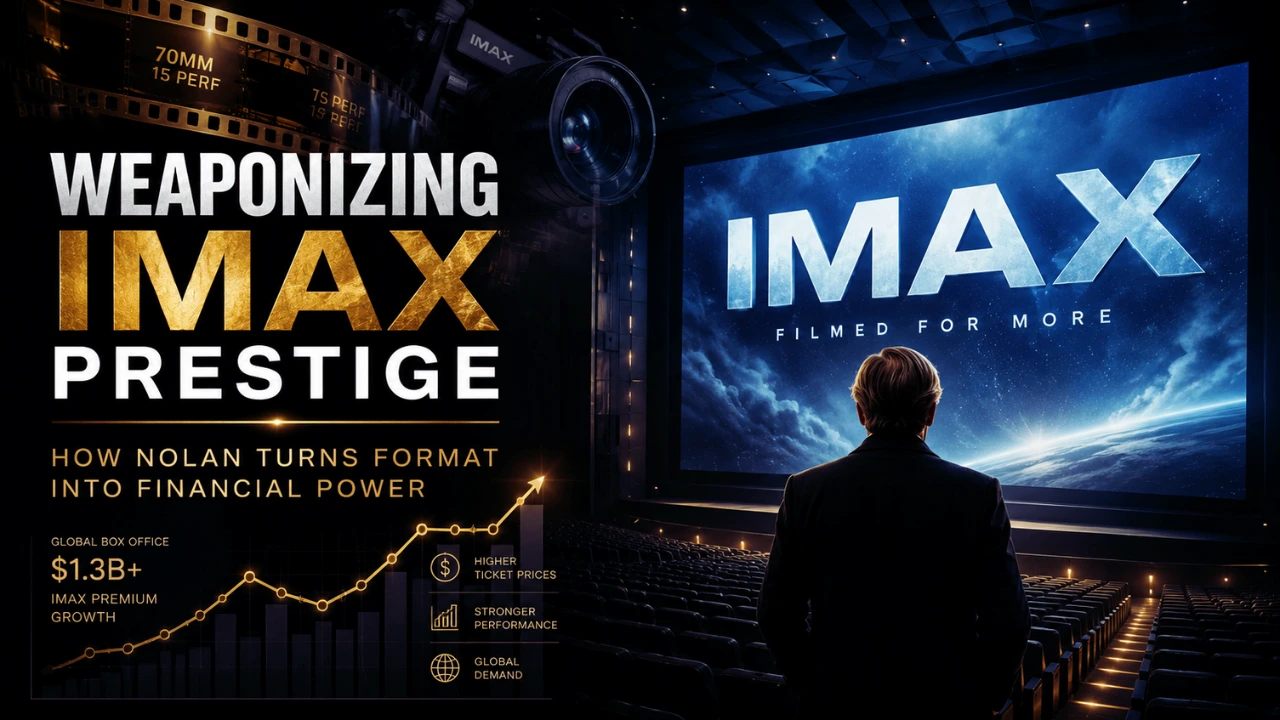
Weaponizing IMAX Prestige Shows Nolan Format Power
This article explains how Christopher Nolan has turned IMAX from a technical format into a powerful business asset. It covers box-office leverage, premium-ticket demand, brand equity, backend deals, and why traditional celebrity net-worth estimates often miss the value of format-driven influence.
Christopher Nolan does not treat IMAX like a bigger screen. He treats it like a financial moat.
That is the heart of Weaponizing IMAX Prestige, a strategy that turns format into scarcity, scarcity into demand, and demand into Hollywood money. For most filmmakers, premium large format is a distribution choice. For Nolan, it has become part of the product itself.
The proof is not just cultural. It is commercial. Oppenheimer grossed about $975.8 million worldwide, according to Box Office Mojo, an unusual result for a three-hour R-rated biographical drama about nuclear history. IMAX also reported that Oppenheimer was its top 2023 grosser with $183.2 million, helping drive a $1.06 billion global box office year for the company.
That is why Nolan’s IMAX play matters. It shows that the value of the modern entertainment business is no longer only about salary, box office, streaming rights, or celebrity net worth. It is about brand equity, distribution control, audience trust, and the ability to make people pay more for a specific experience.
Why This Celebrity Wealth Trend Matters Now?
Hollywood is still trying to solve a painful question. How do you convince audiences to leave home when streaming has made convenience the default?
Nolan’s answer is simple but difficult to copy. Make the theater feel non-negotiable.
His name now signals more than authorship. It signals scale, craft, film projection, limited access, and premium presentation. That creates brand equity. In the entertainment business, brand equity is the money value of trust. Audiences believe a Nolan film is worth seeing in the best possible format, so IMAX becomes part of the sale.
This matters because studios need events, not just releases. A normal movie can be delayed, skipped, or watched later. A true event creates urgency. With The Odyssey, that urgency began early. Reuters reported that Nolan’s follow-up to Oppenheimer will debut in cinemas on July 17, 2026, with Matt Damon starring as Odysseus.
Even before release, premium-format demand became a story of its own. The Guardian reported that select 15/70 IMAX tickets for The Odyssey went on sale a year before release and sold out at several locations.
That is not just fandom. That is a form of financial power.
The Business Model Behind the Money
The Nolan IMAX model works because it connects creative choices to revenue channels.
A director chooses cameras, aspect ratio, film stock, sound design, theatrical window, and release positioning. Those choices affect how audiences perceive the movie. If the perception is strong enough, theaters can charge premium ticket prices, studios can protect the theatrical run, and the filmmaker’s negotiating power grows.
IMAX benefits from Nolan, who gives the brand cultural heat. Studios benefit because premium formats can lift average ticket revenue. Theaters benefit because fans often travel, book early, and treat the screening like a limited event. Nolan benefits because his format discipline strengthens his leverage on future deals.
Salary Versus Ownership
Salary is upfront income. Ownership and backend participation are different.
A filmmaker can earn a directing fee, a writing fee, a producing fee, or a salary. But the real upside often comes from backend deals, gross participation, rights, or producer control. Forbes estimated that Nolan’s Oppenheimer deal involved 15% of first-dollar gross, meaning he shared in revenue before the studio fully recouped expenses. Forbes also estimated a major payday tied to box office, home video, and early streaming licensing.
That does not mean every director can demand this. Most cannot. Nolan’s leverage comes from a long track record, audience trust, and a repeatable ability to turn non-franchise ideas into theatrical events.
Brand Equity and Audience Trust
Nolan’s name functions almost like a luxury label. The promise is not glamour. It is seriousness, scale, craft, and scarcity.
That is why IMAX is so valuable to the Nolan brand. The format gives the audience a clear reason to choose theaters over streaming. It also creates a hierarchy of experience. Standard screening is good. IMAX is better. IMAX 70mm becomes the trophy version.
This is similar to celebrity brands in beauty, tequila, fashion, or hospitality. The name opens the door, but the product has to justify the premium. Social media attention can launch demand, but trust sustains it.
Helpful Table
| Wealth Driver | How It Works | Why It Matters |
|---|---|---|
| Upfront salary | Fixed payment for directing, writing, producing, or acting | Creates immediate income but limits upside |
| Backend participation | Share of revenue or profits based on deal terms | It can become highly valuable when a film overperforms |
| Premium format demand | Higher-value tickets through IMAX and other formats | Raises theatrical revenue and strengthens event status |
| Brand equity | Audience trust is attached to a creator’s name | Helps sell original films without relying only on franchises |
| Distribution control | Strong theatrical windows and release positioning | Protects scarcity and supports box office momentum |
| Streaming rights | Licensing after theatrical release | Adds another revenue layer after cinemas |
Why Traditional Net Worth Estimates Often Miss the Full Picture?
Celebrity net worth estimates often focus on visible income. That can include salary, public deals, known real estate, endorsements, or reported business ventures. But Hollywood money is rarely that clean.
A director like Nolan may earn through multiple layers: salary, producing fees, backend participation, home entertainment, streaming licensing, and long-term catalog value. Publicly available data can suggest the scale, but exact wealth is hard to verify because contracts are private.
The same issue appears across celebrity wealth. A singer may not own their masters but still earn from touring, publishing, brand deals, and licensing. An actor may make less upfront but negotiate a backend bonus. An athlete may build more wealth from equity deals and private investments than from endorsements.
Taxes, agents, managers, lawyers, production costs, debt, charitable giving, and private holdings also change the real number. That is why net worth sites can be entertaining, but they should not be treated as audited financial statements.
Examples That Show How This Works
Oppenheimer is the cleanest example of Nolan’s format strategy turning into financial power.
On paper, it was risky. A long adult drama. A historical subject. No superheroes. No existing cinematic universe. Yet Nolan framed it as a must-see theatrical experience. IMAX became part of the pitch, not just part of the release plan.
The result reshaped expectations. Box Office Mojo lists Oppenheimer as the third-highest worldwide release of 2023, behind Barbie and The Super Mario Bros. Movie.
The bigger lesson is not that every serious drama can make nearly $1 billion. Most cannot. The lesson is that format can become a business asset when the creator has enough credibility to make audiences care.
The Odyssey is now testing the next version of that model. Official promotional material describes the film as a mythic action epic shot using new IMAX film technology and set for theaters on July 17, 2026.
That positions the movie not only as a story adaptation, but as a premium theatrical object.
The Risks Behind Celebrity Business Ventures
The IMAX prestige model has risks.
First, scarcity can create pressure. If audiences are told that the best version is limited, unavailable tickets can frustrate casual viewers. A premium-format event can also become overly dependent on superfans.
Second, production complexity can raise costs. Film cameras, large-format projection, specialized prints, and premium distribution are not cheap or simple. The Guardian reported that 15/70 IMAX requires specific staff and equipment, and that only a limited number of cinemas can show those versions.
Third, the brand must keep delivering. Celebrity brands fail when the name is stronger than the product. The same rule applies here. If audiences feel the format is a marketing trick rather than a meaningful creative choice, the premium weakens.
Fourth, timing matters. Nolan’s strategy works partly because theaters need him, IMAX benefits from him, and audiences still associate him with theatrical quality. A weaker film, poor release window, or shifting audience habits could reduce that leverage.
What does this reveal about modern celebrity wealth?
Nolan’s IMAX strategy reveals a wider truth about Hollywood money. Wealth is not only earned through paychecks. It is built through control.
Control over format. Control over release windows. Control over audience expectations. Control over the story a movie tells before anyone even buys a ticket.
That is why modern celebrity wealth is increasingly tied to ownership deals, royalties, licensing, residual income, streaming rights, private investments, and brand equity. The biggest money often comes when fame is connected to assets that can scale.
Nolan is not selling a celebrity tequila brand or beauty line. But the principle is similar. His brand makes people pay attention. His format strategy makes them pay more. His track record gives him negotiation power.
That is the real financial lesson behind Weaponizing IMAX Prestige. The format is not just technology. In Nolan’s hands, it becomes leverage.
Conclusion
Christopher Nolan has turned IMAX into a business language. It tells audiences that the film is an event, tells theaters that premium screens matter, and tells studios that a director-led movie can still command blockbuster economics.
The bigger shift is about modern entertainment wealth. Salary still matters, but it is no longer the whole story. The new power comes from ownership, backend participation, distribution strategy, brand equity, and timing.
Nolan’s IMAX play shows how a creator can make a format feel like value. As Hollywood searches for the next reason to get people into theaters, that may be one of the most valuable assets a filmmaker can own.
FAQs
Why is Nolan associated with IMAX?
Christopher Nolan has used IMAX as a core part of his filmmaking identity since The Dark Knight. Over time, the format became closely tied to his brand because audiences expect his films to be large-scale theatrical experiences.
How does IMAX help a movie make more money?
IMAX can increase revenue through premium ticket pricing, early demand, repeat viewing, and event-style marketing. It can also help a film stand out from standard theatrical and streaming options.
Does Nolan make money directly from IMAX tickets?
Public reporting does not confirm a simple direct payment from each IMAX ticket to Nolan. His earnings depend on private contract terms, but strong box-office performance can increase the value of backend participation when such deals exist.
Why do celebrity net worth estimates miss Hollywood money?
They often rely on visible income, reported salaries, and public assets. Private contracts, backend deals, royalties, licensing income, taxes, expenses, and investments are usually hard to verify.
Is format becoming part of celebrity wealth?
Yes, for some creators. Format, distribution, and presentation can become part of brand equity. When audiences trust a creator enough to pay for a premium experience, that trust can become real financial leverage.
Explore more celebrity wealth and entertainment business breakdowns to see how fame, ownership, distribution, and timing shape the biggest fortunes in Hollywood.

Table of Contents