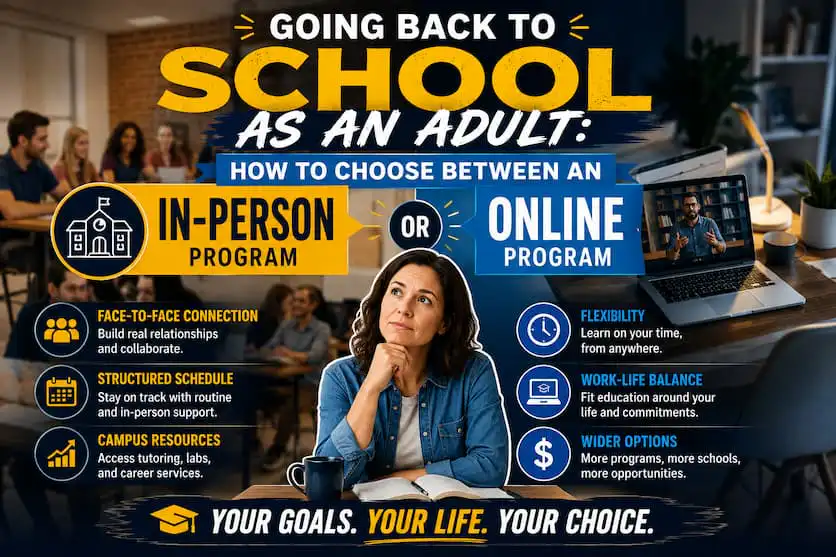
Going Back to School as an Adult: How to Choose Between an In-Person or Online Program
Choosing between an in-person or online education program is often as much about convenience and cost as it is about goals and learning preferences. Whether you’re completing your degree, hoping to advance your career or looking to enrich your life, the setting you choose can make a big difference in your experience. Here’s how to weigh the benefits and challenges of each option.
Start with your goal
Before you compare programs, you need to identify your goal. If you want career advancement, you may want a program that offers networking opportunities or career advising services. But if you need licensure or certification, you’ll need a program that meets the required standards.
Goals aren’t the only deciding factor. However, knowing what you want to achieve may keep you from choosing a program simply because it’s convenient or popular.
Compare the real costs
Make sure you compare all the expenses that may come with each program. That list might include:
- Tuition and fees
- Books and supplies
- Technology and internet costs
- Transportation, gas, parking or transit
- Childcare or dependent care
- Lost income from reducing work hours
- Housing or meals
Online programs are often less expensive because they help cut commuting and campus-related costs. But if a program takes longer to complete, charges higher fees or limits how much you can work, the costs may offset any savings.
Review your current budget
Understanding your monthly obligations can make it easier to estimate what you can afford. Take a look at your income and expenses, existing debt and emergency savings. If your budget feels tight, a debt consolidation loan may help lower your monthly payments, depending on your situation.
While a loan doesn’t make school less expensive, having just one payment to track may make it easier to budget for books and tuition. Try using a personal loan calculator to estimate the monthly cost of paying back the loan.
Consider your preferences
In-person programs may be a better fit if you prefer hands-on experiences or live discussions. Online courses could appeal to you if you like absorbing information through reading, recorded lectures and independent study.
Your learning preferences matter, but weigh them against other needs. You might prefer face-to-face instruction, but work commitments may mean you need the flexibility of an online program.
When an online program may make sense
An online program may be the right choice if:
- You need flexibility. Many online programs let you study on your own schedule. Some may even be self-paced, letting you decide how many learning modules to complete at a time.
- You live far from campus. With an online program, you don’t spend additional time commuting to class.
- You’re comfortable managing deadlines independently. Online classes require self-discipline and initiative.
- The program is only available outside your area. Some online programs give you access to opportunities that might otherwise require you to move.
- You have reliable internet and technology. The cost of an online program may increase if you don’t already have these.
People often choose online learning for the convenience, but it usually works best when they have the tools and motivation to keep moving forward.
When an in-person program may make sense
An in-person program may be a better fit if :
- You learn best with face-to-face interaction. In-person instruction helps some people focus and can provide immediate feedback and stronger collaboration.
- You need to complete labs, clinical hours or studio work. Certain types of learning require hands-on training that may be difficult or impossible to complete fully online.
- You prefer more structure and accountability. Going to class on a regular schedule helps some people stay on track.
- You want to take advantage of campus resources. In-person programs usually offer easier access to career services, tutoring, advising, libraries or campus life.
- Your home environment makes studying difficult. If you don’t have reliable internet access or a quiet place to study, campus spaces can make it easier to focus.
In-person learning may requires time on campus, but the structure, support and hands-on experience can make it worthwhile.
Should you consider a hybrid program?
A hybrid program may be a practical middle ground if you want flexibility and face-to-face instruction. Many hybrid programs offer online components, such as lectures and readings you complete on your schedule, plus required attendance for in-person components, such as scheduled workshops or labs. Some might also offer live instruction through video conferencing platforms.
Before choosing a hybrid program, make sure you understand which parts are online and which are in person. That can help you decide whether the format offers enough flexibility while still providing the structure and interaction you want.
Pick the program that supports your goals
Going back to school as an adult can be an enriching experience, but it’s important to choose a program that fits your needs and wants. The right format can help you achieve objectives — whether it’s online, in-person or somewhere in between. When you consider your goals, learning preferences and budget, you can find a program that supports both your education and daily life.

Table of Contents