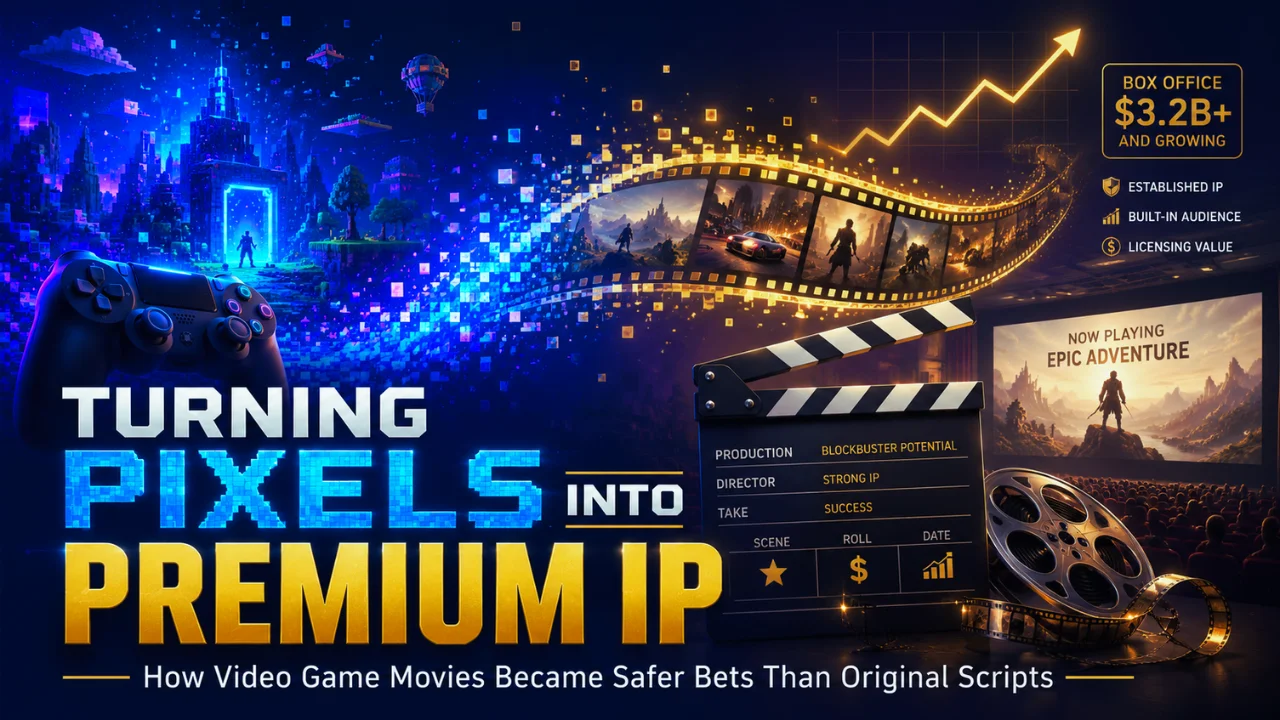
How Video Game Movies Became Safer Bets Than Original Scripts
This article explains why Hollywood is leaning more heavily into video game movies rather than betting solely on original scripts. It breaks down the money behind gaming IP, including licensing, ownership deals, royalties, brand equity, streaming rights, celebrity wealth, and the risks that still come with adapting beloved games.
A decade ago, video game movies were treated like risky experiments. Today, they sit near the center of Hollywood money.
The reason is not just nostalgia. It is economics. Studios are chasing recognizable characters, built-in fan communities, global merchandise potential, and intellectual property that can stretch across films, games, streaming, toys, music, and theme parks. That is why video game movies have become safer bets than original scripts in a market where theatrical attention is harder to earn, and marketing costs keep rising.
Original movies still matter. Some still break through. But from a business perspective, a popular game franchise gives studios something an unknown script usually cannot offer on day one: audience awareness before the trailer even drops.
Why This Celebrity Wealth Trend Matters Now?
Gaming has become too big for Hollywood to ignore. Newzoo reported that the global games market reached $201.6 billion in 2025, while ESA data shows more than 205 million Americans play video games, with players spread across age groups rather than limited to teenagers. That gives studios access to a massive audience base with emotional memory already attached to characters, worlds, and stories.
That matters for Hollywood money because awareness is expensive. A studio launching an original script has to teach audiences what the story is, why they should care, and why it deserves a theater ticket. A game adaptation starts with existing brand equity.
For celebrities, this shift can also be useful. Actors who join successful gaming franchises may gain more than a paycheck. They can benefit from global exposure, future sequels, voice work, convention visibility, endorsement deals, and the broader creator economy around fan communities. That does not mean every cast member receives ownership or royalties. Most do not unless their contract says so. But being attached to premium IP can raise cultural relevance, which often feeds other business ventures.
How Video Game Movies Became Safer Bets Than Original Scripts
The phrase “safer bet” does not mean guaranteed success. It means the project starts with more commercial signals than a completely unknown story.
A game franchise can offer:
| Wealth Driver | How It Works | Why It Matters |
|---|---|---|
| Box Office | Ticket sales from theatrical release | Creates the first major revenue event |
| Licensing Deals | Paid use of game characters and worlds. Let’s | s IP owners earn without fully operating the film |
| Royalties | Payments tied to use, sales, or rights agreements | Can support long-term income |
| Streaming Rights | Sale or licensing of post-theatrical viewing rights | Adds revenue after cinemas |
| Merchandise | Toys, apparel, collectibles, books, and tie-ins | Extends the movie beyond the screen |
| Sequels and Spin-offs | Follow-up films, series, or related content | Turns one hit into a franchise system |
| Game Sales Lift | Renewed interest in the original games | Helps the IP owner beyond film revenue |
The strongest gaming adaptations work because they are not just movies. They are attention engines.
The Super Mario Bros. Movie is the clearest modern example. Box Office Mojo lists the film’s worldwide box office at about $1.36 billion, and Nintendo later said its mobile and IP-related business rose sharply in the quarter after the film, helped by royalties and visual content income tied to the movie.
That is the real business lesson. The film created revenue, but it also refreshed Mario as a global consumer brand.
Salary Versus Ownership
For actors, directors, and producers, salary is the immediate payment. Ownership is different.
A celebrity can be paid well for acting in a video game movie without owning the underlying IP. The true long-term wealth usually belongs to the company or rights holder that controls the characters, publishing rights, trademarks, and licensing structure.
That is why ownership deals are so powerful. Nintendo’s official announcement for the live-action Legend of Zelda film said the project would be co-financed by Nintendo and Sony Pictures, with more than 50 percent financed by Nintendo. It also said Sony would handle worldwide theatrical distribution. That kind of structure shows how an IP owner can stay deeply involved rather than simply renting out its brand.
Brand Equity and Audience Trust
A strong game brand carries emotional trust. Fans know the world. They know the rules. They know the characters.
That trust can lower marketing friction, but it also raises expectations. A bad adaptation does not just disappoint moviegoers. It can anger the core audience that made the property valuable in the first place.
This is why studios increasingly involve game creators, publishers, and franchise guardians. The closer the adaptation feels to the spirit of the game, the more likely fans are to treat it as an extension rather than a cash grab.
The Business Model Behind the Money
A video game movie can earn from several layers. Theatrical box office is only the headline.
After cinemas, money may come from premium video on demand, streaming rights, pay television windows, physical media, airline licensing, international distribution, soundtrack use, merchandise, toys, apparel, books, collectibles, and renewed game sales.
That is why Hollywood money follows IP. A successful original script may earn well once. A successful gaming franchise can become a repeatable business model.
A Minecraft Movie shows why studios are excited. Box Office Mojo lists it among the top worldwide releases of 2025 with about $960 million globally, turning a game brand built around creativity and user participation into a major theatrical event.
The same logic applies to lower-budget examples. Five Nights at Freddy’s had a much smaller production profile than many tentpoles, yet Box Office Mojo lists it at about $291 million worldwide. In comparison, IMDb lists an estimated production budget of $20 million. That gap explains why horror gaming IP is especially attractive when costs are controlled.
Why Traditional Net Worth Estimates Often Miss the Full Picture?
Celebrity net worth estimates often focus on visible income: salaries, endorsement deals, real estate, and public business ventures. But entertainment wealth is rarely that simple.
A star may earn upfront salary, residual income, bonuses, or backend compensation. A producer may earn fees plus participation. An IP owner may earn licensing revenue, royalties, merchandising income, and equity-like upside through financing arrangements.
Private investments make the picture even harder to verify. So do taxes, manager fees, agent commissions, debt, divorce settlements, production overhead, and undisclosed ownership stakes.
That is why celebrity wealth should be framed carefully. A person appearing in a billion-dollar video game movie is not automatically a billionaire. The biggest financial prize usually goes to the rights holders, financiers, distributors, and producers who control the deal structure.
Examples That Show How This Works
The modern gaming movie boom is built on a few visible wins.
The Super Mario Bros. Movie proved that a family-friendly game adaptation could become a global box office giant while supporting Nintendo’s broader IP strategy. Nintendo later reported that IP-related income still included categories such as movies, videos, smart-device content, royalties, and official store merchandise sales, showing how film fits inside a wider brand machine.
A Minecraft Movie showed how a sandbox game with no traditional movie plot could still translate into mass-market cinema because the brand already stood for creativity, social play, and digital childhood memories for millions of fans.
Five Nights at Freddy’s showed the power of fan-first horror. It did not need to look like a four-quadrant blockbuster to become financially meaningful. It needed a recognizable concept, controlled spending, and an audience that felt a sense of ownership over the lore.
These examples do not prove that every game adaptation will win. They prove that the right IP, cost structure, creative approach, and release strategy can make video game movies unusually attractive compared with unknown scripts.
The Risks Behind Video Game Movie Ventures
The risk is still real.
Borderlands is a useful cautionary example. Variety reported that the $100 million-budgeted film was expected to lead to a $30 million write-down for Lionsgate, while other coverage noted its weak opening against stronger competition.
That failure highlights a key rule: recognition is not the same as audience trust. A known game title can help open doors, but weak creative choices, poor timing, tonal confusion, overexpansion, or fan rejection can damage the upside.
The biggest risks include:
Poor product-market fit
A game may be popular because it is fun to play, not because it naturally works as a movie.
Fan backlash
Core fans can reject casting, story changes, visual design, or tone if the film feels disconnected from the source.
Licensing complexity
Rights can involve publishers, developers, distributors, merchandise partners, music owners, and international deals.
Celebrity mismatch
A famous actor does not guarantee sales. Star power is most effective when it supports the IP rather than distracts from it.
Franchise fatigue
If studios flood the market with adaptations, audiences may become selective fast.
What does this reveal about modern celebrity wealth?
Celebrity wealth is no longer just about salary, box office bonuses, music sales, or sports contracts. It is increasingly shaped by ownership, timing, distribution, IP leverage, and brand equity.
For actors, game movies can create visibility. For producers, they can become repeat business. For studios, this reduces the uncertainty around audience awareness. For game companies, they create a path to royalties, licensing deals, merchandise, streaming rights, and renewed game engagement.
The bigger lesson is simple: the most valuable entertainment assets are no longer just performances. They are worlds. A world can be rebooted, expanded, licensed, streamed, sold, and rediscovered by new generations.
That is why video game movies are now part of the premium IP economy. The winners are not only the stars on the poster. They are the companies and creators who control the pixels before Hollywood turns them into a global screen business.
FAQs
Why did video game movies become safer bets than original scripts?
Video game movies became safer bets because they often start with built-in audiences, recognizable characters, existing brand equity, and merchandising potential. That does not guarantee success, but it gives studios more commercial signals than a fully original story.
How do celebrities make money from video game movies?
Celebrities may earn salaries, bonuses, residuals, or backend compensation depending on their contracts. Some also benefit indirectly through higher visibility, endorsement deals, convention appearances, voice work, and future franchise opportunities.
Do actors own a stake in video game movie franchises?
Usually not. Most actors are paid for their role unless a specific equity, producer, royalty, or backend deal is negotiated. The largest long-term value usually belongs to the IP owner, studio, distributor, and financiers.
Why do some video game movies fail?
They fail when the creative execution does not match audience expectations. Common problems include weak scripts, poor casting fit, confusing tone, high budgets, bad timing, and changes that alienate the original fan base.
Why do celebrity net worth estimates miss gaming IP income?
Net worth estimates often miss private investments, undisclosed backend deals, licensing income, royalties, taxes, debt, management fees, and ownership structures. Public data rarely shows the full financial picture.
Explore more entertainment business breakdowns to understand how celebrity wealth, Hollywood money, gaming IP, and ownership deals are reshaping modern fame.

Table of Contents