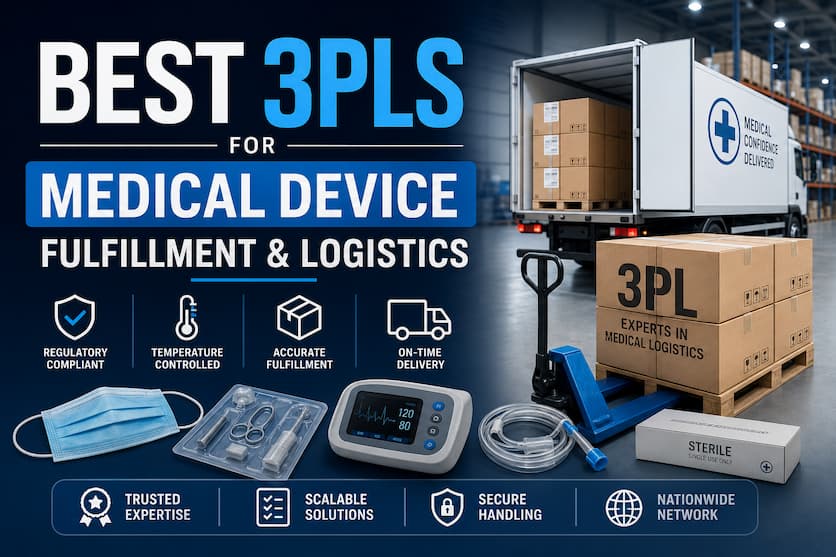
Best 3PL Companies for Medical Device Fulfillment and Logistics
Medical device fulfillment isn’t a space where you can afford guesswork. The best 3PL companies handling this category need to do more than pick, pack, and ship. They need to protect product integrity, maintain precise inventory records, and keep orders moving without errors. Scaling during peak demand, getting real-time visibility into stock, and keeping fulfillment costs predictable are real pressure points here. After reviewing providers across capabilities, infrastructure, and industry fit, this guide breaks down the top options worth serious consideration.
The research approach for this ranking
Publicly available information drove the evaluation here, pulling from review platforms, case studies, logistics directories, and official company websites. Only providers with a demonstrated track record in fulfillment operations made the cut. Newer or unverified entrants without documented results weren’t included.
→ See the full research breakdown
- Rush Order – Best for e-commerce and retail fulfillment at scale
- eFulfillment Service – Best for ecommerce fulfillment for small to mid-size businesses and seasonal retailers
- Fidelitone – Best for multi-industry supply chain and order fulfillment
- Fulfyld – Best for e-commerce fulfillment and order management
- ShipMonk – Best for DTC and B2B ecommerce fulfillment
Why 3PL Companies Matter for Your Business
Medical device fulfillment sits at the intersection of strict accuracy requirements and real operational pressure. When your 3PL gets an order wrong, it’s not just a customer service headache. It can affect patient outcomes or trigger costly returns.
The challenge most operations teams face isn’t finding a 3PL. It’s finding one that can scale during peak demand without letting order accuracy slip, and one that gives you genuine real-time inventory visibility instead of end-of-day batch updates that leave you guessing.
A well-chosen 3PL partner changes those outcomes a lot. Strong providers bring the infrastructure to maintain a high order accuracy rate, a reliable on-time shipping rate, and a consistent inventory accuracy percentage across every sales channel.
That kind of performance is rare. And it’s exactly what separates the right fit from a costly experiment.
Top 5 3PL Companies Breakdown and Comparison
Note: All data in this table is sourced from review platforms and the official websites of the listed companies.
| Company Name | Years Operating | Team Size | Headquartered In |
| Rush Order | Est. 1989 | 201-500 | Gilroy, CA |
| eFulfillment Service | Est. 2001 | 51-200 | Traverse City, MI |
| Fidelitone | Est. 1929 | 501-1,000 | Wauconda, IL |
| Fulfyld | Est. 2016 | Not disclosed | Huntsville, AL |
| ShipMonk | Est. 2014 | 2,000+ | Fort Lauderdale, FL |
Rush Order – Best for E-Commerce and Retail Fulfillment at Scale
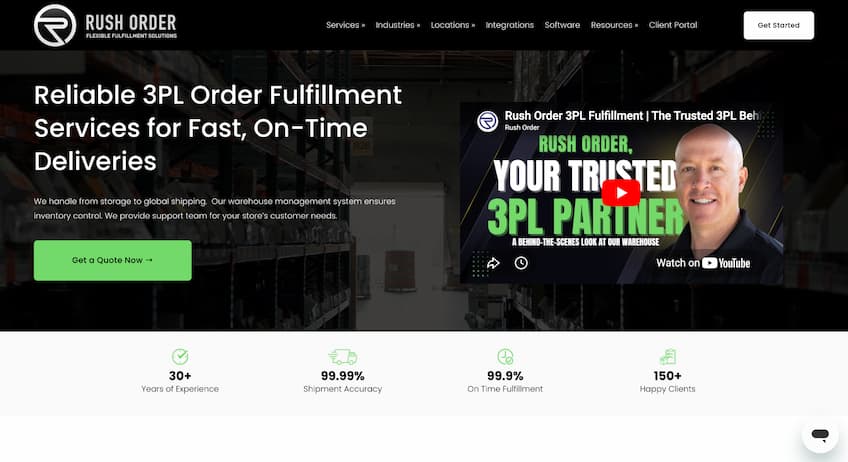
What Does Rush Order Do?
Rush Order has been running global fulfillment operations since 1989, covering 13 locations across North America, Europe, Asia, and Australia. Their work spans B2C order fulfillment, retailer EDI, customer support, and back-office operations. For businesses that need tight inventory control across multiple sales channels, their multi-checkpoint barcode verification system and real-time dashboard make a real difference. Teams that need order fulfillment for medical supplies handled accurately at scale will find their infrastructure built for exactly that kind of operational demand.
Why Does Rush Order Stand Out for 3PL Companies?
Human error in high-stakes fulfillment is where most providers quietly struggle. Rush Order’s multi-checkpoint barcode verification system tackles that problem at the process level, not after the fact. Their same-day shipping cutoff for orders placed before 2 pm, combined with connections across Shopify, WooCommerce, Amazon, and NetSuite, means their accuracy doesn’t slow down the operation.
Summary of Real User Reviews:
Clients consistently highlight Rush Order’s ability to support business scaling without demanding heavy internal management on the client side. The feedback points to real confidence in their fulfillment consistency during growth periods, which is harder to find than most people expect.
eFulfillment Service – Best for Small to Mid-Size Businesses and Seasonal Retailers
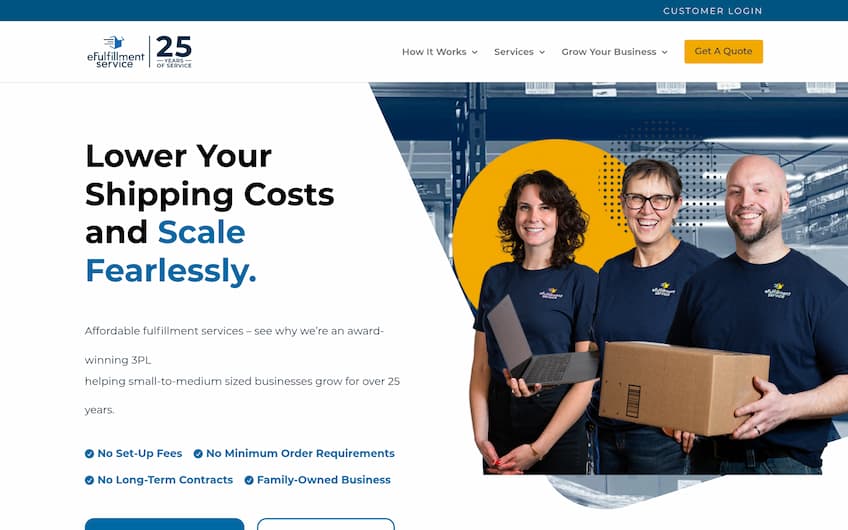
What Does eFulfillment Service Do?
eFulfillment Service has been handling ecommerce fulfillment since 2001 as a family-owned operation based in Traverse City, Michigan. They cover storage, order processing, shipping, and returns through a web-based Fulfillment Control Panel that keeps clients informed about inventory and order status in real time. With connections across 40+ shopping cart platforms and no minimum order volumes or storage requirements, they’re built to work for businesses at almost any stage of growth.
Why Does eFulfillment Service Stand Out for 3PL Companies?
The absence of minimum order requirements removes a genuine barrier that stops early-stage and seasonal businesses from accessing reliable fulfillment. That flexibility, combined with over two decades of operational consistency, builds the kind of trust that keeps clients around for 15 years or more.
Summary of Real User Reviews:
eFulfillment Service holds an A+ rating with the Better Business Bureau, and the review patterns reflect that. Clients report strong growth supported by eFS infrastructure, with one business growing monthly order volume by over 150% across two years. That’s the kind of result that speaks for itself.
Fidelitone – Best for Multi-Industry Supply Chain Services
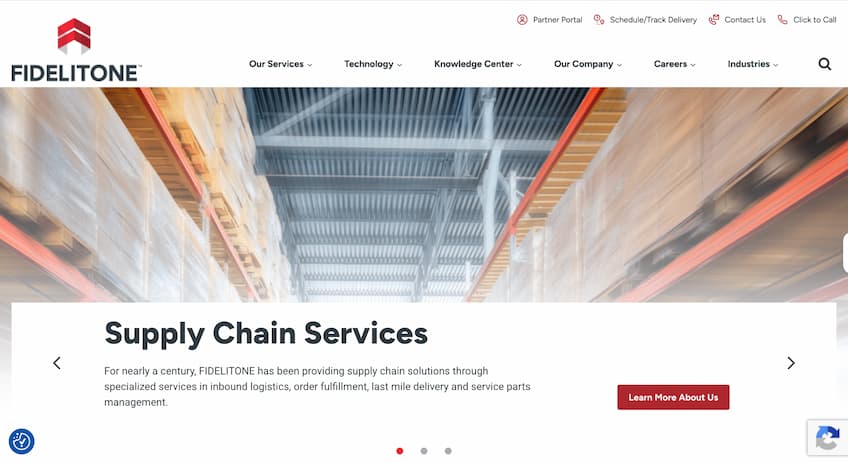
What Does Fidelitone Do?
Founded in 1929, Fidelitone brings nearly a century of supply chain experience to inbound logistics, order fulfillment, last-mile delivery, and service parts management. Operating across 64 locations with roughly $259M in annual revenue, they work with clients who need serious geographic coverage and proven operational depth. Their Partner Portal gives clients real-time visibility into inventory, orders, and analytics, with documented fill rates sitting between 95-99% across their network.
Why Does Fidelitone Stand Out for 3PL Companies?
Geographic gaps in fulfillment coverage quietly increase average delivery times and hurt last-mile performance. Fidelitone’s 64-location network is built to close those gaps. Their documented first-time repair rates exceeding 90% show that service quality holds up across a wide operational footprint, which is genuinely hard to maintain at that scale.
Summary of Real User Reviews:
Fidelitone’s industry recognition tells a clear story. Named the 2019 Home Delivery Carrier of the Year by DHL and recognized as a top 3PL by Multichannel Merchant for both 2021 and 2022, their reputation in the sector is well-established. Sustained consistency across multiple industries is their strongest trait.
Fulfyld – Best for E-Commerce Fulfillment and Order Management
What Does Fulfyld Do?
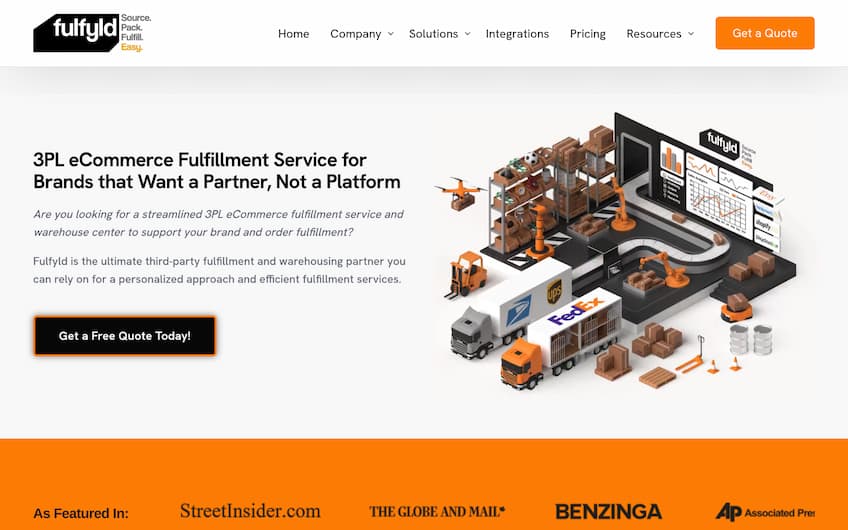
Fulfyld launched in 2016 with a focused mission: e-commerce fulfillment across the US and Canada, and nothing else. Operating a 130,000 square foot warehouse in Madison, Alabama, they handle product sourcing, packaging design, order fulfillment, and door-to-door shipment. Their software connects with over 100 shopping carts and online marketplaces, and they’ve invested in InVia Robotics automation to keep accuracy high and fulfillment cycles short (not a small investment for a provider of their size).
Why Does Fulfyld Stand Out for 3PL Companies?
Fulfillment costs can become unpredictable fast when pricing structures are complex. Fulfyld’s flat-rate model with no minimum order volumes directly addresses that. Their exclusive focus on e-commerce means their automation and account management are purpose-built for that channel, rather than spread thin across unrelated logistics segments.
Summary of Real User Reviews:
Public reviews on Fulfyld are limited, but their client case studies point to strong delivery conditions and positive consumer feedback at the end of the chain. The dedicated account management during the setup phase gets mentioned as a genuine differentiator, and from what the available data shows, clients feel supported from day one.
ShipMonk – Best for DTC and B2B Ecommerce Fulfillment
What Does ShipMonk Do?
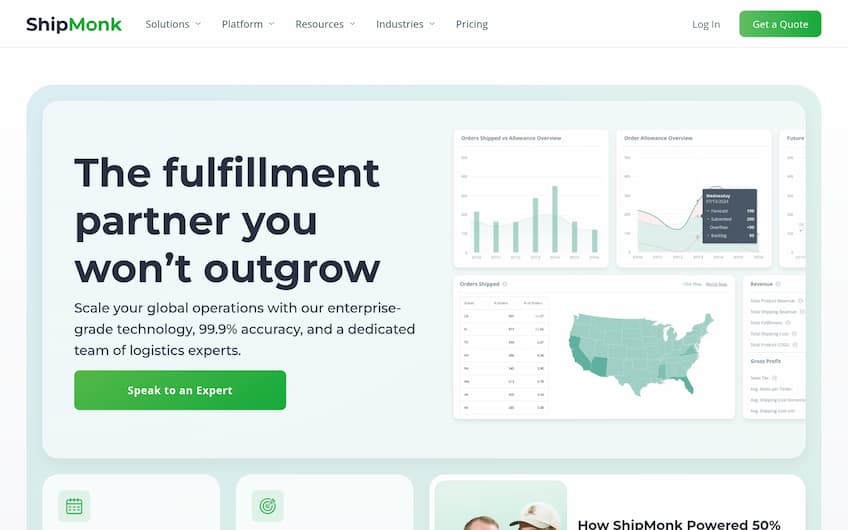
ShipMonk has grown fast since 2014, now running 12 facilities across the US, Canada, Mexico, and Europe with a team of over 2,000 people. They cover order fulfillment, inventory management, shipping management, and warehouse management for ecommerce businesses processing 500 or more orders monthly. Their Virtual Carrier Network pulls negotiated shipping rates across multiple carriers, and their systems handle high SKU counts and complex kitting without losing accuracy (they document 99.9% accuracy across their network).
Why Does ShipMonk Stand Out for 3PL Companies?
Carrier rate volatility is a real margin problem for ecommerce operations. ShipMonk’s Virtual Carrier Network gives clients access to shipping rates that most brands couldn’t negotiate on their own. Five consecutive years on the Inc. 5000 list and $365M in funding back up what their performance numbers suggest: this is a provider that keeps delivering under growth pressure.
Summary of Real User Reviews:
ShipMonk earns consistent recognition across major review and awards platforms, including top honors in 25 Gartner Digital Markets award categories and four consecutive years as Company of the Year from the Business Intelligence Group. Reviewers point to reasonable entry-level pricing and flexible pay-per-use models as practical advantages. The award volume alone is impressive for a provider that’s only been operating since 2014.
Research Methodology and Selection Process
The goal of this ranking was straightforward: identify providers that genuinely perform in fulfillment operations, not just those with the loudest presence online.
Initial Data Collection
The process started by building a broad longlist from multiple sources, including logistics industry directories, third-party review platforms, published case studies, and direct research on provider websites. The aim was to cast a wide net before narrowing down, capturing both well-known names and providers with strong track records that don’t always dominate search results. Entries were documented based on publicly available service information, team size, geographic footprint, and stated specializations.
Shortlisting Phase
From that initial pool, providers without verifiable operational history or documented fulfillment track records were removed. Review patterns across platforms were analyzed for consistency. Providers with a handful of reviews concentrated in a short window raised questions about reliability and weren’t carried forward. What remained were companies with genuine client feedback spread across meaningful time periods, pointing to sustained performance rather than a single good stretch.
Verification of Claims
Each provider’s stated capabilities were cross-checked against what clients actually reported experiencing. Fill rates, shipping accuracy, and connection depth are common claims in 3PL marketing. Where those claims couldn’t be corroborated through real-world client feedback, case studies, or documented results, they were treated with appropriate skepticism. The comparison focused on providers where claims and outcomes aligned closely enough to build confidence.
Authority and Industry Contribution Layer
Published awards, mentions in logistics trade publications, and recognition from established industry bodies were factored into the final evaluation. These signals don’t tell the whole story, but consistent recognition across multiple years from respected sources does suggest operational reliability that goes beyond a single strong performance period. Providers like Fidelitone and ShipMonk showed particularly clear patterns here.
3PL Companies-Specific Evidence
Dedicated service pages for medical device and healthcare-related fulfillment, verified client reviews from operations managers and supply chain teams, and relevant case studies were weighted heavily in the final selection. Providers with general fulfillment pages but no evidence of handling specialized product categories were noted as lower-fit options for this specific context. Companies that showed documented results in accuracy-sensitive fulfillment scenarios carried more weight in the final ranking.
How to Choose the Right 3PL Companies
Picking a 3PL for medical device or specialized fulfillment comes down to a few factors that matter more than price alone.
- Industry/Domain Experience: Look for providers with a documented history of handling products in your category. General warehousing experience doesn’t automatically translate to accuracy-sensitive fulfillment. Ask for case studies from similar clients.
- Features and Service Capabilities: Real-time inventory visibility, barcode verification, and multi-channel connection aren’t extras in this space. They’re table stakes. Confirm what’s built into the base offering versus what costs more.
- Pricing Structure: Flat-rate models give you predictability. Per-transaction models can spiral during peak periods. Get a full breakdown of how costs scale before committing.
- Results Measurement: Ask how they report on order accuracy rate, on-time shipping rate, and inventory accuracy percentage. Providers that track and share these metrics openly are the ones who know they’re performing well.
- Industry Knowledge and Compliance: Specialized product categories come with handling requirements. Confirm that the provider understands DOT, IATA, C-TPAT, FDA, and customs compliance standards relevant to your product type before signing anything.
Bottom Line
Choosing the right 3PL partner for medical device fulfillment isn’t just a logistics decision. It’s a business continuity decision. The providers in this list stand out because they bring real infrastructure, documented accuracy, and the kind of visibility that keeps operations running without surprises. As fulfillment demands grow and product categories get more specific, the gap between a generalist warehouse and a fit-for-purpose partner will only get wider.
Table of Contents