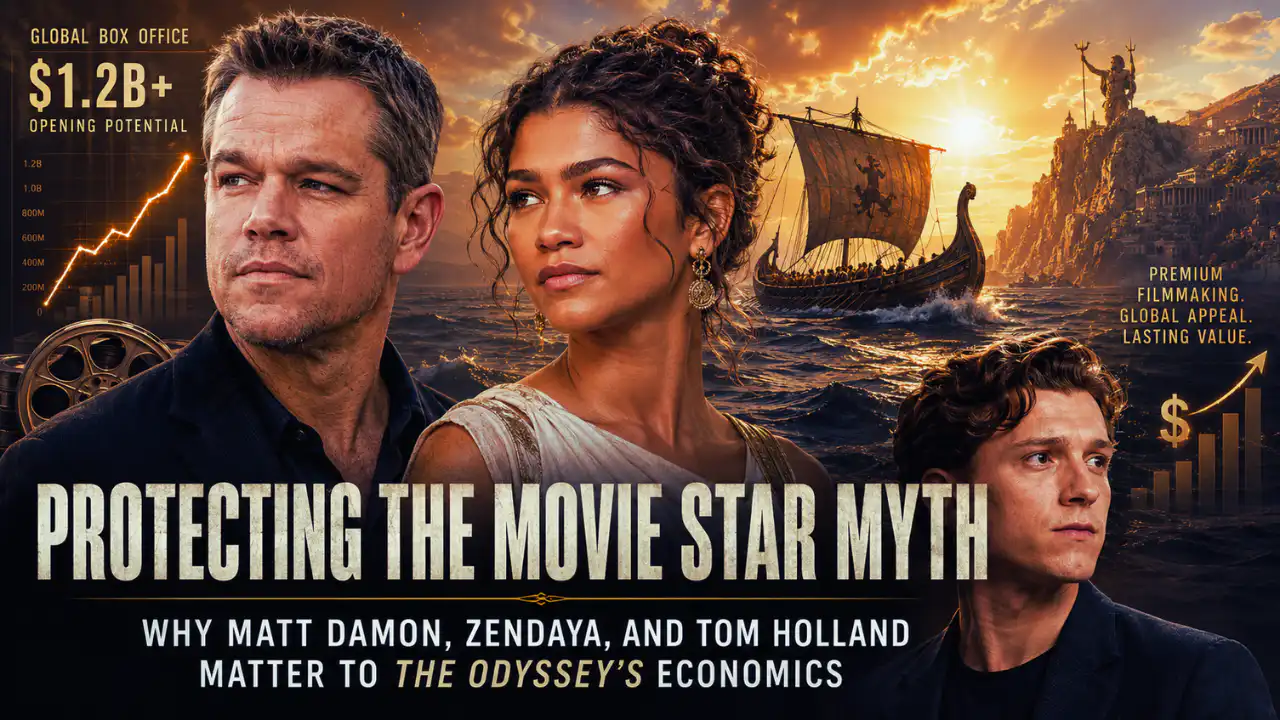
Matt Damon, Zendaya, Tom Holland, and The Odyssey Economics
This article explains how Matt Damon, Zendaya, and Tom Holland add commercial value to Christopher Nolan’s The Odyssey beyond simple casting. It looks at Hollywood money, brand equity, audience trust, theatrical economics, celebrity wealth, and why net worth estimates rarely capture the full business picture.
A movie star used to be someone who could open a film on their name alone. That myth has been weakened by franchises, streaming, algorithms, and superhero brands bigger than any one actor. Yet The Odyssey is testing whether the old idea still has financial power.
That is why the Odyssey economics matter. Christopher Nolan’s film is not only selling Homer, IMAX, and prestige filmmaking. It is also selling Matt Damon, Zendaya, and Tom Holland as different kinds of audience insurance. Damon brings adult credibility. Zendaya brings cultural heat. Holland brings global franchise familiarity. Together, they help turn a literary epic into a modern entertainment business event.
Official materials position The Odyssey as a July 17, 2026, theatrical release shot entirely with IMAX film cameras, while NBCUniversal describes it as a large-scale cinematic event produced by Emma Thomas and Christopher Nolan under Syncopy.
Why This Celebrity Wealth Trend Matters Now?
Hollywood is trying to solve a difficult problem. Audiences still show up for event movies, but they are more selective about what deserves a theater ticket. A big cast can help, but only when the casting feels meaningful rather than decorative.
That is where Damon, Zendaya, and Holland become economic signals. They tell different audience groups that The Odyssey is not just a school-text adaptation. It is a premium theatrical product with recognizable faces, cultural relevance, and enough star power to justify attention.
This matters because the entertainment business is no longer built only around box office totals. A movie now creates value through theatrical revenue, premium formats, streaming rights, awards campaigns, social media conversation, international sales, licensing opportunities, and long-term library value.
Nolan also has recent proof that prestige can become commercial. Oppenheimer grossed more than $975 million worldwide, according to Box Office Mojo, despite being a three-hour R-rated historical drama. That result changed how the industry reads his brand. He is not just a director. He is a distribution asset.
The Business Model Behind The Odyssey Economics
The basic movie business starts with ticket sales, but the real model is layered. A theatrical release creates the first wave of revenue. Premium formats such as IMAX can raise average ticket value. Later windows can include digital rental, physical media, pay TV, streaming, international licensing, and library exploitation.
Universal’s own UK site notes that its content moves across theatrical exhibition, home entertainment, pay and free television, and subscription on-demand services. That is the bigger machine behind a major studio film.
For The Odyssey, the cast matters because stars can lower the psychological risk for audiences. A viewer may not know Homer deeply. They may not care about ancient Greek structure. But they may trust Damon in a serious lead role, follow Zendaya’s fashion and film choices, or connect Holland with blockbuster entertainment.
Salary Versus Ownership
Salary is upfront pay for acting work. It is usually the simplest form of income to understand, even if exact numbers are rarely public.
Ownership is different. Ownership means having a stake in an asset, production company, intellectual property, or backend participation that is tied to performance. Unless a deal is publicly confirmed, it is not safe to claim an actor has equity, royalties, or ownership in a specific film.
For The Odyssey, public reporting confirms the film is produced by Emma Thomas and Christopher Nolan under Syncopy, with Universal distributing. That does not mean every actor owns part of the project. Their value may still be enormous, but it may come through salary, career leverage, future deal-making power, endorsements, and increased brand equity.
Brand Equity and Audience Trust
Brand equity is the value attached to a name. For celebrities, it includes reputation, taste, fan loyalty, press appeal, and cultural meaning.
Damon’s brand signals to audiences that the film has old-school dramatic weight. Zendaya’s brand turns red carpets, interviews, fashion coverage, and social media into attention multipliers. Holland’s brand connects the film to a younger global audience familiar with franchise storytelling.
None of this guarantees sales. But in Hollywood money terms, it can improve awareness, reduce marketing friction, and make the movie feel like a must-see event rather than another expensive release.
Helpful Table
| Wealth Driver | How It Works | Why It Matters |
|---|---|---|
| Salary | Upfront payment for acting or creative work | Creates immediate income |
| Residuals | Payments from reuse, reruns, or certain distribution windows | Can support long-term earnings |
| Backend Deals | Compensation linked to performance or profits | It may become valuable if a film overperforms |
| Brand Equity | Commercial value of a celebrity’s public image | Helps convert fame into leverage |
| Endorsement Deals | Paid partnerships with brands | Turns public attention into marketing income |
| Licensing Deals | Paid use of name, image, likeness, or IP | Can create income without operating a full business |
| Ownership Deals | Equity in a company, production, or asset | Can build wealth if the asset grows |
Why Traditional Net Worth Estimates Often Miss the Full Picture?
Celebrity net worth estimates are popular because they reduce fame to a single number. The problem is that wealth is rarely that clean.
Public estimates may miss private investments, taxes, debt, management fees, profit participation, real estate structures, royalties, licensing deals, and undisclosed equity deals. They may also overstate wealth by treating gross earnings like take-home money.
For actors, a major film can create financial value without immediately appearing as confirmed wealth. A role in The Odyssey may increase negotiating power for future salary, backend terms, endorsement deals, producing opportunities, or business ventures. That is why celebrity wealth often grows through leverage as much as direct payment.
Examples That Show How This Works
The clearest recent comparison is Oppenheimer. Its theatrical success proved that an auteur-driven film could behave like a blockbuster when the packaging was right. The film combined Nolan’s reputation, a serious historical subject, premium-format urgency, a strong ensemble, awards momentum, and public conversation.
IMAX also became part of the value story. IMAX reported a record $1.28 billion global box office in 2025 and highlighted The Odyssey as the first theatrical feature shot entirely with IMAX film cameras in its 2026 slate.
Advance interest shows how format and filmmaker branding can create scarcity. The Guardian reported that early IMAX 1570 tickets for The Odyssey sold out around the world long before release, with select screenings becoming collector-like events for fans.
That is not only movie marketing—it is a luxury positioning.
The Risks Behind Celebrity Business Ventures
Star power can attract attention, but attention is not the same as conversion. A film can have famous actors and still underperform if the story, timing, reviews, price point, or audience mood fails.
The same is true in celebrity entrepreneurship. Fashion lines, restaurants, tequila brands, beauty brands, memoir deals, and streaming projects can struggle when the product-market fit is weak. Social media followers do not automatically become customers. A celebrity brand can also suffer from overexposure, poor management, licensing disputes, quality issues, or changes in public image.
For The Odyssey, the risk is different. The film must make an ancient story feel urgent without making it feel like homework. Nolan told Reuters that adapting Homer was challenging because epic poetry assumes audience familiarity, while a movie must work for both newcomers and people who already care about the source.
That is exactly why the cast matters. Stars become entry points.
What does this reveal about modern celebrity wealth?
Modern celebrity wealth is no longer just about salary. It is about ownership, distribution, timing, credibility, and cultural leverage.
Matt Damon, Zendaya, and Tom Holland matter to The Odyssey because they help protect the movie star myth at a time when Hollywood keeps asking whether stars still move markets. The answer is more complicated than yes or no.
A single actor may not guarantee a hit. But the right combination of actor, filmmaker, format, story, and release strategy can still create enormous economic force. In that sense, The Odyssey is not only a mythic adventure. It is a test of whether prestige, celebrity, and theatrical scarcity can still build Hollywood money in the franchise era.
FAQs
Why do Matt Damon, Zendaya, and Tom Holland matter to The Odyssey economics?
They represent different audience groups and different types of trust. Damon adds prestige credibility, Zendaya adds cultural relevance, and Holland brings blockbuster familiarity.
Do actors make money only from their salary?
No. Actors may earn through salary, residuals, backend deals, endorsements, licensing deals, producing work, and business ventures. Exact deal terms are often private.
What is brand equity in celebrity wealth?
Brand equity is the commercial value of a celebrity’s name, image, taste, reputation, and audience trust. It can help them secure better roles, partnerships, and ownership opportunities.
Why are celebrity net worth estimates often unreliable?
They often rely on public estimates and may miss taxes, debt, private investments, royalties, real estate, management costs, and undisclosed deal structures.
Can star power still sell movies?
Yes, but not by itself. Star power works best when paired with strong storytelling, smart distribution, clear positioning, good timing, and audience trust.
For more sharp breakdowns of celebrity wealth, Hollywood money, ownership deals, and entertainment business strategy, explore our latest celebrity net worth and media economics stories.

Table of Contents