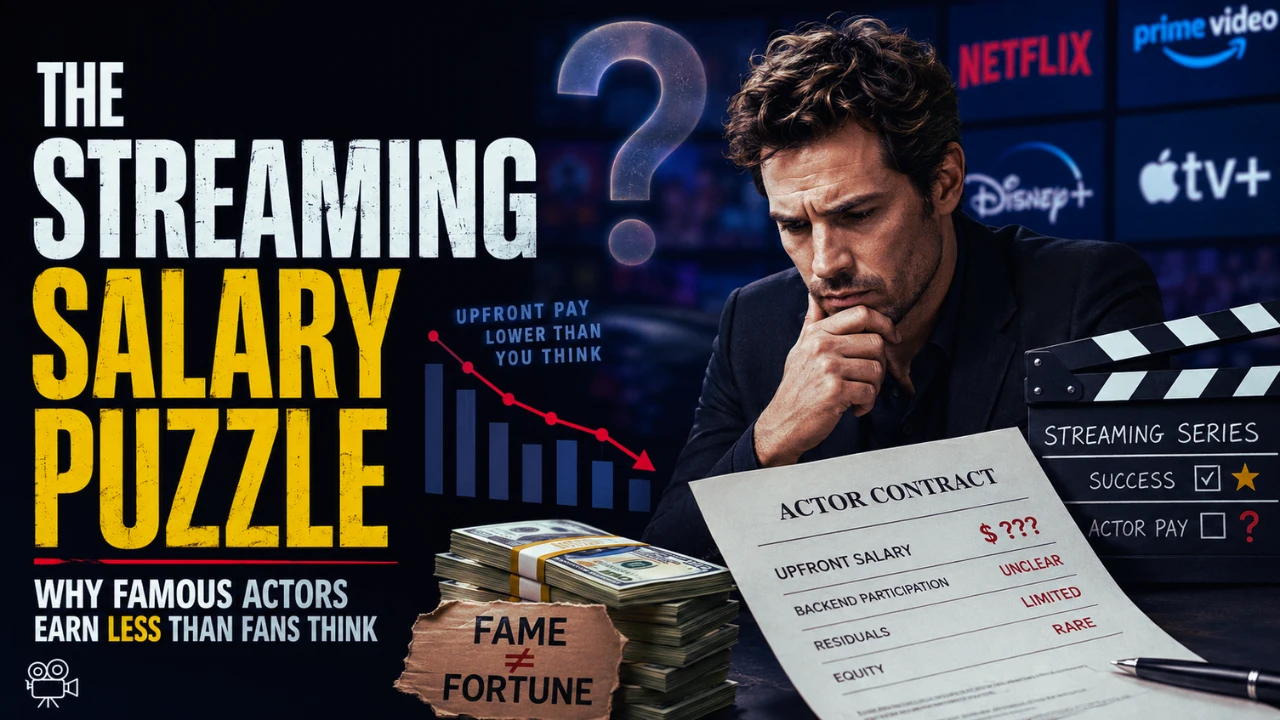
Streaming Salary Puzzle for Famous Actors
For decades, Hollywood trained audiences to think in blockbuster numbers. If an actor starred in a hit film or dominated a streaming chart, fans assumed they were walking away with tens of millions.
Reality is often more complicated.
The streaming salary puzzle has become one of the entertainment industry’s biggest misconceptions. While some A-list stars still command enormous fees, many actors working on successful streaming projects earn less upfront than audiences expect. At the same time, others quietly build wealth through production companies, licensing deals, endorsements, and ownership opportunities that rarely make headlines.
As streaming continues to reshape Hollywood money, understanding how actors are paid tells us a lot about modern celebrity wealth and the changing economics of entertainment.
Why This Celebrity Wealth Trend Matters Now?
Streaming changed more than how people watch television. It changed how Hollywood values talent.
Traditional film economics were relatively straightforward. Studios invested in a project, theatres generated ticket sales, and successful films could create years of residual income through home video, cable licensing, and syndication.
Streaming disrupted that model.
Today, a series can become a global phenomenon overnight, yet audiences may never know how much revenue it actually generated. Unlike box office receipts, subscriber growth and viewing data are often closely guarded by streaming companies.
That lack of transparency affects everyone involved, including actors.
Industry observers have noted that performers increasingly negotiate for guaranteed compensation because backend participation can be harder to structure when success metrics remain private. The 2023 Hollywood labor disputes also brought renewed attention to residual income and the challenges performers face in the streaming era.
Celebrity wealth is now influenced by much more than acting credits. Production ownership, business ventures, private investments, and creator economy opportunities often matter just as much.
The Business Model Behind the Money
Streaming platforms operate differently from traditional studios.
Their primary goal is not selling individual tickets. Instead, they focus on subscriber retention, international expansion, and keeping audiences engaged over time. That changes how talent is compensated.
An actor’s pay package may include:
| Wealth Driver | How It Works | Why It Matters |
|---|---|---|
| Salary | Upfront payment for acting work | Creates immediate income |
| Residuals | Payments tied to reuse or contractual agreements | Supports long-term earnings |
| Equity | Ownership in a business or production entity | Can appreciate over time |
| Licensing | Paid use of name or likeness | Generates additional revenue streams |
| Brand Deals | Endorsements and partnerships | Converts fame into marketing value |
| Producing Credits | Participation behind the camera | Adds influence and earning potential |
Salary Versus Ownership
A £2 million salary sounds impressive. Yet ownership can ultimately prove more valuable.
Many high-profile actors have established production companies to retain greater control over their projects. By producing content, they may benefit from licensing arrangements, future distribution opportunities, or additional fees tied to development and production.
Actors such as Reese Witherspoon and Margot Robbie have publicly demonstrated how producing can become an important part of a long-term wealth strategy.
Fans often focus on salaries because they are easy to understand. Ownership, however, tends to be where lasting wealth is built.
Brand Equity and Audience Trust
A celebrity’s financial value extends beyond their screen time.
An actor with a loyal audience may attract endorsement deals, podcast partnerships, publishing opportunities, and investments in consumer brands. Their reputation effectively becomes an asset.
That does not guarantee success. Brand equity is fragile.
Public image can shift quickly, and consumer trust is difficult to rebuild once lost. Still, for many celebrities, their name carries financial value that extends far beyond acting contracts.
Why Traditional Net Worth Estimates Often Miss the Full Picture?
Celebrity net worth remains one of the internet’s favorite topics, but estimating wealth is notoriously difficult.
Public databases rarely have access to:
- Private investments
- Real estate holdings
- Tax obligations
- Management and legal expenses
- Undisclosed licensing agreements
- Equity compensation
- Debt and liabilities
- Trust and estate structures
An actor reported to have earned millions from a streaming series may have significantly lower take-home income after taxes, commissions, agents’ fees, and business expenses.
Conversely, someone earning a modest salary could possess valuable ownership interests in production companies or startups that are not publicly disclosed.
This is why celebrity wealth estimates should be viewed as approximations rather than confirmed financial statements.
That Shows How This Works
Several public examples highlight the changing entertainment business model.
Ryan Reynolds is frequently discussed not only for his acting career but also for his business activities. His investments and entrepreneurial ventures have arguably become as significant to his public financial profile as his film work.
Similarly, Issa Rae leveraged creative success into broader ownership opportunities through producing and media development.
Meanwhile, performers involved in major streaming hits have openly discussed concerns surrounding residual income. During recent industry negotiations, actors and writers highlighted how streaming economics differ substantially from traditional television compensation.
The lesson is straightforward: visibility does not always equal profitability.
An actor appearing on one of the world’s most-watched streaming shows may earn less than a lesser-known producer with ownership stakes in multiple projects.
The Risks Behind Celebrity Business Ventures
Celebrity entrepreneurship is not a guaranteed path to wealth.
Many ventures struggle because of:
- Weak product-market fit
- Poor management decisions
- Overexpansion
- Licensing complications
- Audience fatigue
- Economic downturns
- Reputational damage
- Increased competition
The entertainment business rewards relevance, but relevance can be temporary.
A celebrity-backed beauty brand or media company might attract attention during launch, yet sustaining growth requires strong operations, product quality, and disciplined leadership.
History is filled with celebrity restaurants, fashion labels, and media ventures that failed despite substantial publicity.
The same principle applies to streaming careers. Today’s breakout star may not necessarily become tomorrow’s business success story.
What This Reveals About Modern Celebrity Wealth?
The streaming salary puzzle reflects a broader shift across Hollywood.
Acting salaries remain important, but they are increasingly just one piece of a much larger financial picture. Ownership deals, intellectual property, licensing arrangements, and strategic investments now play a central role in how celebrity wealth is created.
Hollywood money has become less predictable and, in many ways, more entrepreneurial.
The celebrities building sustainable fortunes are often those who understand leverage. They use fame to create opportunities beyond the screen, whether through production companies, consumer products, publishing, or investments.
For readers fascinated by celebrity net worth, that may be the most important takeaway of all.
Success in modern entertainment is no longer defined solely by how much someone gets paid for a role. It is increasingly determined by what they own when the cameras stop rolling.
Conclusion
The streaming era has challenged many assumptions about fame and fortune. While some actors continue to secure lucrative deals, many earn less upfront than audiences expect, particularly when compared with the blockbuster headlines of previous decades.
At the same time, the expansion of ownership opportunities, business ventures, and licensing strategies has created entirely new pathways to wealth. Understanding the streaming salary puzzle offers a clearer picture of how celebrity wealth works today and where Hollywood’s financial future may be headed.
FAQs
Why do famous actors sometimes earn less on streaming projects?
Streaming companies often prioritize fixed compensation structures, and project performance data is not always publicly available, making traditional backend deals more difficult to negotiate.
How do celebrities make money outside acting salaries?
Celebrities may earn income through endorsements, production companies, licensing deals, investments, speaking engagements, books, and business ventures.
Are celebrity net worth estimates accurate?
Most estimates rely on publicly available information and should be treated as approximations rather than confirmed figures.
What are residuals in Hollywood?
Residuals are payments performers receive when their work is reused under specific contractual terms, such as reruns or certain distribution arrangements.
Can ownership be more valuable than salary?
Yes. Ownership in businesses, intellectual property, or production companies can generate long-term wealth that exceeds a single upfront payment.
Interested in how celebrities really build wealth? Explore more entertainment business stories, celebrity net worth analysis, and deep dives into Hollywood’s evolving money machine.

Table of Contents