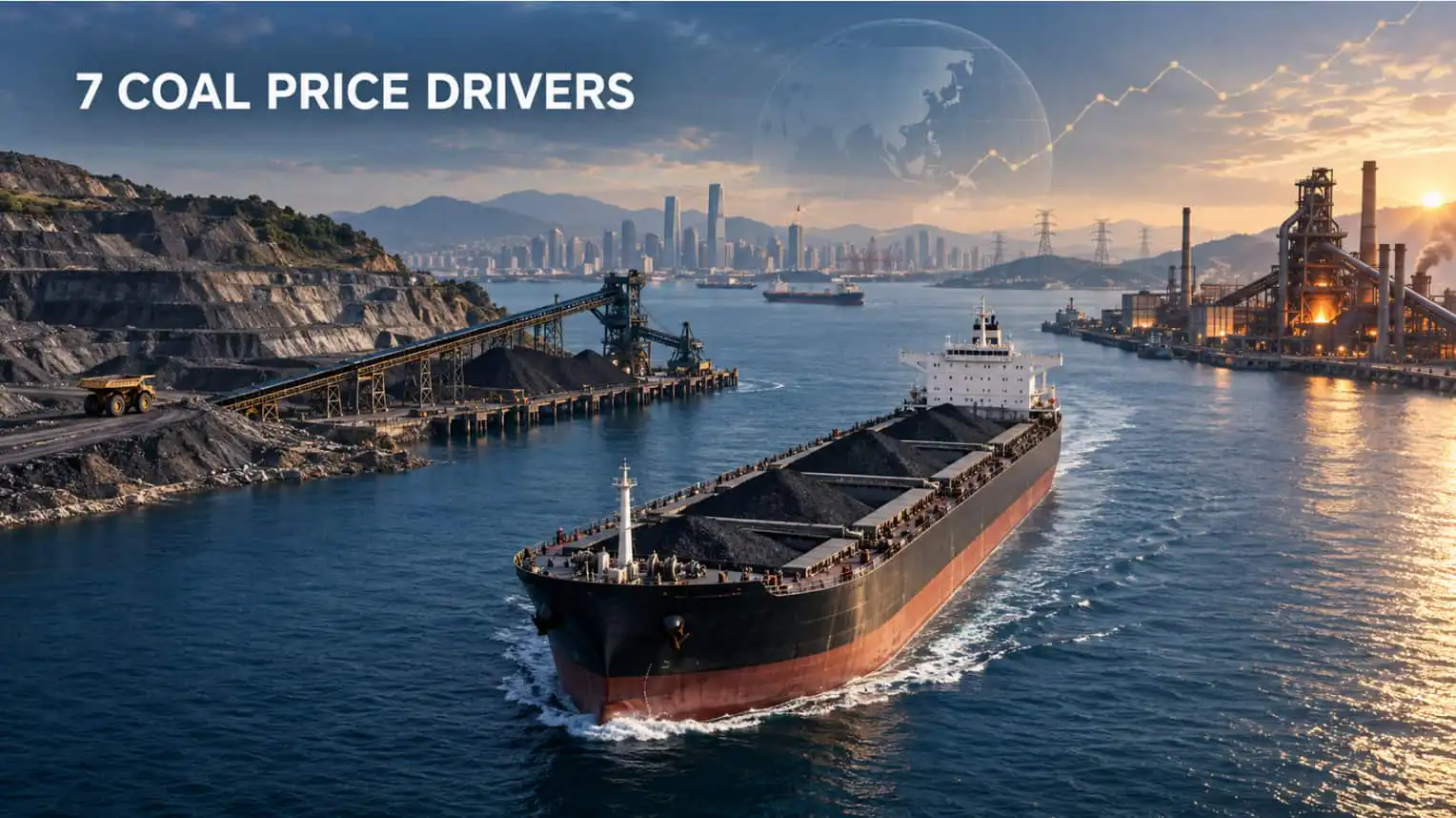
7 Factors That Could Shape Global Coal Prices in the Coming Years
A neat-looking coal price forecast can give the impression that the market follows a tidy path. It rarely does. Coal may be abundant globally and still become expensive for a buyer who needs a certain grade at a particular port. A wet mining season, a weak steel market or an unexpected jump in electricity use can change the picture within weeks.
What China and India Actually Import
China and India are so large that modest changes in their buying can be felt across the seaborne market. However, news reports on total coal use often do not provide information on changes in traded prices.
For instance, if China’s mines provide the additional fuel, they can increase electricity production by coal. In China, for example, the additional electricity could be produced without increasing imports, were it to be supplied by China’s mines. However, if a utility is forced to send electric power to overseas supply sources due to safety, transportation issues, or limited local production, even though electric demand has changed little. Coal is used heavily in India as a result of the nation’s strong power requirements; however, the quantity that makes its way to exporters is dependent on domestic production, rail supply, and inventory. Import volumes often matter more to global pricing than national consumption.
How Quickly Cleaner Power Meets New Demand
Renewable energy is expanding, but the effect on coal depends on timing. A country can add a great deal of solar capacity while its overall electricity needs rise even faster. In that case, solar may slow the growth of coal generation without pushing it down.
Capacity Is Not the Same as Output
A plant’s listed capacity says how much it could produce under suitable conditions. Actual generation depends on weather, grid connections, storage, and demand throughout the day. Hydropower varies with rainfall.
The International Energy Agency’s Coal 2025 report says roughly two-thirds of global coal use is tied to power generation. Its outlook through 2030 places rising electricity needs on one side and expanding renewables, nuclear power and natural gas on the other. Coal prices will reflect which side moves faster regionally.
Whether Mines Can Respond in Time
Higher prices do not produce more coal overnight. A mine may need additional machinery, workers, permits, and rail capacity before it can raise shipments. New projects take longer still, especially when financing is difficult or local opposition delays approval.
This creates a familiar commodity-market problem. During a weak period, producers cut spending, close expensive operations, and postpone expansion. If demand returns, missing investment can leave few quick sources of extra coal. Prices rise until supply appears or buyers reduce consumption. A brief rally may not persuade a company to fund a mine expected to operate for decades.
Problems Between the Mine and the Buyer
Coal has little value to a utility if it cannot arrive when needed. Export supply depends on railways, river barges, loading terminals and shipping routes. Heavy rain can flood an Australian mine, dry weather can restrict a river in Indonesia, and congestion can hold cargoes outside a port. None of these events changes underground reserves, but each can reduce coal available for immediate delivery.
Not Every Cargo Is a Substitute
Power stations are designed around ranges of heat content, moisture, ash and sulphur. Steelmakers are even more particular about coking quality. A disrupted cargo cannot always be replaced by whatever coal happens to be cheapest. Buyers may instead compete for a smaller pool of compatible supply, creating a regional premium.
The Price and Availability of Natural Gas
Coal does not trade in a vacuum. In power markets where generators can use either coal or gas, the relative cost of the two fuels affects daily operating decisions. Cheap and readily available gas can push coal plants further down the running order. Expensive gas can bring them back.
Liquefied natural gas makes this relationship increasingly international. New export projects may add supply and soften gas prices over time, encouraging some utilities to burn less coal. A cold winter, an outage or disruption along a major shipping route can pull in the opposite direction. The effect varies by country because carbon charges, plant efficiency, and long-term contracts also enter the calculation. Still, any useful coal price forecast needs to keep one eye on LNG.
The Health of Steelmaking and Construction
Thermal coal keeps power plants running. Metallurgical coal has a separate job: it is used to make coke for conventional blast-furnace steel production. That gives it a different demand cycle.
When construction slows, manufacturers cut orders or property investment weakens, steel mills may reduce output and buy less coking coal. Infrastructure programmes can reverse the trend. Over a longer period, greater use of recycled steel and electric-arc furnaces may reduce reliance on coke. The transition will not occur at the same speed everywhere. Countries building new cities, transport networks and industrial capacity may continue using blast furnaces even as mature markets adopt different methods.
Policy Choices and the Cost of Capital
Policy can press on both sides of the market. Carbon prices, emissions standards and scheduled plant closures may reduce coal demand. Tighter lending rules can make mines more expensive to develop, limiting supply. These measures do not always produce a smooth decline.
Governments also worry about electricity prices and energy security. During a shortage, they may extend a plant’s life, increase domestic mining, or rebuild fuel stocks. Such decisions can support demand even when the long-term policy points elsewhere. The World Bank’s Commodity Markets Outlook illustrates how geopolitical shocks can quickly reshape expectations across energy commodities. For coal, the result is often a market pulled between gradual structural change and immediate security concerns.
Conclusion
Coal’s direction will not be decided by one country, one fuel or one climate target. Imports, power demand, mine investment, transport, gas competition, steel output and policy will overlap, sometimes reinforcing one another and sometimes cancelling out. A sensible coal price forecast should therefore be updated as those conditions change. Scenarios and ranges may feel less precise than a single number, but they offer a more honest view of a market still capable of sudden turns.

Table of Contents