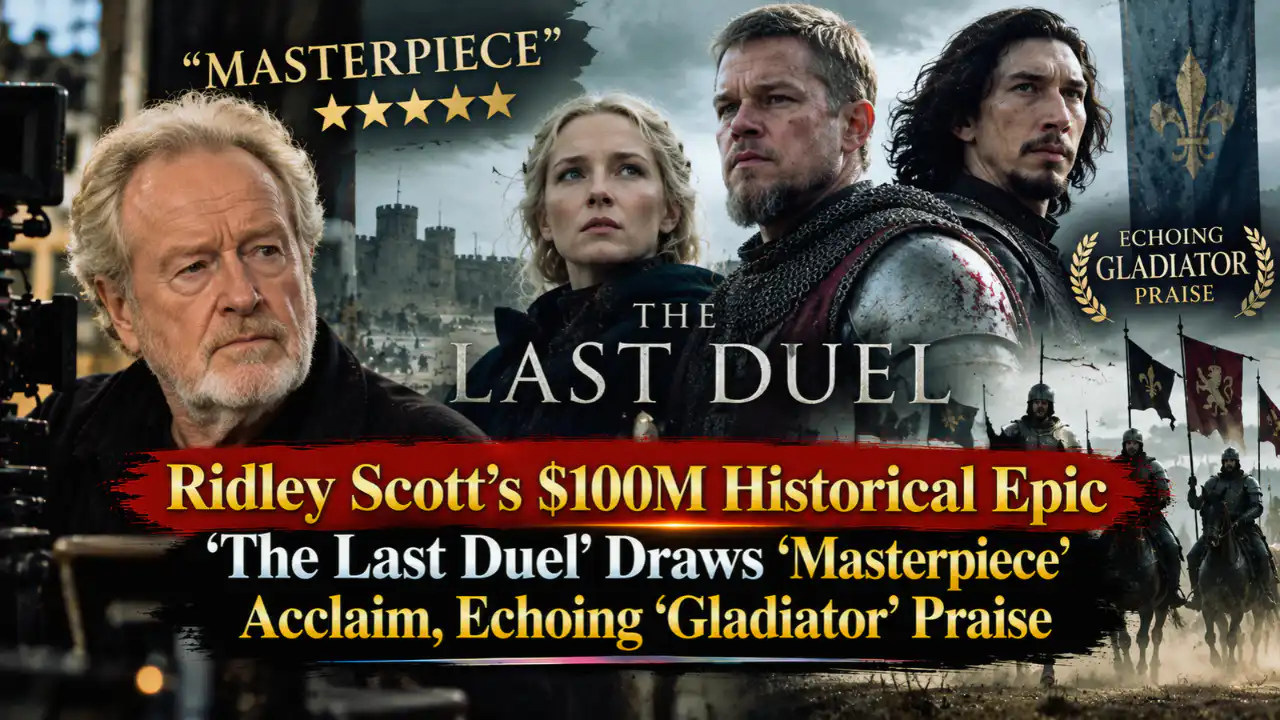
Ridley Scott’s $100M Historical Epic ‘The Last Duel’ Draws ‘Masterpiece’ Acclaim, Echoing ‘Gladiator’ Praise
A $100 million historical epic, “The Last Duel,” has earned its place among critics and film historians as a modern masterpiece. The film’s painstaking historical detail, complex narrative structure, and gripping performances have drawn direct comparisons to Scott’s 2000 Oscar-winning epic, “Gladiator,” and it’s a real high point in his later career.
Ridley Scott’s $100 million historical epic “The Last Duel” is widely regarded by critics as a masterpiece. The film’s gripping story and historical accuracy have led reviewers to compare its cinematic impact to Scott’s 2000 epic “Gladiator” and praise his sustained mastery of the historical drama genre.
Key Details
- What happened: Critics praised “The Last Duel” upon release, with many major outlets calling it a masterpiece of the historical genre.
- Who’s in it: Directed by Ridley Scott, starring Matt Damon, Adam Driver, and Jodie Comer.
- Where: Global theatrical release, then digital and streaming.
- When: October 2021 (original release) and still being talked about in retrospective film discussions
- Latest update: The film’s stature only seems to grow with constant re-evaluation, often mentioned in the same breath as “Gladiator” in discussions of Scott’s finest work.
- What happens next: It is a major reference point for modern historical epics and continues to influence Scott’s later historical projects.
The Critical Consensus: A Modern Masterpiece
When “The Last Duel” was released, critics gave it strong approval. Review aggregators echo this consensus, with the film holding a high certification score on Rotten Tomatoes and a favorable Metacritic score. Critics frequently lauded the movie for its uncompromising depiction of medieval justice and its innovative narrative.
The film has a “Rashomon-style” narrative, retelling the same events from the perspectives of three characters: Jean de Carrouges (Damon), Jacques Le Gris (Driver), and Marguerite de Carrouges (Comer). Critics said the structure elevates the film from a routine action epic to a complex character study and a sharp critique of institutional power.
Many film critics and entertainment writers have described the film’s ambition and execution as similar to “Gladiator”. Gladiator may have helped popularize the modern historical action epic. Still, reviewers say The Last Duel improves on the formula by emphasizing historical authenticity and thematic depth over spectacle.
Production Context and the $100 Million Budget
The “$100M historical epic” reference in the title matches the reported production budget of “The Last Duel.” Spending $100 million on an R-rated, talky period drama is very unusual in the studio system these days; that kind of money is usually reserved for franchise films or PG-13 blockbusters.
Note on Ridley Scott’s filmography: Scott’s later historical epic, “Napoleon” (2023), was also heavily promoted, though its production budget was widely reported to be around $200 million. Labeling “The Last Duel” as a “$100M historical epic” is fair.
You see the financial investment on screen. The production design, the accuracy of the costumes, the painstakingly choreographed final judicial combat – all speak to the resources poured into achieving historical verisimilitude. Adapted from Eric Jager’s 2004 book, The Last Duel: A True Story of Trial by Combat in Medieval France, the film shows the production team working closely with historians to ensure an authentic portrayal of 14th-century France.
What Critics and Sources Said
- On the direction: Critics highlighted Ridley Scott’s ability to manage large-scale battle sequences while maintaining intimate character focus, a skill honed during the production of “Gladiator.”
- On the performances: Jodie Comer’s performance as Marguerite was widely highlighted as the film’s emotional anchor, with reviewers noting her ability to convey the narrative’s stakes in a deeply patriarchal society.
- On the historical accuracy: Reviewers praised the film’s refusal to romanticize the Middle Ages, noting its grim, realistic portrayal of the era’s hygiene, violence, and legal systems.
Why It Matters
- Viability of R-Rated Epics: It proved that there is still an audience for mature, serious historical epics, pushing back against the industry trend of relying solely on sanitized, four-quadrant blockbusters.
- Historical Representation: The film’s narrative structure placed the perspective of a medieval woman at the center of a historical epic, offering a fresh critique of how history is recorded and who gets to tell it.
- Director’s Legacy: For Ridley Scott, the film reinforced his status as a master of the historical epic genre, bridging his early career classics and his modern filmography.
What Happens Next
FAQ
What is Ridley Scott’s $100M historical epic?
Ridley Scott’s $100 million historical epic: “The Last Duel” (2021). The film reportedly cost $100 million to make, compared with his later historical epic “Napoleon,” which was budgeted at around $200 million.
Why is The Last Duel being compared to Gladiator?
Critics often compare The Last Duel to Gladiator, both films showcasing Ridley Scott’s talent for historical epics. While “Gladiator” is known for its grand spectacle and arena combat, “The Last Duel” is lauded for refining Scott’s approach with a more rigorous, historically accurate, and complex narrative structure.
Is The Last Duel based on a true story?
Yes. “The Last Duel” is based on Eric Jager’s 2004 historical book. The film is based on the true story of the judicial duel between Jean de Carrouges and Jacques Le Gris in 1386, France’s last legally recognized duel.
Who is in “The Last Duel”?
In the film, Matt Damon plays Jean de Carrouges, Adam Driver plays Jacques Le Gris, and Jodie Comer plays Marguerite de Carrouges, withount Pierre din a supporting role ‘Alençon. in a supporting role

Table of Contents