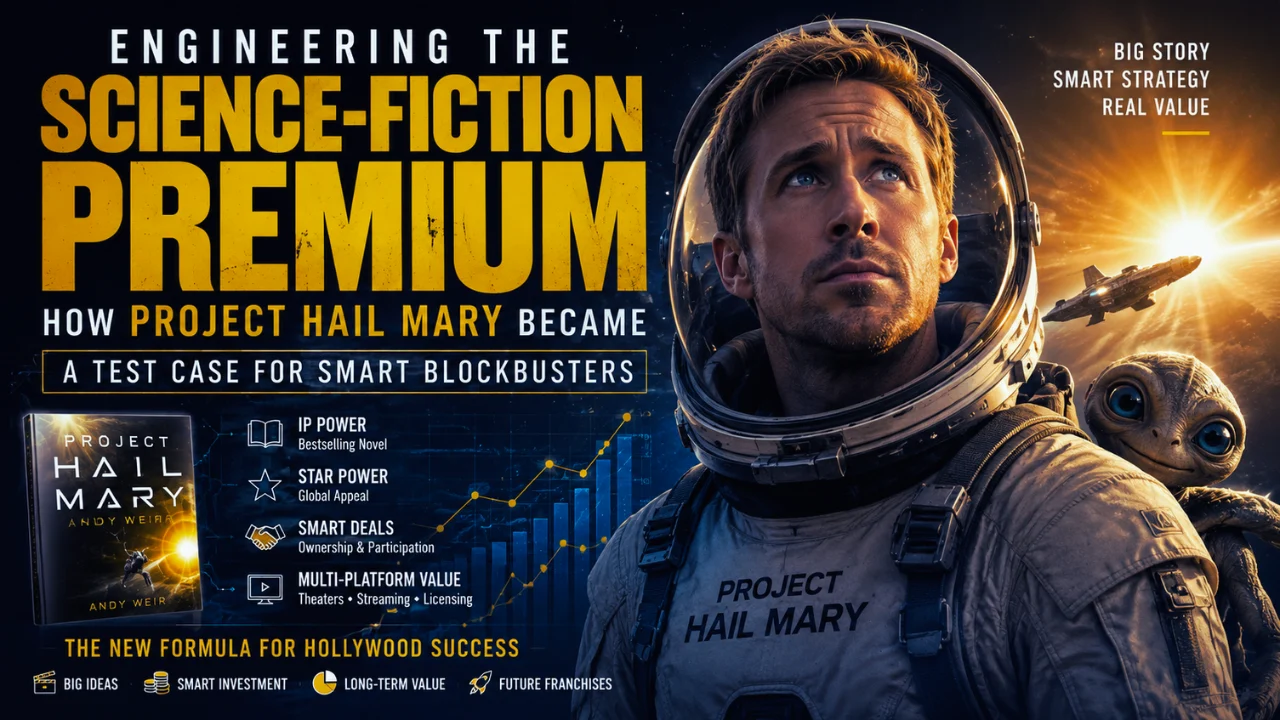
Project Hail Mary and the Science Fiction Premium
Hollywood has always loved science fiction, but studios have learned an expensive lesson over the past decade: not every space adventure becomes the next Star Wars or Dune. Big budgets alone are no longer enough.
That is why the story behind Project Hail Mary matters. The Ryan Gosling-led adaptation of Andy Weir’s bestselling novel became more than another movie release. It emerged as a fascinating experiment in how studios engineer what many executives quietly chase: the science fiction premium.
With Amazon MGM Studios, producers Amy Pascal, Phil Lord, Christopher Miller, and Gosling himself attached, the project combined proven intellectual property, recognizable talent, and a genre with enormous long-term licensing potential.
For readers interested in Hollywood money, ownership deals, and modern entertainment business models, Project Hail Mary offers a revealing look at how smart blockbusters are built.
Why This Entertainment Business Trend Matters Now?
Science fiction has entered a new era.
Studios are increasingly moving away from betting exclusively on original ideas or endless sequels. Instead, they’re targeting premium intellectual property with established fan communities. Andy Weir’s track record helped make Project Hail Mary especially attractive after the success of The Martian.
Today’s entertainment economy rewards projects that can generate revenue across multiple channels:
- Theatrical releases
- IMAX screenings
- Streaming rights
- International distribution
- Home entertainment sales
- Merchandise and collectibles
- Future franchise opportunities
The biggest blockbusters are no longer just films. They are assets.
Amazon’s acquisition of MGM gave the company one of Hollywood’s largest content libraries, and Project Hail Mary arrived at a moment when streamers are seeking event films that justify subscriptions while still succeeding theatrically.
That shift has created a premium around high-quality science fiction. The genre attracts loyal audiences, travels well internationally, and often retains value for decades.
The Business Model Behind the Money
At its core, Project Hail Mary represents a layered business strategy.
Public reporting indicates MGM acquired film rights to Andy Weir’s novel in 2020 for approximately $3 million before Amazon acquired the studio. Ryan Gosling joined as both star and producer, adding another layer of creative and commercial alignment.
The business model includes several revenue streams:
| Wealth Driver | How It Works | Why It Matters |
|---|---|---|
| IP Rights | Adaptation of Andy Weir’s novel | Reduces market uncertainty |
| Theatrical Revenue | Box office and premium formats | Generates immediate returns |
| Streaming Rights | Prime Video availability | Supports subscriber growth |
| International Distribution | Sony handles many overseas markets | Expands global reach |
| Producer Participation | Potential backend arrangements | Aligns incentives |
| Franchise Potential | Sequels, spin-offs, licensing | Extends long-term value |
Salary Versus Ownership
One of Hollywood’s oldest lessons remains true: ownership matters more than salary.
While actors may receive substantial upfront compensation, producer credits can create additional participation opportunities depending on deal structures. Exact terms for Gosling or other producers have not been publicly disclosed.
This distinction explains why celebrity wealth is often misunderstood.
A £10 million acting salary may generate significant income today, but ownership interests, royalties, and backend participation can create earnings that continue long after a film leaves cinemas.
Brand Equity and Audience Trust
Ryan Gosling brings more than acting talent to a project like Project Hail Mary.
His reputation has become a commercial asset.
Following successes across dramas, comedies, and major studio films, Gosling carries a level of audience trust that studios increasingly value. Similarly, Lord and Miller’s creative brand has become marketable in its own right after projects such as Spider-Verse and The LEGO Movie.
In modern Hollywood, brand equity functions much like an investment portfolio:
- Trusted actors reduce perceived risk.
- Acclaimed directors attract audiences.
- Established authors bring built-in fandom.
- Premium IP improves licensing opportunities.
The result is a stronger commercial package before cameras even begin rolling.
Why Traditional Net Worth Estimates Often Miss the Full Picture?
Celebrity net worth headlines rarely tell the complete story.
Public estimates typically focus on salaries, real estate holdings, and visible endorsement deals. They often overlook:
- Producer participation agreements
- Undisclosed royalties
- Licensing income
- Private investments
- Management and agency costs
- Taxes and legal expenses
- Deferred compensation structures
Consider someone like Ryan Gosling. Publicly available information can identify major projects, but it cannot fully account for private investment activity or confidential entertainment contracts.
The same principle applies to producers and writers.
Andy Weir’s publicly reported film rights sale represents only one visible piece of a broader career built around intellectual property. A successful author can generate income through publishing, international editions, adaptations, and future licensing opportunities.
Celebrity wealth increasingly depends on ownership rather than visibility.
That Shows How This Works
Hollywood has repeatedly demonstrated the value of premium science fiction.
The Martian transformed Andy Weir into one of the industry’s most sought-after science fiction authors.
Dune proved audiences would support ambitious, intellectually driven storytelling.
Christopher Nolan’s films continue to command premium theatrical experiences through IMAX and event marketing.
Project Hail Mary sits at the intersection of all three trends:
- Proven literary IP.
- Prestige filmmaking talent.
- Event-level theatrical positioning.
- Long-term streaming value.
Its release strategy further illustrates this approach. The film debuted theatrically through Amazon MGM Studios and Sony’s international distribution network before expanding to streaming platforms.
That staggered model allows studios to maximize revenue across multiple windows rather than relying on a single source of income.
The Risks Behind Smart Blockbusters
Of course, premium science fiction remains one of Hollywood’s riskiest investments.
These films often require:
- Significant visual effects budgets
- Long production timelines
- Complex marketing campaigns
- Global audience appeal
- Strong critical reception
When science fiction succeeds, the upside can be enormous. When it fails, losses can be equally dramatic.
Audience tastes change quickly. Franchise ambitions can become liabilities. Even beloved source material does not guarantee commercial success.
Studios also face a growing challenge: audience fatigue.
Consumers have more entertainment options than ever. A project competing against gaming, streaming, social media, and other theatrical releases must justify its place in an increasingly crowded market.
That makes every major sci-fi release a high-stakes business decision.
What This Reveals About Modern Celebrity Wealth?
The larger lesson behind Project Hail Mary extends far beyond one film.
Modern entertainment wealth is increasingly tied to ownership.
Actors become producers. Authors become intellectual property businesses. Directors build personal brands. Studios leverage libraries across theatrical, streaming, and licensing ecosystems.
The biggest fortunes in Hollywood are rarely built from a single pay cheque.
They are built through:
- Intellectual property ownership
- Equity deals
- Producer credits
- Licensing agreements
- Residual income
- Strategic partnerships
- Long-term audience trust
Project Hail Mary illustrates how the entertainment industry is evolving into a business of portfolios rather than projects.
That may be the true science fiction premium.
Conclusion
Project Hail Mary became more than an adaptation of a popular novel. It became a case study in how Hollywood approaches intelligent, commercially viable blockbuster filmmaking.
By combining established intellectual property, proven talent, and multi-platform distribution, the project shows the industry’s growing focus on ownership, brand equity, and long-term value.
As studios continue searching for the next premium franchise, the future of entertainment wealth will likely belong to those who control the stories, not simply those who appear in them.
FAQs
What is Project Hail Mary about?
Project Hail Mary follows Ryland Grace, a science teacher who awakens aboard a spacecraft and discovers he may be humanity’s last hope. It is based on Andy Weir’s bestselling 2021 novel.
Why is Project Hail Mary considered a smart blockbuster?
It combines proven intellectual property, major talent, premium theatrical positioning, and streaming value, making it a strong example of modern entertainment business strategy.
Did Ryan Gosling produce Project Hail Mary?
Yes. Publicly available credits list Ryan Gosling among the film’s producers alongside Phil Lord, Christopher Miller, Amy Pascal, and others.
How do celebrities make money beyond acting salaries?
Many earn additional income through producer credits, royalties, licensing deals, investments, endorsement agreements, and ownership interests.
Why are celebrity net worth estimates often inaccurate?
Most estimates rely on publicly available information and cannot account for private investments, taxes, confidential contracts, or undisclosed business holdings.
Enjoy exploring the business behind Hollywood? Discover more entertainment wealth breakdowns, celebrity ownership stories, and analyses of the money shaping modern fame.

Table of Contents