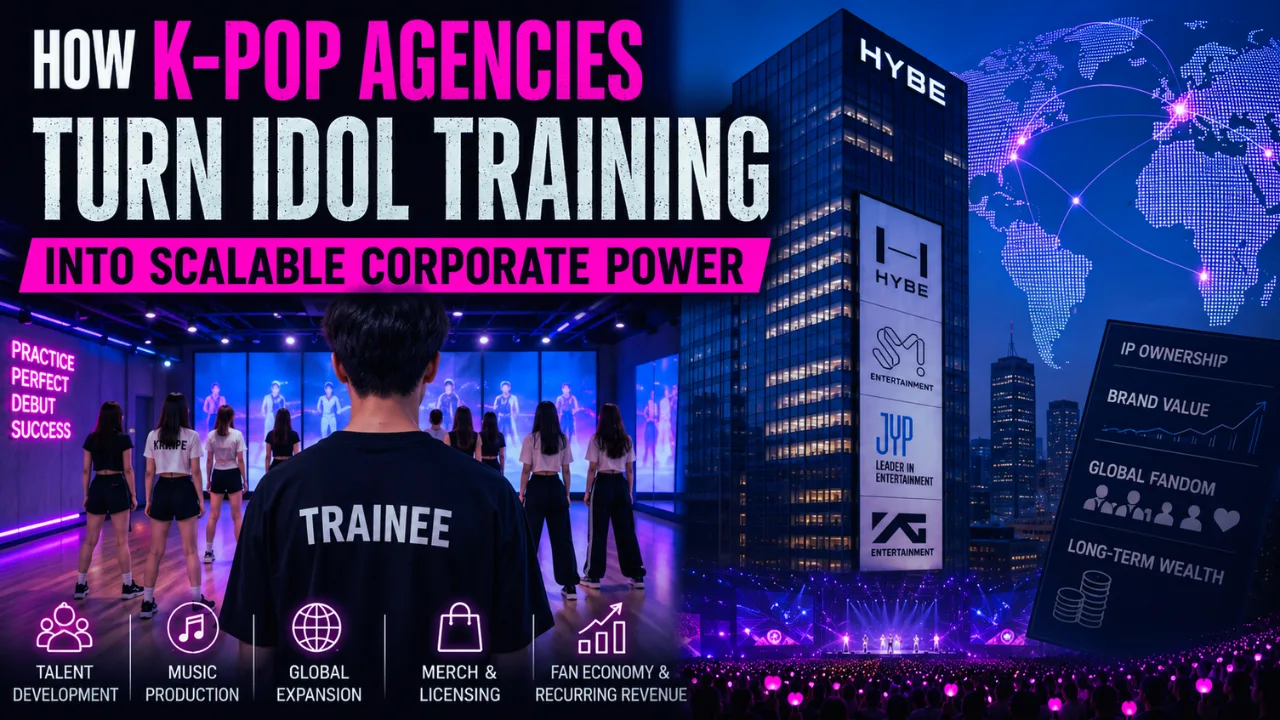
How K-pop Agencies Turn Idol Training Into Corporate Power
Before a K-pop group sells out arenas or tops global streaming charts, years of preparation happen behind closed studio doors.
That preparation is not just about singing lessons or dance practice. It is part of a highly structured business model that has helped South Korean entertainment companies build global influence. The modern K-pop industry has effectively turned talent development into a repeatable corporate process.
Understanding how K Pop agencies turn idol training into scalable corporate power reveals something bigger than pop music. It shows how entertainment companies create intellectual property, build brand equity, monetize fandoms, and expand internationally without owning movie studios or television networks. In many ways, K-pop agencies are among the most sophisticated entertainment businesses operating today.
Why This Celebrity Wealth Trend Matters Now?
The global entertainment economy has changed dramatically over the past decade.
Music companies no longer rely solely on album sales. Revenue increasingly comes from touring, merchandise, fan subscriptions, digital experiences, licensing, streaming rights, and branded partnerships.
K-pop agencies recognized this shift early. Rather than waiting for artists to emerge organically, companies like HYBE, SM Entertainment, JYP Entertainment, and YG Entertainment built systems designed to produce globally marketable talent at scale.
That approach has turned entertainment into infrastructure.
HYBE’s expansion from BTS’s management company into a multinational entertainment business with labels, technology platforms, and international partnerships illustrates the shift. Its collaboration with Geffen Records to create KATSEYE demonstrated that the K-pop training model itself can be exported as intellectual property.
For readers interested in celebrity wealth, the lesson is clear. Modern entertainment fortunes are increasingly built through ownership of systems rather than ownership of a single hit song.
The Business Model Behind the Money
K-pop agencies operate more like vertically integrated businesses than traditional music labels.
Their activities often include:
- Talent scouting
- Multi-year training programs
- Music production
- Choreography development
- Merchandise sales
- Fan community platforms
- Brand partnerships
- Concert production
- International licensing
- Content distribution
Every successful idol group becomes an intellectual property asset that can generate revenue across multiple channels.
Salary Versus Ownership
Most idols earn income through contracts tied to music activities, endorsements, appearances, and touring.
The agencies, meanwhile, typically own or control much of the underlying infrastructure. They invest heavily upfront in training, production, marketing, and distribution, allowing them to benefit from the long-term value of successful groups.
This distinction matters.
An idol’s earnings may rise during peak popularity, but the agency retains the ability to scale its business by debuting additional groups, expanding internationally, and monetizing existing intellectual property.
That is why entertainment executives and shareholders often accumulate more wealth than individual performers over time.
Brand Equity and Audience Trust
K-pop agencies are experts at creating brand equity.
Fans are not simply buying songs. They are buying into narratives, aesthetics, personalities, and communities.
Groups become brands. Agencies become trusted curators.
SM Entertainment built a reputation around polished performances. YG cultivated a premium image. JYP emphasized accessibility and personality. HYBE leveraged fandom technology and a multi-label strategy to expand globally.
Once audience trust exists, monetization opportunities multiply.
A single group can support:
- Merchandise lines
- Streaming content
- Licensing deals
- Global sponsorships
- Fan memberships
- Documentary projects
- Gaming collaborations
- Concert films
The business is less about individual releases and more about maximizing the lifetime value of entertainment intellectual property.
Helpful Table
| Wealth Driver | How It Works | Why It Matters |
|---|---|---|
| Training Systems | Develops talent before debut | Creates scalable talent pipelines |
| Intellectual Property | Ownership of group brands and content | Generates long-term value |
| Licensing Deals | Third parties pay to use IP | Expands revenue globally |
| Fan Platforms | Paid memberships and content | Builds recurring income |
| Brand Deals | Partnerships with global brands | Converts popularity into revenue |
| Touring | Live performances and events | Major income source for artists and agencies |
| Merchandise | Physical and digital products | Extends fan spending beyond music |
Why Traditional Net Worth Estimates Often Miss the Full Picture?
Celebrity net worth estimates frequently focus on visible earnings.
That creates an incomplete picture in K-pop.
Publicly available data rarely captures:
- Private investments
- Equity holdings
- Licensing agreements
- Royalty structures
- Taxes and expenses
- Corporate share ownership
- Real estate holdings
- Revenue-sharing arrangements
For example, discussions around the wealth of K-pop founders often overlook stock ownership and corporate transactions. When HYBE went public, attention shifted from artist earnings to enterprise value and shareholder wealth.
Similarly, agency valuations can fluctuate based on future growth expectations, intellectual property portfolios, and investor confidence.
Celebrity wealth is increasingly tied to ownership structures, not simply paychecks.
That Shows How This Works
Several examples highlight how scalable theK-popp model has become.
- HYBE expanded beyond BTS through acquisitions, multiple labels, and its Weverse platform.
- SM Entertainment developed one of the industry’s earliest standardized training systems.
- JYP successfully exported its talent model across Asian markets.
- YG built premium global brands around acts like BLACKPINK and BIGBANG.
Perhaps the most telling development is that international companies are now attempting to replicate the model.
The K-pop trainee system has become a product in itself.
That is a remarkable shift. Few entertainment industries can claim that their development process is valuable enough to export globally.
The Risks Behind Celebrity Business Ventures
The K-pop system is powerful, but it is not without risk.
Training programs require significant investment, and many trainees never debut. Even successful groups face challenges that can affect long-term profitability.
Common risks include:
- Changing audience tastes
- Contract disputes
- Leadership controversies
- Overexpansion
- Fan fatigue
- Market saturation
- Reputational damage
- Geopolitical issues affecting international markets
Recent disputes involving major agencies have also highlighted tensions around creative control and governance. Public disagreements can influence stock prices and investor confidence just as much as album performance.
The industry’s dependence on a small number of blockbuster acts also creates concentration risk. Analysts have long noted how closely some companies’ performance can be tied to a handful of artists.
For every global success story, there are smaller agencies that struggle to survive.
What This Reveals About Modern Celebrity Wealth?
The biggest lesson from K-pop is that fame has become infrastructure.
Celebrity wealth is no longer defined solely by music sales or endorsement deals. It increasingly depends on ownership, intellectual property, distribution, and the ability to build ecosystems around audiences.
K-pop agencies have mastered this approach.
They train talent, own brands, operate fan platforms, negotiate licensing deals, and expand internationally. The result is a business model where every successful debut has the potential to become a long-term corporate asset.
That helps explain why entertainment companies are attracting investor attention once reserved for technology and media firms.
The future of celebrity wealth may not belong to the biggest stars alone. It may belong to the companies that build the systems capable of producing them repeatedly.
Conclusion
K-pop’s rise is often told as a story about music and fandom, but it is equally a story about business strategy.
By transforming idol training into a scalable corporate model, South Korea’s leading entertainment companies created an engine for intellectual property, global expansion, and long-term value creation. Their influence now extends far beyond the music industry.
As entertainment becomes increasingly interconnected with technology, ownership, and audience platforms, the K Pop playbook may become one of the defining business case studies of the modern media era.
FAQs
How do K Pop agencies make money?
K Pop agencies generate revenue through music sales, touring, merchandise, licensing, fan subscriptions, sponsorships, and intellectual property monetization.
Why is the K Pop trainee system so important?
The trainee system allows agencies to develop talent systematically, creating consistent standards and scalable business opportunities.
Do K Pop idols earn more than agency founders?
Not necessarily. Agency founders and shareholders may accumulate greater wealth through stock ownership, acquisitions, and long-term business growth.
Why are celebrity net worth estimates often inaccurate?
Many estimates exclude private investments, equity deals, taxes, royalties, and confidential business arrangements.
Can other countries replicate the K-pop model?
Many are trying. Partnerships such as HYBE’s collaboration with Geffen Records suggest that aspects of the K-pop system can be adapted internationally.
Interested in the business behind fame? Explore more entertainment industry breakdowns, celebrity wealth stories, and net worth analysis articles to discover how modern stars and media companies build lasting fortunes.

Table of Contents