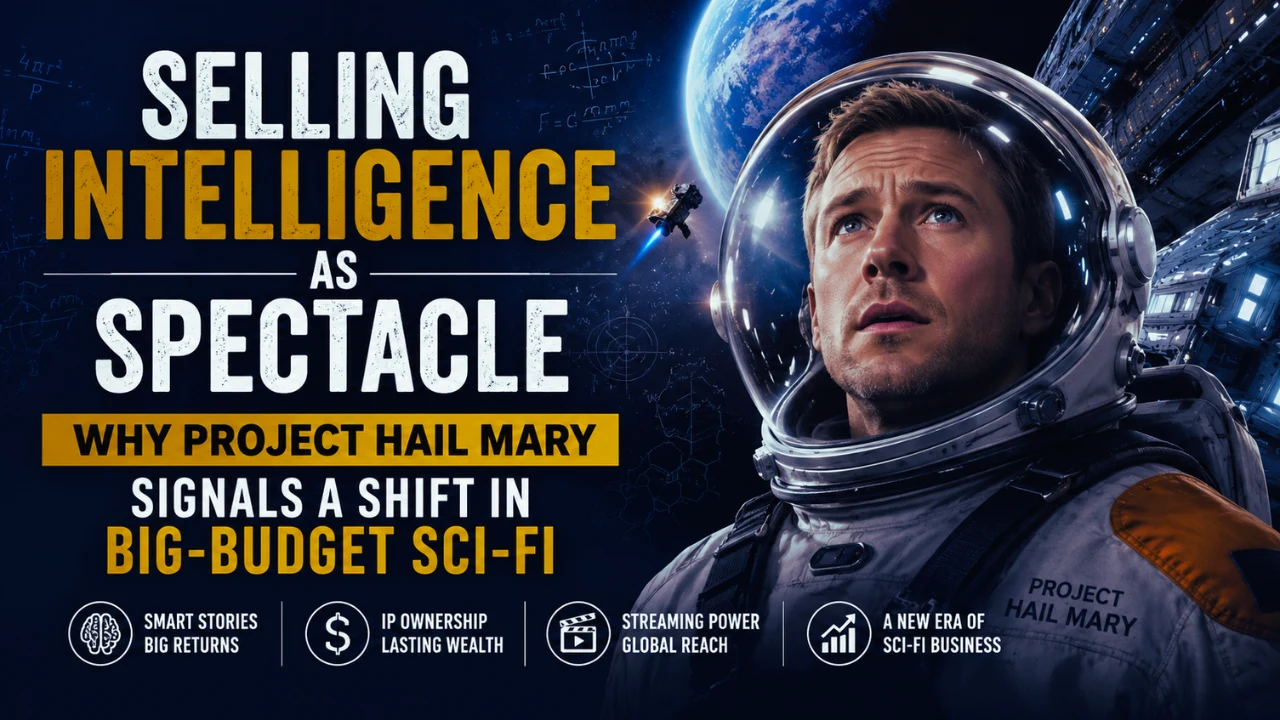
Project Hail Mary and the Future of Big Budget Sci Fi
For years, Hollywood treated intelligence as a niche product. Big budgets were reserved for superheroes, sequels, and familiar franchises. Then came Project Hail Mary.
Based on Andy Weir’s bestselling novel and led by Ryan Gosling, the film arrived with an unusual pitch: audiences would pay to watch a science teacher solve equations, build hypotheses, and save humanity through problem-solving rather than brute force. Publicly available information shows the adaptation brought together major talent, including Phil Lord, Christopher Miller, and screenwriter Drew Goddard, while Amazon MGM backed it as a theatrical event.
The significance goes beyond box office results. Selling Intelligence as Spectacle: Why Project Hail Mary Signals a Shift in Big-Budget Sci-Fi is really a story about changing audience tastes, intellectual property economics, and how Hollywood is rethinking what premium entertainment looks like.
Why This Celebrity Wealth Trend Matters Now?
The entertainment industry has spent the last decade chasing established intellectual property. Marvel, Star Wars, and legacy franchises dominated investment decisions because they offered predictability.
But Project Hail Mary suggests audiences may be willing to embrace something else: smart, emotionally driven science fiction built around ideas.
That matters for everyone involved.
For Ryan Gosling, projects like this expand brand equity beyond traditional leading-man roles. For Amazon MGM Studios, it strengthens a growing film portfolio that can feed theatrical releases, streaming subscriptions, and future licensing opportunities. For Andy Weir, it demonstrates the long-term value of owning highly adaptable intellectual property. Public reports indicate Weir sold film rights for approximately $3 million while also receiving a producer credit on the adaptation.
Hollywood increasingly treats books, podcasts, and original concepts as financial assets rather than simply creative works.
The result is a business environment where intelligence itself becomes marketable.
The Business Model Behind the Money
At its core, Project Hail Mary operates on several revenue streams:
| Wealth Driver | How It Works | Why It Matters |
|---|---|---|
| Film Rights | Studios acquire adaptation rights | Creates upfront income for creators |
| Producer Credits | Key talent participates in production | May increase compensation opportunities |
| Box Office | Ticket sales worldwide | Immediate revenue source |
| Streaming Rights | Distribution through subscription platforms | Extends audience reach |
| Licensing | Merchandise and publishing opportunities | Generates additional income |
| Brand Equity | Builds long-term value for talent and studios | Opens future opportunities |
Unlike many modern blockbusters, the film’s biggest selling point is its premise. That’s an important distinction.
Ideas can become intellectual property.
And intellectual property can become wealth.
Salary Versus Ownership
Most people associate Hollywood earnings with salaries.
A star receives a pay cheque. A director receives a fee. End of story.
Reality is usually more complicated.
Ryan Gosling is publicly credited as both star and producer. Producer participation often carries additional financial upside depending on deal structures, although specific terms remain private. Similarly, Andy Weir benefits not only from book sales but from adaptation rights and increased visibility across his broader catalog.
Ownership almost always outlasts salary.
A £10 million acting fee may be significant, but ownership of intellectual property can generate value for decades through reprints, licensing deals, and future adaptations.
Brand Equity and Audience Trust
There’s another reason Project Hail Mary matters.
Audiences trust certain names.
Andy Weir previously benefited from The Martian. Drew Goddard adapted both novels. Lord and Miller built reputations through projects like Spider-Verse and The LEGO Movie. Ryan Gosling brings credibility across drama, comedy, and blockbuster filmmaking.
Combined, those names become financial assets.
Hollywood increasingly packages talent as carefully as it packages stories.
Why Traditional Net Worth Estimates Often Miss the Full Picture?
Celebrity net worth websites are popular because they offer simple answers.
Unfortunately, Hollywood rarely works in simple ways.
Public estimates usually struggle to account for:
- Undisclosed backend participation
- Private investments
- Royalties from publishing
- Producer arrangements
- Residual income
- Taxes and management fees
- Real estate holdings
- Licensing revenue
- Future intellectual property opportunities
Andy Weir’s wealth, for example, cannot be understood solely through book sales. His catalog continues to generate value through adaptations, licensing agreements, and renewed consumer interest whenever a film launches.
The same principle applies across entertainment.
Celebrity wealth increasingly reflects ownership rather than visibility.
That Shows How This Works
Hollywood has seen this pattern before.
The Martian transformed Andy Weir from a self-published author into a major science fiction brand. Christopher Nolan built decades of brand equity through original filmmaking. Denis Villeneuve turned Dune into a prestige blockbuster franchise.
Each example points to the same lesson.
Intellectual property matters.
A compelling science fiction story can generate:
- Film adaptations
- International distribution deals
- Streaming revenue
- Physical media sales
- Merchandise opportunities
- Convention appearances
- Future sequels or spin-offs
Amazon MGM’s decision to release Project Hail Mary theatrically before moving it to Prime Video also highlights the industry’s hybrid distribution strategy. A single title can generate revenue across multiple windows instead of relying on one release format.
The Risks Behind Celebrity Business Ventures
Of course, intelligence is not a guaranteed box office strategy.
Studios face several risks when investing in science-heavy projects:
- High production costs
- Audience fragmentation
- International market uncertainty
- Overreliance on star power
- Competition from established franchises
- Difficulty marketing complex concepts
Even respected creators experience setbacks.
Lord and Miller famously exited Solo: A Star Wars Story before completion, demonstrating how unpredictable Hollywood partnerships can become.
Celebrity brands face similar challenges.
Public attention changes quickly. Audiences become fatigued. Trends disappear.
Building long-term wealth requires timing, execution, and a bit of luck.
What This Reveals About Modern Celebrity Wealth?
The biggest lesson from Project Hail Mary isn’t about space.
It’s about value.
Modern celebrity wealth is increasingly built through:
- Ownership deals
- Intellectual property
- Producer credits
- Streaming rights
- Licensing agreements
- Business ventures
- Brand equity
- Strategic partnerships
That’s a meaningful shift from Hollywood’s old model.
Today’s entertainment economy rewards people who own pieces of the machine, not just those who appear on screen.
Project Hail Mary demonstrates that audiences still want spectacle. They’re simply becoming more open to a different kind of spectacle.
One built around curiosity, science, and ideas.
And for Hollywood, that may prove to be one of the most profitable discoveries of all.
Conclusion
Project Hail Mary arrives at a fascinating moment for the entertainment business. It suggests that big-budget science fiction no longer needs to choose between commercial appeal and intellectual ambition.
For creators, it reinforces the value of owning adaptable intellectual property. For studios, it highlights the growing importance of premium storytelling in an increasingly crowded marketplace. And for audiences, it offers evidence that blockbuster cinema can still surprise us.
The next generation of Hollywood wealth may not be built solely on capes and cinematic universes. It could just as easily come from the people who figured out how to make intelligence worth watching.
FAQs
1. What is Project Hail Mary about?
Project Hail Mary is a science fiction story about Ryland Grace, a teacher who awakens aboard a spacecraft and must use science and problem-solving to save Earth.
2. Why is Project Hail Mary important to Hollywood?
It represents a growing appetite for original and intellectually driven science fiction supported by major studios and premium talent.
3. How do authors make money from film adaptations?
Authors can earn from adaptation rights, producer credits, royalties from increased book sales, and licensing opportunities depending on their agreements.
4. Why are celebrity net worth estimates often inaccurate?
Most public estimates cannot account for private investments, backend deals, royalties, taxes, or undisclosed ownership arrangements.
5. Do celebrities earn more from ownership than salaries?
In many cases, long-term ownership of intellectual property and equity interests can generate more wealth than a one-time salary.
Interested in the business behind fame? Explore more celebrity wealth breakdowns, entertainment industry analyses, and deep dives into how Hollywood really makes its money.

Table of Contents