Why Michael Jackson Biopic Business Became Bigger Than Film
This article explains why Michael became more than a movie release and why the Michael Jackson biopic business matters in the modern entertainment economy. It looks at box office revenue, catalog value, estate strategy, brand equity, licensing, royalties, and the risks behind turning legacy fame into long-term celebrity wealth.
A Michael Jackson movie was never going to be just another Hollywood release.
When Michael arrived, he entered a world where celebrity stories are no longer measured only by ticket sales. Music streams, catalog valuations, licensing deals, stage shows, merchandise, streaming rights, public image, and the long-term power of intellectual property measure them.
That is why the Michael Jackson biopic business became such a major entertainment story. The film did not simply retell the rise of the King of Pop. It helped reopen the financial machine around one of the most valuable celebrity brands in music history.
The bigger question is not only how much the movie made. It is how a film can rebuild attention around an estate, reprice cultural memory, and turn legacy into a fresh wave of Hollywood money.
Why the Michael Jackson Biopic Business Matters Now?
The timing of Michael matters because the entertainment business has changed. Studios want recognizable intellectual property. Music companies want reliable catalogs. Streaming platforms want famous stories. Estates want controlled legacy projects that keep older icons relevant to younger audiences.
Michael Jackson sits at the center of all of those trends.
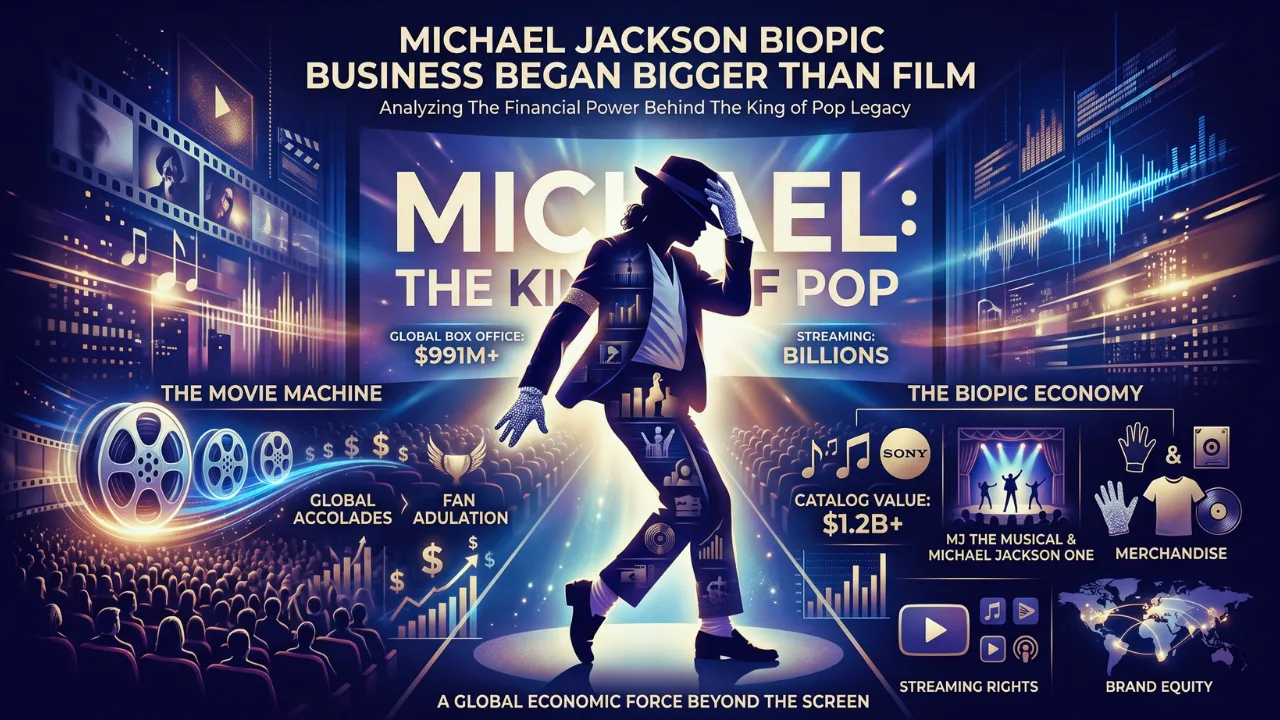
The film’s box office showed the global pull of his name. Box Office Mojo lists Michael with more than $991 million worldwide, including over $371 million domestic and more than $620 million internationally. It also lists a $97.2 million domestic opening and a reported $155 million production budget.
That level of performance turns a biopic into more than cinema. It becomes a marketing engine for the wider Michael Jackson economy.
The movie also arrived after a major movement around Jackson’s music assets. In 2024, Sony reportedly acquired a major stake in Jackson’s catalog in a deal valuing the assets at more than $1.2 billion. That context matters because a hit film can push listeners back to old songs, make catalog rights more visible, and remind investors why legacy music remains valuable.
The Business Model Behind the Money
A film like Michael creates several money lanes at once.
There is a theatrical box office first. Studios, distributors, theaters, financiers, and producers all participate in that chain. Then come premium formats, international distribution, home entertainment, digital rental, streaming licensing, music usage, soundtrack attention, and brand partnerships.
The movie also supports a larger ecosystem. Michael Jackson’s estate has long been linked to projects across music, theater, and live entertainment. Cirque du Soleil’s Michael Jackson ONE continues to run in Las Vegas as an immersive show centered on Jackson’s music and visual legacy. The North American tour of MJ the Musical completed its run in May 2026 after 91 stops across 82 cities, according to its official tour site.
That matters because one successful project can strengthen another. A movie can send fans to a stage show. A stage show can keep songs alive. Streaming can support catalog value. Catalog value can justify new licensing and brand extensions.
Salary Versus Ownership
Salary is simple. It is money paid for work.
Ownership is different. Ownership can keep paying long after the first check clears. In entertainment, ownership may include music publishing, master recordings, producer participation, backend rights, trademarks, likeness rights, or licensing control.
For a living celebrity, the difference is personal wealth building. For an estate, it is legacy management.
A star who takes only a salary earns once. A star or estate with rights participation can benefit from future uses of the work, including streaming, sync licensing, stage adaptations, merchandise, or international distribution.
That is why traditional celebrity net worth estimates often miss the real story. They may count visible earnings, but they rarely reveal contract structures, taxes, legal costs, estate obligations, private investments, or undisclosed rights deals.
Brand Equity and Audience Trust
Michael Jackson’s brand equity is built on music, dance, fashion, visuals, nostalgia, and global recognition. That kind of cultural memory has financial value.
A name can sell tickets. A catalog can drive streaming. A glove, jacket, dance move, or music video reference can be incorporated into licensing language. But brand equity is not the same as guaranteed sales.
Public trust matters. So does timing. The response to Michael showed that audiences and critics can see the same film very differently. Rotten Tomatoes listed a weak critic score but a much stronger verified audience score. In contrast, the critics’ consensus described the film as a greatest-hits-style biopic that needed more insight.
That gap explains the risk. Fans may reward celebration. Critics may question control, omissions, or estate involvement. Both reactions shape the long-term value of the brand.
Helpful Table
| Wealth Driver | How It Works | Why It Matters |
|---|---|---|
| Box Office | Ticket revenue from domestic and international theaters | Creates immediate commercial impact |
| Royalties | Ongoing income from music usage, sales, or performance | Supports long-term estate revenue |
| Licensing Deals | Paid use of name, image, songs, or likeness | Turns legacy into repeatable income |
| Streaming Rights | Revenue from digital film and music distribution | Extends the audience beyond theaters |
| Catalog Value | Market value of publishing and master recordings | Can rise when demand and visibility increase |
| Live Shows | Stage musicals, residencies, and immersive productions | Converts fandom into premium experiences |
| Brand Equity | Cultural power is attached to the celebrity’s name | Helps sell projects across generations |
Why Traditional Net Worth Estimates Often Miss the Full Picture?
Celebrity net worth pages can be useful as rough snapshots, but they are rarely complete.
They usually cannot see private contracts, estate expenses, debt, taxes, management fees, legal settlements, or how money is divided among beneficiaries, partners, producers, and rights holders. They may also struggle to value intellectual property because music catalogs are priced on projected future cash flow, not only past sales.
Forbes estimated that Michael Jackson topped its 2025 list of the highest-paid dead celebrities with $105 million in annual earnings and roughly $3.5 billion in posthumous earnings since 2009. Those figures are useful indicators, but they should still be read as estimates rather than confirmed personal wealth.
With estates, the gap between “earnings” and “net worth” can be huge. Gross income is not the same as money retained after taxes, expenses, legal obligations, debt service, operating costs, and beneficiary distributions.
That shows how this works
The clearest example is the catalog business.
Michael Jackson’s music is not just a playlist. It is an income-producing asset that can be monetized through streaming, publishing, licensing, sync placements, stage productions, documentaries, films, and global brand use.
The reported Sony catalog transaction showed how valuable legacy music has become in the streaming era. Catalogs from major artists are often treated like long-term financial assets because they can generate predictable income from repeated use.
Another example is the stage business. MJ the Musical and Michael Jackson ONE show how a music legacy can move from albums into live entertainment. A song becomes a scene. A dance move becomes a ticketed experience. A brand becomes a night out in New York, Las Vegas, or on tour.
Then there is the movie itself. Michael did not only sell nostalgia. It created a fresh commercial moment around the King of Pop economy. For younger fans, it was an entry point. For older fans, it was a reminder. For rights holders, it was a signal that the brand could still command global attention.
The Risks Behind Celebrity Business Ventures
The same machine that builds celebrity wealth can also create backlash.
Biopics are especially risky because they shape memory. If a film feels too sanitized, critics may call it brand management instead of storytelling. If it leans too heavily into controversy, fans may reject it. If it ignores difficult chapters, audiences may question its credibility.
Michael faced that tension. Public reporting and reviews have focused on questions around estate involvement, narrative choices, and how the film handles controversy. The Guardian reported that the movie drew criticism over claims it protected a multibillion-dollar brand by avoiding darker parts of Jackson’s story.
There are financial risks, too. Large production budgets raise the break-even point. Music rights can be expensive. Legal limits can force rewrites or reshoots. Audience fatigue can weaken demand. Public image can change quickly.
A celebrity brand also needs product-market fit. Fame alone does not make every venture work. Restaurants, fashion lines, beauty brands, liquor labels, documentaries, and streaming projects can fail when the product is weak, the timing is poor, or the audience does not believe the celebrity connection.
What does this reveal about modern celebrity wealth?
Modern celebrity wealth is no longer only about salaries, album sales, tour grosses, or movie fees.
The bigger money often sits in ownership, distribution, and intellectual property. That includes music catalogs, likeness rights, licensing deals, equity deals, residual income, real estate, private investments, and business ventures. For estates, it also includes the careful management of the legacy.
That is why Michael became more than a movie release. It was a financial event inside a larger entertainment business structure.
The film helped show how Hollywood now treats celebrity stories as brand platforms. A successful biopic can drive streaming, revive catalog demand, support stage shows, attract licensing partners, and reshape the public conversation around a legacy.
Conclusion
Michael proved that a celebrity biopic can operate like a business reset button.
The film generated major box-office attention, but its deeper value lay in the way it reactivated the King of Pop economy. It linked cinema, music rights, licensing, live entertainment, nostalgia, and estate strategy into one commercial moment.
That is the future of celebrity wealth. The biggest fortunes will not always come from a single paycheck. They will come from ownership, timing, intellectual property, and the ability to turn cultural memory into durable business value.
FAQs
Why did Michael become more than a movie release?
Michael became more than a movie release because it supported a wider business ecosystem around Michael Jackson’s catalog, estate, stage shows, licensing value, and global brand equity.
How does a biopic help celebrity wealth?
A biopic can renew public attention, increase music streaming, boost merchandise sales, boost licensing demand, and create fresh value around a celebrity’s name, image, and intellectual property.
Why are celebrity net worth estimates often incomplete?
Celebrity net worth estimates often miss private investments, taxes, debt, royalties, licensing deals, estate costs, legal expenses, and undisclosed ownership structures.
What is brand equity in celebrity wealth?
Brand equity is the financial value attached to a celebrity’s public image, audience trust, cultural relevance, name recognition, and ability to influence demand.
Do celebrities make more from ownership than endorsements?
Sometimes, yes. Endorsements usually pay a fee, while ownership or equity can grow over time if the business, catalog, or intellectual property becomes more valuable.
For more sharp breakdowns of celebrity wealth, entertainment business strategy, and the money behind fame, explore our latest celebrity net worth and Hollywood business analysis stories.

Table of Contents