Who Is James Burrows? Net Worth, Career & Legacy
Who is James Burrows? is a question many television fans are asking after the death of one of the most important comedy directors in American TV history. James Burrows was an Emmy-winning television director, producer, and co-creator of Cheers, best known for shaping the rhythm of classic sitcoms including Taxi, Cheers, Frasier, Friends, Will & Grace, The Big Bang Theory, and many more.
He was not always a household celebrity in the way actors are, but inside Hollywood, his name carried unusual weight. His career, family life, awards, income sources, and widely reported net worth have all become points of public curiosity because Burrows helped build some of the most profitable and beloved comedy franchises ever made.
Quick Facts
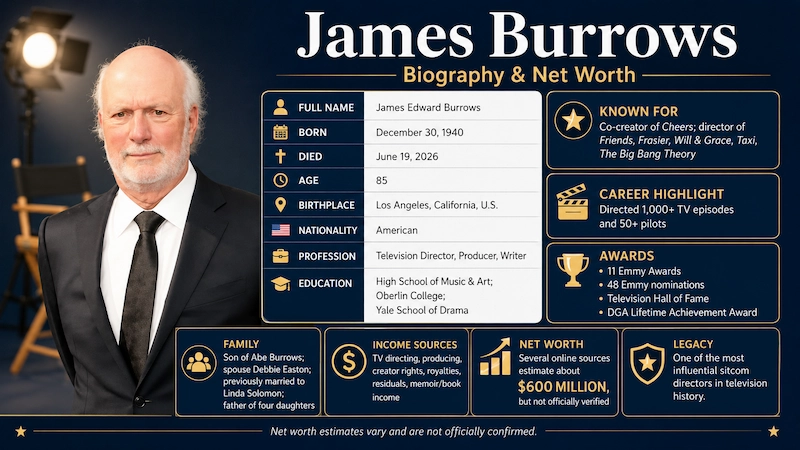
| Detail | Information |
|---|---|
| Full Name | James Edward Burrows |
| Popular Name | James Burrows, Jim Burrows, Jimmy Burrows |
| Date of Birth | December 30, 1940 |
| Age | 85 at the time of death |
| Date of Death | June 19, 2026 |
| Birthplace | Los Angeles, California, United States |
| Nationality | American |
| Profession | Television director, producer, writer, actor |
| Education | High School of Music & Art, Oberlin College, Yale School of Drama |
| Marital Status | Married at the time of death |
| Spouse or Partner | Debbie Easton; previously married to Linda Solomon |
| Children | Four daughters reported publicly |
| Known For | Co-creating Cheers and directing over 1,000 TV episodes |
| Current Residence | No current residence; passed away in 2026 |
| Estimated Net Worth | Around $600 million according to Celebrity Net Worth; not officially verified (Not publicly confirmed) |
| Main Income Sources | Television directing, producing, royalties, residuals, backend participation, book income |
| Active Years | 1960s–2025 |
| Official Website | No reliable official personal website found (Not publicly confirmed) |
| Official Social Media Profiles | Instagram: @therealjamesburrows, listed as official by the profile (Not publicly confirmed by a separate official website) |
These details reveal a figure whose public identity was built less on celebrity visibility and more on professional authority. Burrows spent most of his life behind the camera, yet his work shaped how millions of people understood sitcom timing, ensemble chemistry,y and live-audience comedy.
Official Sources
- Television Academy Profile
- Directors Guild of America Statement
- IMDb Profile
- Penguin Random House Author Page / Memoir
Early Life and Background
James Edward Burrows was born on December 30, 1940, in Los Angeles, California. His father, Abe Burrows, was a respected writer, humorist, and Broadway figure connected with major stage works such as Guys and Dolls and How to Succeed in Business Without Really Trying. That family background matters because James Burrows did not enter entertainment from the outside. He grew up close to theater, writers, rehearsals,s and the particular pressure of making comedy work in front of people.
| Early Life Detail | Information |
|---|---|
| Birth Name | James Edward Burrows |
| Birthplace | Los Angeles, California |
| Family Influence | Son of Broadway writer and director Abe Burrows |
| Childhood Setting | Raised partly around New York theater circles |
| Early Creative Exposure | Theater, comedy writing, staging, and live performance |
There is a sense that Burrows inherited not only access to show business but also its discipline. Comedy, in his world, was not casual. It was built, rehearsed, cut, timed, and tested. That practical understanding later became the foundation of his television style.
Education
Burrows’ education reflected both artistic training and professional seriousness. Public records and major profiles describe him as having attended New York’s High School of Music & Art before studying at Oberlin College and later the Yale School of Drama.
| Institution | Area / Degree | Status |
|---|---|---|
| High School of Music & Art | Arts-focused schooling | Publicly reported |
| Oberlin College | Undergraduate studies | Publicly reported |
| Yale School of Drama | Graduate training | Publicly reported |
His Yale training helped give him a stage director’s eye. Unlike many television directors who approached sitcoms mainly as camera work, Burrows treated episodes like short plays. Actors moved with purpose. Jokes landed because the physical geography made sense. The studio audience was not an accessory; it was part of the machine.
Career Journey
James Burrows’ career did not begin with instant power. He worked in theater, stage management, and early television before finding his real opening in the 1970s. His television break came through MTM Enterprises, where he directed episodes of The Mary Tyler Moore Show and The Bob Newhart Show. Those early jobs placed him inside one of the smartest comedy factories in American television.
| Period | Career Stage | Key Work |
|---|---|---|
| 1960s–early 1970s | Theater and early production work | Stage management, theater directing |
| 1974 | TV directing breakthrough | The Mary Tyler Moore Show |
| Late 1970s | Sitcom reputation grows | Taxi |
| 1982–1993 | Major creative breakthrough | Co-created and directed Cheers |
| 1990s | Peak network sitcom era | Frasier, Friends, 3rd Rock from the Sun |
| 1998–2020 | Long-running signature work | Directed every episode of Will & Grace |
| 2000s–2025 | Veteran comedy architect | Two and a Half Men, The Big Bang Theory, Mike & Molly, Mid-Century Modern |
The turning point was Taxi. Burrows learned how to guide a brilliant ensemble without flattening individual comic voices. Then came Cheers, the show that changed his professional life. Co-created by Glen and Les Charles, Cheers began quietly, struggled early in its ratings run, and eventually became one of the defining sitcoms of American television.
Watching the career unfold, it is hard not to notice the pattern: producers trusted Burrows when the stakes were high. He became the pilot director people called when a show needed chemistry fast. That is why his name appears near the beginnings of so many successful comedies.
Major Achievements
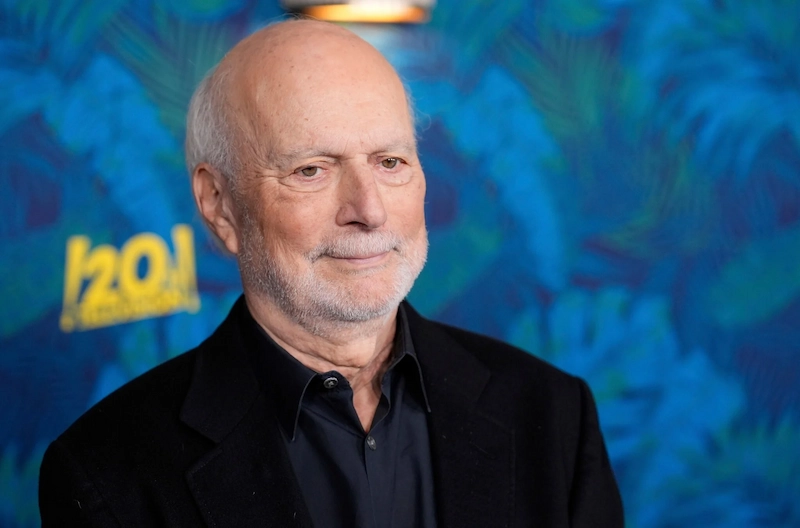
Burrows’ achievements are unusually deep because they are both statistical and cultural. He directed more than 1,000 television episodes, directed more than 50 pilots, won 11 Emmy Awards, received dozens of Emmy nominations, and earned major recognition from the Directors Guild of America.
| Achievement | Details |
|---|---|
| Emmy Awards | 11 wins |
| Emmy Nominations | 48 nominations reported by Television Academy / DGA |
| DGA Recognition | Lifetime Achievement Award in Television Direction |
| Television Hall of Fame | Inducted in 2006 |
| Major Shows | Taxi, Cheers, Frasier, Friends, Will & Grace |
| Career Milestone | Directed more than 1,000 TV episodes |
| Memoir | Directed by James Burrows |
These achievements show more than longevity. They show taste. Burrows had a gift for identifying the temperature of a scene — when to let a laugh breathe, when to move an actor, when to cut a joke, and when to protect emotion from being swallowed by punchlines.
Businesses, Investments, and Income Sources
James Burrows made money primarily through television. His income sources included directing fees, producer compensation, co-creator participation, residuals, syndication value, and long-term association with major sitcom properties.
| Income Source | Details |
|---|---|
| Television Directing | Main professional income source |
| Producing | Executive producer and producer credits on multiple shows |
| Cheers Co-Creator Rights | Likely major long-term wealth source |
| Royalties and Residuals | Reported as significant,t but exact figures are not officially verified |
| Book Income | Memoir Directed by James Burrows |
| Real Estate | Several online sources mention property holdings, but full details are not officially verified (Not publicly confirmed) |
The strongest income stream appears to have come from television ownership and residual economics rather than one-time directing checks. A director who works on a forgettable show earns a fee. A director and co-creator attached to a long-running syndicated classic can build wealth across decades.
Net Worth Analysis
Several online sources estimate James Burrows’ net worth at around $600 million, but this figure is not officially verified (Not publicly confirmed). Estimates vary across sources, and the exact figure has not been publicly confirmed.
| Net Worth Factor | Publicly Known or Reported Context |
|---|---|
| Common Online Estimate | Around $600 million (Not publicly confirmed) |
| Main Wealth Source | Television directing and producing |
| Major Asset Driver | Cheers creator participation and long-term sitcom economics |
| Recurring Income | Royalties, residuals, and backend earnings reported online (Not publicly confirmed) |
| Real Estate | Property holdings reported by wealth sites (Not publicly confirmed) |
| Official Financial Disclosure | No reliable public official disclosure found (Not publicly confirmed) |
The $600 million estimate is believable to many observers because Burrows was connected to shows with enormous rerun, syndication, and streaming value. Still, it should not be treated as a confirmed financial statement. Unlike public company executives, television directors and producers rarely disclose exact figures for their personal wealth.
His wealth story is best understood through the lens of leverage. Burrows did not merely direct individual episodes. He helped launch shows, shape pilots, and maintain creative quality across long runs. In television, that can create lasting economic value.
Personal Life
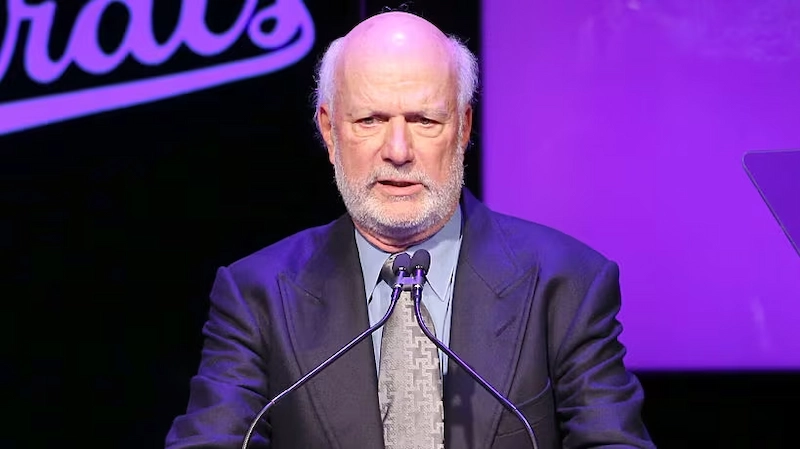
James Burrows kept his personal life relatively private compared with the fame of the shows he directed. He was married to Debbie Easton at the time of his death. He was previously married to Linda Solomon. Public reports state that he had four daughters and seven grandchildren.
| Personal Detail | Information |
|---|---|
| Wife | Debbie Easton |
| Previous Marriage | Linda Solomon |
| Children | Four daughters publicly reported |
| Grandchildren | Seven publicly reported |
| Father | Abe Burrows |
| Lifestyle | Private, industry-focused, family-oriented public image |
Burrows’ family statement after his death emphasized not only his professional influence but also his kindness, generosity, and devotion as a husband, father, and grandfather. That matters because many tributes from actors and collaborators echoed the same theme: he was demanding about the work, but generous with people.
Public Image and Influence
James Burrows was often described as a director’s director. Viewers knew his shows, even when they did not know his face. In Hollywood, however, his reputation was enormous. Actors trusted him. Writers respected his instincts. Networks valued his ability to make pilots feel alive.
His influence was especially strong in multi-camera sitcoms. He understood how to use a studio audience without letting the audience control the show. He also helped normalize a faster, more theatrical rhythm that became a signature of NBC comedy during the Cheers, Frasier, Friends, and Will & Grace eras.
There were no major verified public controversies that defined his legacy. His public image rests mainly on craftsmanship, mentorship, IP, and consistency.
Social Media Presence
Burrows was not a social-media-first public figure. His career was built long before Instagram, TikTok, or X became part of celebrity branding. Still, an Instagram account using the handle @therealjamesburrows describes itself as his official account.
| Platform | Profile / Status |
|---|---|
| @therealjamesburrows, listed as official by the profile (Not publicly confirmed by a separate official website) | |
| X / Twitter | No reliable official public profile found (Not publicly confirmed) |
| No reliable official public profile found (Not publicly confirmed) | |
| YouTube | No reliable official personal channel found (Not publicly confirmed) |
His online influence comes less from his own posts and more from the continued popularity of his shows. Clips from Friends, Cheers, Frasier, and Will & Grace still circulate widely, introducing younger audiences to his work without always naming him.
Interesting Facts About James Burrows
- James Burrows directed more than 1,000 television episodes.
- He co-created Cheers with Glen Charles and Les Charles.
- He directed every episode of the original Will & Grace and returned for the revival.
- He directed the pilot episode of Friends.
- He was inducted into the Television Academy Hall of Fame in 2006.
- He won 11 Emmy Awards across his career.
- His father, Abe Burrows, was a major Broadway writer and director.
- He published the memoir Directed by James Burrows.
- He was widely known in the industry as “Jimmy.”
- Several online sources estimate his net worth at around $600 million, but this is not officially verified (Not publicly confirmed).
Future Plans and What Comes Next
Because James Burrows died on June 19, 2026, plans now belong to his legacy rather than active career moves. His work will likely continue to be studied by comedy writers, actors, directors, and television historians. There is also room for renewed interest in his memoirs, interviews,s and archived directing work.
The next phase of public attention may focus on reassessing his authorship. Television often gives more public credit to actors and showrunners than directors, yet Burrows’ career makes that hierarchy look too simple. He shaped performances, rhythm, and tone across multiple generations of comedy.
FAQs
Who is James Burrows?
James Burrows was an American television director, producer,r and co-creator of Cheers, best known for directing more than 1,000 sitcom episodes.
What is James Burrows known for?
He is known for directing Taxi, Cheers, Frasier, Friends, Will & Grace, The Big Bang Theory,ry and many other classic sitcoms.
What was James Burrows’ net worth?
Several online sources estimate James Burrows’ net worth at around $600 million, but this figure is not officially verified (Not publicly confirmed).
How did James Burrows make money?
He made money through television directing, producing, co-creator rights, royalties, residuals, and book income.
How old was James Burrows?
James Burrows was 85 years old when he died on June 19, 2026.
Was James Burrows married?
Yes. James Burrows was married to Debbie Easton at the time of his death. He was previously married to Linda Solomon.
What did James Burrows do for a living?
He worked as a television director and producer, specializing in sitcoms and multi-camera comedy.
Where is James Burrows now?
James Burrows died in 2026. His legacy continues through the many television shows he directed and helped create.
Final Reflection
James Burrows’ story is unusual because he helped define popular culture without becoming its central celebrity. He was the person behind the laugh, the pause, the entrance, the exit, and the chemistry that made a cast feel like family. That kind of work is easy to miss when it is done well.
In many ways, James Burrows represents the invisible architecture of television comedy. Audiences may not have shouted his name, but his timing lived in their living rooms for decades. People continue to search for him because his death reminded viewers that behind some of the most familiar shows in American TV history stood one director with a rare instinct for people, rhythm, and laughter.

Table of Contents