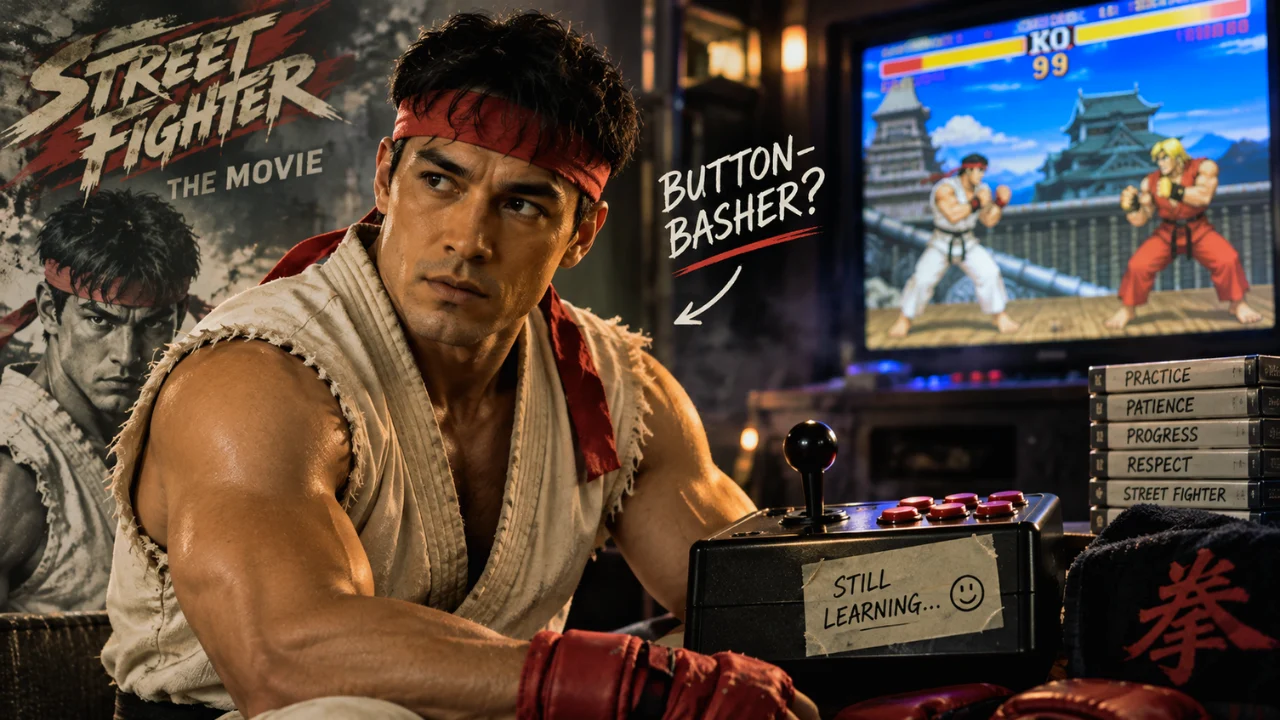
Street Fighter Movie’s Ryu Actor Admits He Was a ‘Button-Basher’ Who Struggled With the Game
Byron Mann, the actor who played iconic martial artist Ryu in the 1994 live-action Street Fighter movie, has been upfront about his lack of skill in the arcade game that started his career. Reflecting on the production in recent years, Mann revealed that he’s a “button-basher” in gaming and that he’s better on-screen than off-screen.
Byron Mann, who starred as Ryu in the 1994 Street Fighter movie, said he wasn’t good at the arcade game during filming. He described his style of play as “button-bashing” rather than precise combos, saying his focus was on physical performance and stunt work rather than reproducing high-level gaming mechanics.
Key Details
- Who: Byron Mann, actor best known for playing Ryu in the 1994 film Street Fighter.
- What: Mann confessed to having no advanced skills in the Street Fighter arcade game.
- Context: The admission highlights the separation between the physical demands of the film role and the technical precision required for competitive gaming.
- Quote: “Mann described himself as a ‘button basher’ during the time the film was made.
- Film Background: Steven E. de Souza directed the 1994 film, which starred Jean-Claude Van Damme as Ken Masters and Raúl Juliá as M. Bison.
The Reality Behind the Hadouken
For fans of the Capcom franchise, Ryu personifies disciplined martial arts and precise execution. But, Mann says, the reality behind the scenes was less about mastering the joystick and more about surviving the physical rigors of filmmaking.
Mann’s admission provides a lighthearted counterpoint to the intense training actors often undergo for action roles. Mann performed many of his own stunts and worked hard on his physical conditioning to become the wandering warrior, but he didn’t have to become a top-tier arcade player to prepare for the role.
Mann, who described himself as a ‘button-basher’, admitted: ‘I was not that good at the game. This term is often used in fighting game communities to describe players who randomly or unstrategically time their button presses, rather than performing specific input commands for special moves such as the Hadouken or Shoryuken.
Physical Performance vs. Gaming Precision
The 1994 Street Fighter movie was one of the first major Hollywood attempts at a video game adaptation. The cultural bridge between cinema and gaming was still in development. Casting relied more on looks and acting ability than on e-sports credentials.
Jean-Claude Van Damme (Ken Masters) was an actual karate champion, so he brought some authenticity to the fight choreography. Similarly, Mann’s martial arts background let him perform the physical movements of Ryu’s fighting style believably on camera. But the digital precision required to play the arcade cabinet competitively was a different skill set that Mann didn’t prioritize.
That distinction underscores a familiar theme with video game adaptations: the visual representation of a character is often more important than the mechanical accuracy of the source material. Mann wanted to deliver a believable physical performance that matched the film’s energetic tone, rather than replicate the frame-perfect inputs of a tournament player.
Legacy of the 1994 Adaptation
The 1994 Street Fighter movie received mixed reviews upon release, but has since become a cult hit. Part of this enduring interest comes from nostalgia for the era, and it was something new to see beloved characters come to life before the days of CGI-heavy blockbusters.
Critics tend to praise Raúl Juliá’s turn as the evil M. Bison even when they pan the story, and it is often named the best thing about the movie. Mann’s Ryu was less flamboyant than the others, but was the moral center of the film. His recent comments add a humanizing humility to his legacy, a reminder that the actors behind these iconic digital avatars are not necessarily experts in the virtual worlds they inhabit.
Why It Matters
Mann’s comments are particularly relevant in an era of media consumption when video game adaptations are regularly derided for their fidelity to the source material. In today’s world of productions like The Last of Us or Fallout, you will often find actors who know the games very well. But Mann’s experience comes from an earlier age of adaptation, when the aim was more to translate the game’s aesthetic and energy to the big screen than to achieve simulation-level accuracy.
And it’s a reminder that being good at something like martial arts or acting doesn’t mean you’re good at something completely different, like competitive gaming. It gives fans a relatable side of the star, bridging the gap between the polished hero on screen and the casual player off screen.
What Happens Next
Byron Mann is still active in film and television today, with recent TV credits in Arrow and Hell on Wheels. There are no current announcements of a return to the Street Fighter franchise for Mann, especially with the recent reboot of the film series and the 2025 Street Fighter movie in development.
As new adaptations loom, Mann’s candid reflection is a historical footnote in the long relationship between Hollywood and Capcom, highlighting fans’ evolving expectations and the different skills needed to bring digital characters to life.
FAQ
Was Byron Mann a pro Street Fighter player?
No. Byron Mann has said he wasn’t very good at the game, calling himself a “button-basher” rather than a competitive or professional player.
Who played Ryu in the 1994 Street Fighter movie?
Byron Mann played Ryu in the 1994 live-action adaptation directed by Steven E. de Souza.
How well did the Street Fighter movie do in 1994?
The film received mixed to negative reviews from critics but was a moderate box office success and has since gained a cult following among fans of the franchise and 1990s action cinema.
Who played Ken Masters in the 1994 movie?
Jean-Claude Van Damme played Ken Masters opposite Byron Mann’s Ryu.

Table of Contents