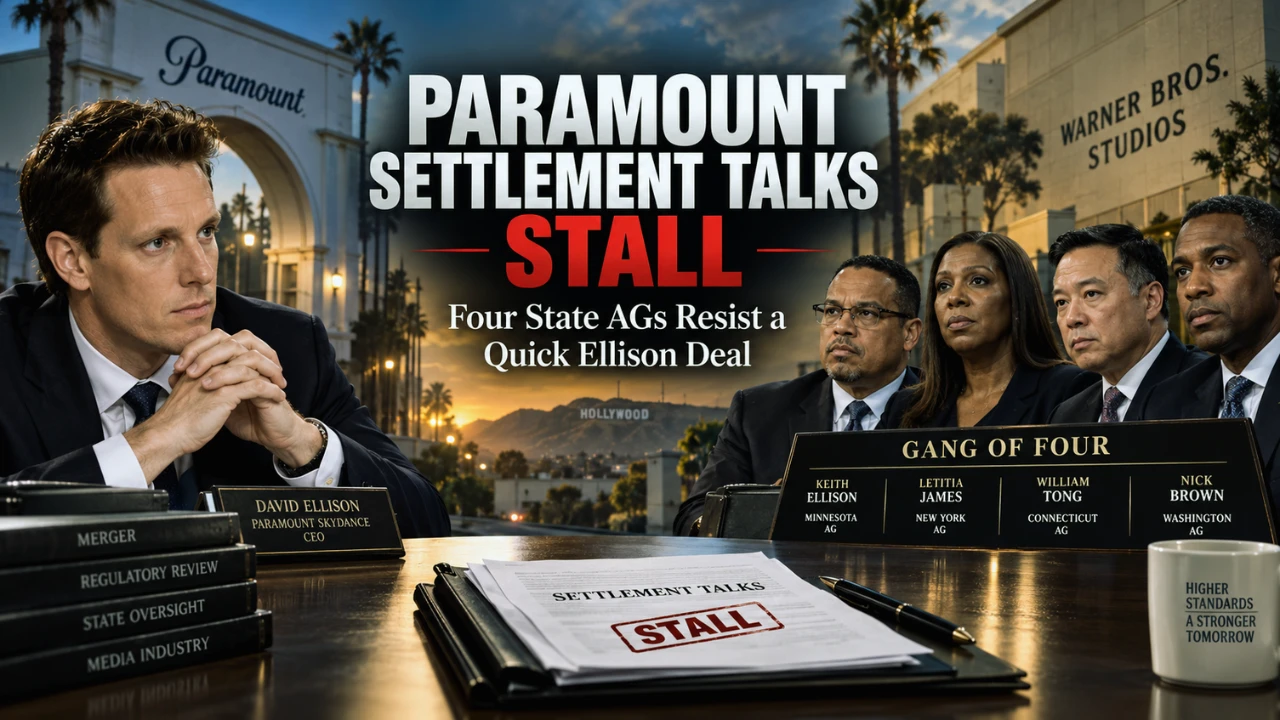
Paramount Settlement Talks Stall as ‘Gang of Four’ State AGs Resist Quick Ellison Deal
Settlement talks over the antitrust lawsuit against Paramount Global’s proposed $111 billion merger with Warner Bros. Discovery have stopped. But a coalition of four state attorneys general is fighting a fast settlement, saying the proposed terms are too lenient and lack meaningful structural remedies, according to multiple reports.
Talks have collapsed over Paramount’s planned $111 billion merger with Warner Bros. Discovery. A group of four state attorneys general, known as the “Gang of Four,” is holding out against a quick settlement agreement. The proposed terms are said to be too lenient on Paramount and don’t offer strong structural remedies to address antitrust concerns about media consolidation.
Key Details
- What happened: Talks to settle an antitrust suit blocking Paramount-Warner Bros. Advanced 12-State Discovery merger talks have hit a snag.
- Who is in it: Paramount Skydance CEO David Ellison, California Attorney General Rob Bonta, and a resisting coalition of four state AGs (Minnesota, New York, Connecticut, Washington).
- Where: United States (California-based legal negotiations, federal courts)
- When: September 2026, with an important deadline of October 1, 2026, looming for Paramount’s threatened California exit.
- The latest: The “Gang of Four” AGs refuse to agree to a settlement they say has no “teeth,” even as they’re being pressured to settle the dispute.
- What comes next: Court-ordered settlement talks are set for Oct. Without a deal, Paramount would face a continuing antitrust trial and a possible change in operating base.
What Happened in the Settlement Talks?
Paramount Skydance, led by Chief Executive David Ellison, has been in advanced talks with California Attorney General Rob Bonta to resolve a multistate antitrust lawsuit over the company’s acquisition of Warner Bros. Discovery. A coalition of 12 states brought a lawsuit claiming that the combined company would result in a “presumptively illegal market concentration” in the distribution of film and TV.
California AG Bonta has reportedly been willing to negotiate a resolution, but the process has splintered. Four of the 12 attorneys general initially involved in the federal court challenge are now breaking from the California-led coalition. The four states are said to be skeptical of the settlement’s proposed parameters, fearing that minor concessions such as cosmetic tweaks around CNN and limited cable network divestitures won’t go far enough to protect market competition.
Who Are the ‘Gang of Four’ Attorneys General?
The coalition of the opposition, called in recent legal and political circles the “Gang of Four,” is composed of:
- Minnesota Attorney General Keith Ellison
- New York Attorney General Letitia James
- Connecticut Attorney General William Tong
- Nick Brown, Washington Attorney General
Apparently, Keith Ellison, Minnesota’s attorney general, has been leading the resistance to the deal. “We’re asking California’s Rob Bonta to take a breath and not overreact to outside pressures, including threats from Paramount leadership,” the quartet said.
What Officials and Advocates Said
The tension has spilled into the public arena, with consumer advocacy groups echoing the holdout states’ complaints. A media advocacy group, Free Press, recently issued a statement urging attorneys general not to cave to what it called corporate pressure, pointing to threats from Paramount to move operations.
People familiar with the negotiations said the holdout states consider the current settlement framework “toothless” and would only be a win for David Ellison, and would let the merger go forward without addressing the antitrust violations at the heart of the original complaint.
Paramount, however, has argued that the combined company’s share of the market, estimated at around 27 percent of U.S. theatrical releases, does not show an illegal dominant market position, especially in a shrinking traditional pay-TV market.
Why It Matters
What happens out of this fight will have a huge impact on what the global media landscape looks like going forward.” If the merger goes through without strong structural remedies, it would create one of the biggest content and distribution conglomerates in history with a huge portfolio of legacy cable networks, film studios and streaming assets.
For California, it’s a game of economic and political stakes. For a long time, Paramount has been a mainstay of the Los Angeles economy. State officials are under tremendous pressure to balance aggressive antitrust enforcement with keeping major corporate employers, as David Ellison threatens to move operations by October 1, 2026.
It is also a key test of state antitrust enforcement amid relatively lax federal action, and it highlights a growing divide among Democratic attorneys general over how to regulate mega-mergers in the technology and media industries.
What Happens Next
The immediate focus is the court-ordered settlement talks set for October 2026. Usually, all 12 state attorneys general involved in the settlement need to sign off on the deal. So, the “Gang of Four” essentially has veto power over the current deal.
If the parties can’t reach a consensus, the lawsuit will move toward trial. Paramount has said it is prepared to go to an antitrust trial in November if talks fail. The Oc1deadlinee, meanwhile, remains a key flashpoint, with Paramount linking its California footprint directly to the outcome of the legal fight.
FAQ
The “Gang of Four” refers to the attorneys general of Minnesota, New York, Connecticut, and Washington, who are resisting a proposed antitrust settlement between Paramount and a 12-state coalition.
They argue that the proposed settlement terms are too lenient and lack “robust structural remedies,” such as meaningful divestitures, to prevent anti-competitive market concentration.
Paramount CEO David Ellison has said the company will begin moving operations out of California starting October 1, 2026, if October 1 does not agree to a settlement in the antitrust dispute.
The proposed acquisition is valued at approximately $81 billion to $111 billion, depending on debt assumptions and final deal structures, and would create a massive combined media entity.

Table of Contents