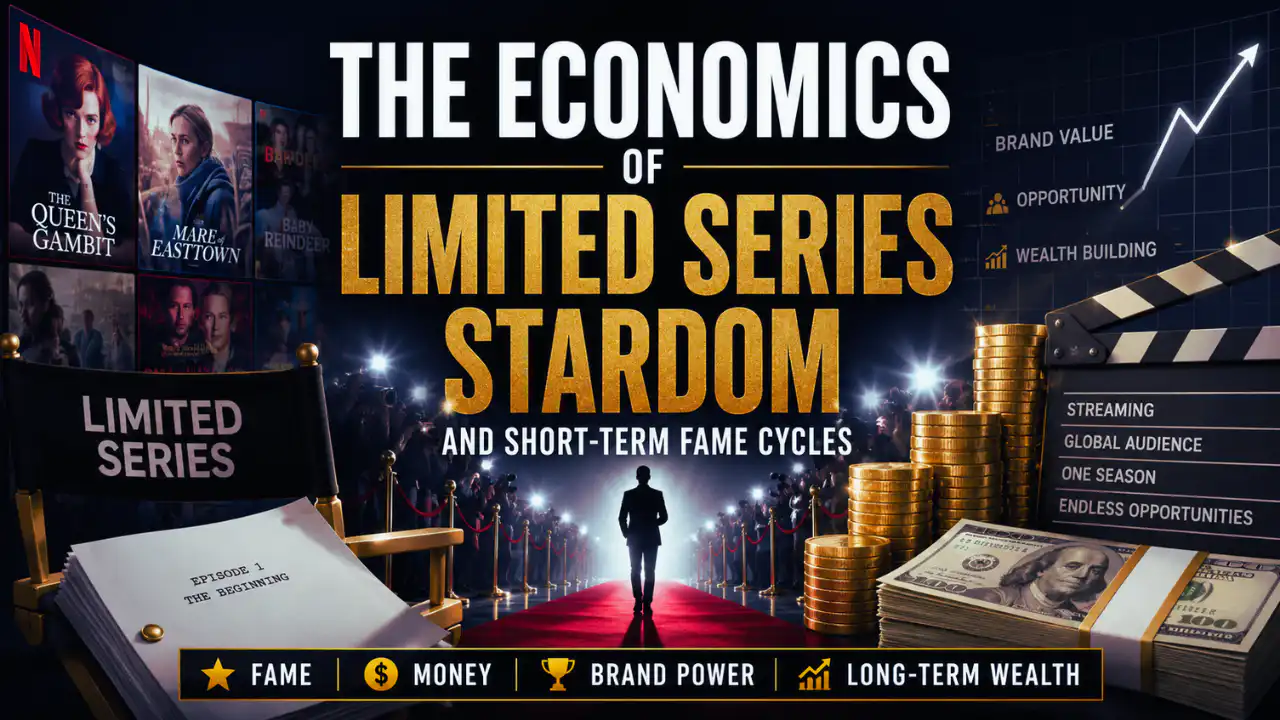
The Economics of Limited Series Stardom Explained
A decade ago, television fame often arrived slowly. Actors spent years building audiences through multi-season hits before leveraging that visibility into larger careers. Today, one limited series can turn a relatively unknown performer into a global name almost overnight.
That shift sits at the center of the economics of limited series stardom.
Streaming platforms have created an environment where audiences binge entire seasons over a weekend, social media amplifies breakout performances within hours, and celebrities experience massive visibility spikes that can disappear just as quickly. For actors, writers, and producers, the question is no longer how to become famous. It is how to convert a brief moment of cultural relevance into lasting wealth.
From award-winning projects like Baby Reindeer and The Queen’s Gambit to prestige hits like Mare of Easttown, limited series have become one of Hollywood’s most effective fame accelerators. Yet the business reality behind these projects is more complicated than many fans realize.
Why This Celebrity Wealth Trend Matters Now?
The entertainment industry has shifted from longevity to velocity.
Streaming companies compete for attention in crowded markets. Limited series fit that strategy perfectly because they offer contained stories, attract A-list talent, and generate award buzz without requiring decade-long commitments.
For performers, that creates opportunity and uncertainty at the same time.
An actor who headlines a breakout series can suddenly secure endorsement deals, agency upgrades, speaking opportunities, and invitations to larger franchise projects. Public attention becomes a financial asset, but only if it is monetized before audiences move on to the next viral show.
Industry observers have frequently noted that streaming has shortened cultural cycles. Shows that dominate headlines in January may barely be discussed by June. That compressed timeline has fundamentally changed celebrity wealth creation.
The creator economy has only accelerated the trend. Actors are increasingly using podcasts, newsletters, production companies, and social media channels to maintain visibility after a show’s release window closes.
The Business Model Behind the Money
Limited series economics are built around a combination of upfront compensation and downstream opportunities.
Actors are typically paid negotiated salaries for their performances. Beyond that, a successful project can unlock significant earning potential across multiple categories.
| Wealth Driver | How It Works | Why It Matters |
|---|---|---|
| Salary | Upfront payment for acting work | Provides immediate income |
| Residual Income | Payments tied to certain distribution agreements | Supports long-term earnings where applicable |
| Brand Deals | Partnerships with companies | Converts visibility into revenue |
| Licensing | Commercial use of image or likeness | Creates income without operating a business |
| Equity Deals | Ownership in ventures or startups | Offers long-term upside |
| Production Credits | Participation behind the camera | Builds ownership and leverage |
Not every actor benefits equally. Much depends on contract structures, representation, audience reception, and timing.
Salary Versus Ownership
Salary is immediate. Ownership is enduring.
An actor may earn a substantial fee for appearing in a limited series, but that payment usually ends once contractual obligations are complete. Ownership, by contrast, can continue generating value for years.
That is why many established stars negotiate executive producer credits or launch production companies. Companies such as Hello Sunshine, founded by Reese Witherspoon, demonstrate how talent can move beyond performance and into intellectual property ownership.
Similarly, performers increasingly seek stakes in consumer brands, media ventures, and startup investments after major career moments.
Brand Equity and Audience Trust
Fame itself has become an asset class.
Brand equity reflects the commercial value associated with a celebrity’s public image. A breakout role can increase that value dramatically, even if only temporarily.
Consider what happens when a limited series becomes a cultural phenomenon:
- Social media followers increase.
- Media appearances multiply.
- Luxury brands pursue partnerships.
- Future project offers expand.
- Speaking and appearance fees rise.
None of these outcomes are guaranteed. Still, publicly available data across the entertainment industry suggests that visibility often influences earning potential long after a show’s release.
The challenge is sustainability. Audience attention is finite, and entertainment cycles move quickly.
Why Traditional Net Worth Estimates Often Miss the Full Picture?
Celebrity net worth figures remain popular online, but they rarely tell the complete story.
Many estimates rely on publicly reported salaries and property records while overlooking private investments, taxes, management fees, and undisclosed ownership arrangements.
An actor’s financial profile might include:
- Production company interests
- Venture capital investments
- Real estate holdings
- Licensing agreements
- Book deals
- Podcast revenue
- Future royalty arrangements
- Private business ventures
At the same time, expenses can significantly reduce apparent wealth. Agents, managers, attorneys, publicists, and tax obligations all affect what celebrities ultimately retain.
For limited series stars, wealth can be especially difficult to assess because career trajectories are still developing. Someone experiencing their first major breakout role may not reach peak earning power until several years later.
That Shows How This Works
Several recent success stories illustrate the economics behind short-term fame cycles.
Anya Taylor-Joy saw her profile rise substantially following The Queen’s Gambit, leading to additional film opportunities and luxury fashion partnerships.
Richard Gadd benefited not only from acting exposure but also from creator recognition, highlighting the value of ownership in modern entertainment.
Meanwhile, Kate Winslet demonstrated how established stars use limited series to reinforce existing brand equity while attracting new audiences.
These examples highlight an important distinction. The biggest financial opportunity often comes after the show, not during it.
The Risks Behind Celebrity Business Ventures
Short-term fame creates pressure to move quickly.
That urgency can lead celebrities into partnerships that fail to align with their audience or expertise.
Common risks include:
- Overexpansion into multiple businesses.
- Weak product-market fit.
- Poor management teams.
- Audience fatigue.
- Declining cultural relevance.
- Licensing disputes.
- Misaligned endorsement deals.
- Overreliance on a single project’s popularity.
Entertainment history is full of examples where temporary fame failed to translate into lasting success.
Limited series can create enormous visibility, but visibility alone does not guarantee celebrity wealth. Sustainable businesses require strategy, operational discipline, and often a willingness to evolve beyond one’s original audience.
What This Reveals About Modern Celebrity Wealth?
The economics of limited series stardom reveal a larger truth about Hollywood money.
Ownership, rather than appearances, increasingly shapes modern celebrity wealth. Intellectual property, production credits, licensing agreements, and private investments now play a larger role in long-term financial outcomes than many viewers realize.
Streaming has compressed the timeline between obscurity and global recognition. It has also compressed the window available to capitalize on that recognition.
For the next generation of entertainers, success may depend less on landing one major role and more on what they build after it.
Limited series are not just entertainment products. They are launchpads for brands, businesses, and entirely new career paths.
As streaming platforms continue investing in premium storytelling, audiences should expect short-term fame cycles to remain a defining feature of the entertainment business for years to come.
FAQs
1. What are the economics of limited series stardom?
It refers to how actors and creators generate income and career opportunities from limited series through salaries, brand partnerships, ownership deals, and related business ventures.
2. Why do limited series create short-term fame?
Streaming platforms concentrate audience attention into short release windows, creating rapid visibility that can fade quickly as new content enters the market.
3. Do actors make more money from ownership than salaries?
In some cases, yes. Ownership stakes, production credits, and equity deals can generate greater long-term value than a single acting paycheck.
4. Why are celebrity net worth estimates often inaccurate?
Many estimates do not account for taxes, private investments, undisclosed business interests, liabilities, or future income streams.
5. How do celebrities turn temporary fame into long-term wealth?
They often leverage visibility into production companies, endorsement deals, licensing agreements, investments, and entrepreneurial ventures.
Interested in the business behind fame? Explore more celebrity wealth stories, Hollywood money breakdowns, and entertainment industry analysis to see how modern stars build fortunes beyond the spotlight.
Table of Contents