Who Is Ken Kesey? Biography, Career, Family & Legacy
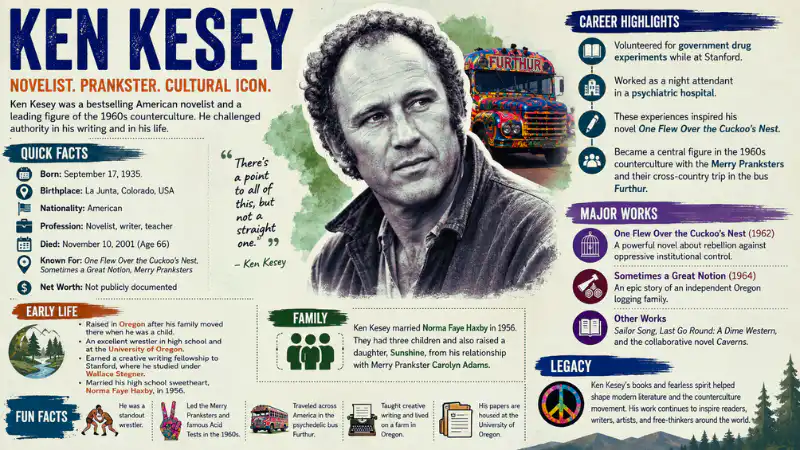
This Ken Kesey biography explores the life of the Oregon-raised novelist behind One Flew Over the Cuckoo’s Nest, along with his second major novel, Counterculture. The Merry Pranksters, family, and lasting cultural influence. It also separates well-documented facts from details such as height and net worth that are not reliably established.
Who Is Ken Kesey?
Ken Kesey was the kind of writer who refused to stay inside the boundaries of literature. Best known for One Flew Over the Cuckoo’s Nest, the 1962 novel that challenged institutional authority and conformity, Kesey became equally famous for his role in the psychedelic counterculture of the 1960s.
So, who is Ken Kesey in the bigger picture? He was an American novelist, essayist, teacher, rancher, and cultural provocateur whose life moved between serious literary work and the wild experimentation of the Merry Pranksters.
Born in Colorado and raised largely in Oregon, Kesey studied at the University of Oregon before earning a creative writing fellowship to Stanford. His experiences working around psychiatric patients and participating in government drug experiments helped shape his most famous novel. Later, his psychedelic parties and cross-country trip in a painted school bus made him an unlikely symbol of the 1960s counterculture.
Quick Facts
| Field | Details |
|---|---|
| Full Name | Ken Elton Kesey |
| Date of Birth | September 17, 1935 |
| Age | 66 at the time of his death |
| Birthplace | La Junta, Colorado, U.S. |
| Nationality | American |
| Profession | Novelist, writer, teacher, cultural figure |
| Height | Not publicly confirmed by reliable sources |
| Known For | One Flew Over the Cuckoo’s Nest, Sometimes a Great Notion, Merry Pranksters |
| Net Worth | Not reliably documented |
Kesey died on November 10, 2001, in Eugene, Oregon, at the age of 66.
Early Life and Background
Ken Elton Kesey was born on September 17, 1935, in La Junta, Colorado. When he was a child, his family moved to the Springfield area of Oregon, where his parents became involved in the dairy business. The Oregon landscape and culture would remain deeply connected to Kesey throughout his life.
Long before he became a literary celebrity, Kesey was an accomplished athlete. He was a standout wrestler in high school and later competed at the University of Oregon. His athletic background was a striking contrast to the image that would eventually define him as a psychedelic-era writer.
Kesey graduated from the University of Oregon in 1957 with a degree in speech and communication. He then moved to Stanford University after receiving a fellowship to study creative writing. At Stanford, he studied under celebrated writer and teacher Wallace Stegner and became part of a creative environment that helped shape his literary ambitions.
His personal life was also established relatively early. Kesey married his high school sweetheart, Norma Faye Haxby, in 1956. The couple remained married until Kesey’s death. They had three children and also raised a daughter connected to Kesey’s relationship with fellow Merry Prankster Carolyn Adams.
Career Breakthrough
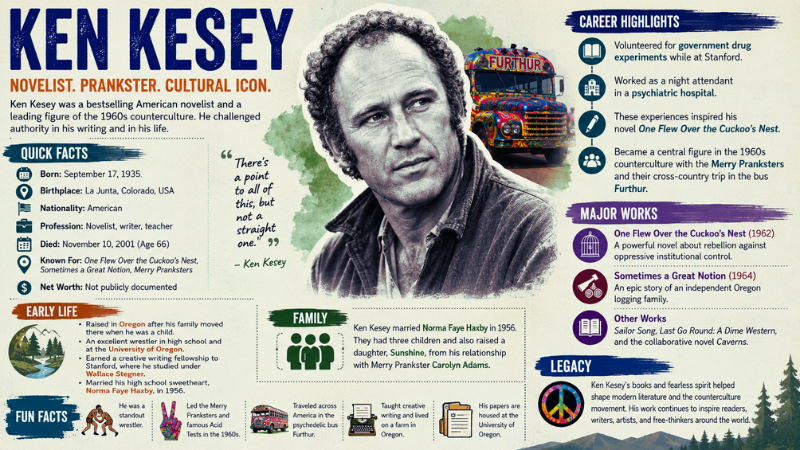
Kesey’s breakthrough came from an unusual combination of literary ambition and firsthand experience.
While studying at Stanford, he volunteered for experimental research involving psychoactive drugs at a Veterans Administration hospital in Menlo Park. He also worked as a night attendant in a psychiatric hospital. Those experiences gave him an unusual perspective on patients, institutional authority, and the ways society labels people who do not conform.
That material became the foundation for One Flew Over the Cuckoo’s Nest.
Published in 1962, the novel follows Randle P. McMurphy, a rebellious inmate who challenges the oppressive Nurse Ratched inside a psychiatric institution. The book quickly became a major success and established Kesey as an important young American novelist.
The Library of Congress describes the novel as an indictment of mental institutions and their treatment of patients, while also connecting its themes of control and rebellion to the wider social tensions of 1960s America.
The book’s success gave Kesey the financial freedom to pursue a very different kind of creative life.
Major Works and Achievements
One Flew Over the Cuckoo’s Nest
Kesey’s first novel remains his defining literary achievement. Its characters, especially McMurphy and Nurse Ratched, became cultural shorthand for rebellion against institutional control.
The novel also had a major life beyond the printed page. A Broadway adaptation appeared in the 1960s, and the 1975 film directed by Miloš Forman became one of the most celebrated American movies of its era.
The film won the five major Academy Awards, including Best Picture, Best Director, Best Actor, Best Actress, and Best Screenplay.
Kesey himself reportedly disliked important differences between the film and his novel and did not embrace the movie as an adaptation of his work.
Sometimes a Great Notion
Kesey followed his first major success with Sometimes a Great Notion, published in 1964.
Set in Oregon, the novel focuses on a fiercely independent logging family and explores loyalty, pride, conflict, work, and individualism. It was more ambitious and structurally complex than Cuckoo’s Nest, using shifting perspectives and unconventional storytelling techniques.
Although it did not achieve the commercial success of his first novel, critics have often regarded it as a major work of American and Pacific Northwest literature. A film adaptation starring Paul Newman and Henry Fonda was released in 1970.
The Merry Pranksters and “Further”
Kesey’s cultural influence expanded dramatically after the success of his novels.
In the 1960s, he became the central figure of a group known as the Merry Pranksters. The group experimented with psychedelic art, music, performance, communal living, and altered states of consciousness.
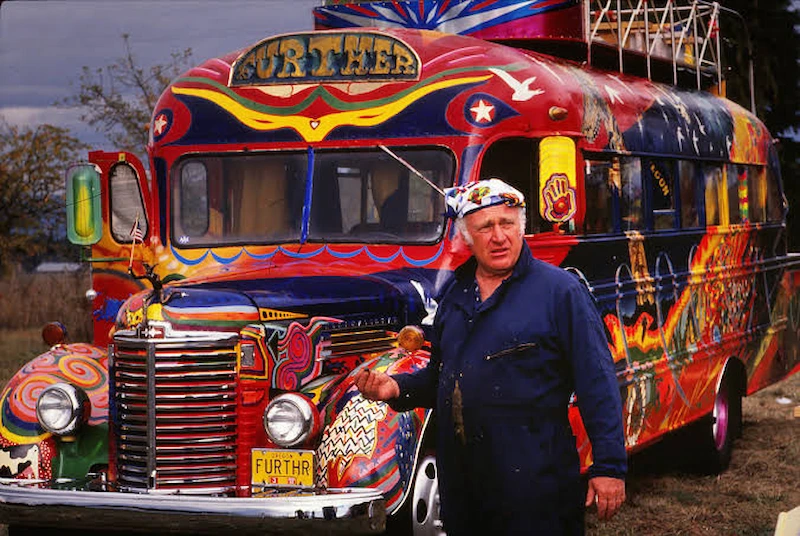
In 1964, Kesey and the Pranksters traveled across the United States in a brightly painted school bus called Furthur. Their journey became one of the defining stories of the emerging counterculture and was later chronicled by Tom Wolfe in The Electric Kool-Aid Acid Test.
The Pranksters also staged events known as Acid Tests, which combined music, visual effects, performance, and psychedelic experimentation. The Grateful Dead became closely associated with these events during their early years.
Kesey’s influence therefore stretched well beyond books. He became one of the figures who helped connect the Beat generation with the hippie culture that emerged later in the 1960s.
Later Career and Life
The intensity of Kesey’s counterculture years eventually gave way to a quieter life in Oregon.
After legal problems connected to marijuana possession, Kesey spent time away from California and eventually settled permanently on a farm in Pleasant Hill, Oregon. There, he raised children, worked the land, taught writing, and continued producing essays, books, plays, and other creative work.
His later books included Sailor Song and Last Go Round: A Dime Western. He also worked with students at the University of Oregon on the collaborative novel Caverns, published under the pseudonym O.U. Levon.
Kesey never quite returned to the enormous commercial impact of One Flew Over the Cuckoo’s Nest. Instead, his later years reflected a broader interest in teaching, community, family, agriculture, experimentation, and preserving the spirit of his earlier work.
He died in Eugene, Oregon, on November 10, 2001.
Ken Kesey Family and Personal Life
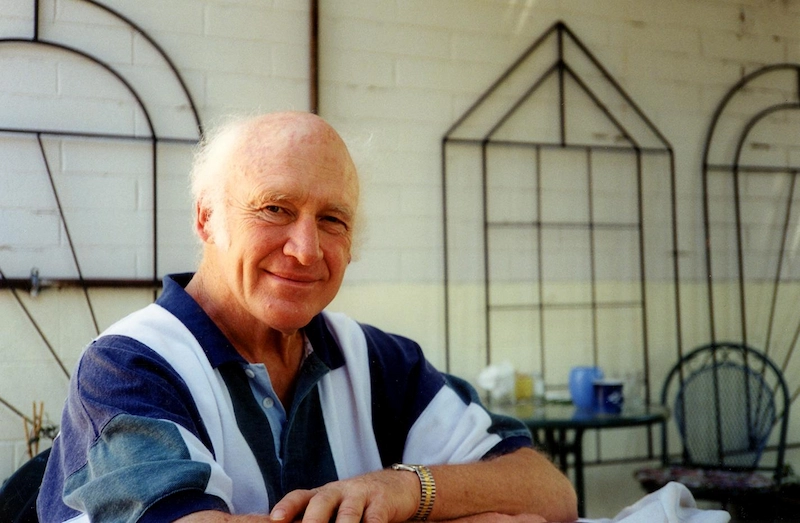
Ken Kesey’s family life was closely intertwined with his career and the dramatic changes he experienced.
He married Norma Faye Haxby in 1956, years before his literary fame. The couple had three children. Kesey also fathered a daughter, Sunshine, with Carolyn Adams, better known as Mountain Girl within the Merry Pranksters.
His wife Faye remained an important figure throughout his life. The reference article about Norma Faye Kesey also highlights the couple’s long marriage and her connection to Kesey’s literary and countercultural years. However, some details in that article are less firmly documented than the biographical information found in institutional sources, so the broader historical record is the safer basis for this biography.
Outside writing, Kesey maintained strong interests in wrestling, farming, teaching, performance, and experimental art. His personality was often described through his willingness to challenge conventional ideas and turn everyday life into a form of creative expression.
Ken Kesey Net Worth and Income Sources
There is no reliable, authoritative public figure for Ken Kesey’s net worth.
Some celebrity and biography websites publish estimates, but these figures are difficult to verify and should not be treated as facts. For that reason, a specific dollar amount would be misleading.
Kesey’s known professional income came primarily from his writing, including the commercial success of One Flew Over the Cuckoo’s Nest and subsequent books. The success of his first novel gave him enough financial freedom to purchase property and pursue his unconventional lifestyle, according to historical accounts.
His literary estate and continued publication of his works also contribute to the ongoing economic value of his writing, although the precise earnings are not publicly established.
Fun Facts About Ken Kesey
- Kesey was a highly accomplished wrestler before becoming a famous writer.
- He studied creative writing at Stanford under Wallace Stegner.
- His work in a psychiatric hospital helped inspire One Flew Over the Cuckoo’s Nest.
- He participated in government-backed psychedelic drug research while at Stanford.
- His Merry Pranksters traveled across America in the psychedelic school bus Furthur.
- Tom Wolfe’s The Electric Kool-Aid Acid Test helped turn the Pranksters’ journey into a defining counterculture story.
- Kesey’s papers are housed at the University of Oregon.
- His second major novel, Sometimes a Great Notion, was deeply rooted in the Pacific Northwest.
- Kesey continued teaching creative writing and experimenting with collaborative storytelling later in life.
Why Ken Kesey Remains Relevant?
Ken Kesey is no longer a living public figure, so describing him as “gaining attention” requires some context. His relevance comes from the fact that the subjects he explored have never really disappeared.
One Flew Over the Cuckoo’s Nest remains part of the American literary canon, while its film adaptation continues to be studied and watched. The Library of Congress includes the novel among significant American works, and the 1975 movie is preserved in the National Film Registry.
His influence also extends into the history of American counterculture. The Merry Pranksters, their Furthur bus, and the Acid Tests remain important reference points in discussions of psychedelic art, music, literature, and the social movements of the 1960s. The Smithsonian has highlighted the Pranksters’ journey as an important cultural artifact of that period.
That combination explains why searches for Ken Kesey continue decades after his death. He was not simply the author of one famous novel. He became part of the story of how American culture changed during the 1960s.
Conclusion
Ken Kesey’s life is difficult to reduce to a single label. He was a successful novelist, a gifted storyteller, an athlete, a teacher, a farmer, and one of the most recognizable figures of America’s psychedelic counterculture.
His greatest literary achievement, One Flew Over the Cuckoo’s Nest, gave him a permanent place in American literature. His Merry Pranksters years gave him a very different kind of fame, connecting him with the music, art, experimentation, and social rebellion of the 1960s.
What makes Kesey particularly interesting is the contrast between those two sides of his life. The serious novelist and the counterculture provocateur were not really separate people. Both reflected his lifelong fascination with freedom, individuality, authority, and the limits society places on human behavior.
More than two decades after his death, his books and cultural legacy continue to give new readers a reason to ask: who is Ken Kesey, and why does his story still matter?
FAQs
Who is Ken Kesey?
Ken Kesey was an American novelist and counterculture figure best known for writing One Flew Over the Cuckoo’s Nest and Sometimes a Great Notion. He also led the Merry Pranksters during the 1960s psychedelic movement.
How old was Ken Kesey when he died?
Ken Kesey was 66 years old when he died on November 10, 2001, in Eugene, Oregon. He was born on September 17, 1935.
What is Ken Kesey known for?
Kesey is best known for One Flew Over the Cuckoo’s Nest, his novel Sometimes a Great Notion, and his leadership of the Merry Pranksters and their psychedelic Acid Tests.
What was Ken Kesey’s height?
Ken Kesey’s height is not reliably documented in the major biographical and institutional sources consulted for this article, so a specific figure should not be presented as fact.
Where was Ken Kesey from?
Ken Kesey was born in La Junta, Colorado, but he grew up largely in Oregon after his family moved to the Springfield area when he was a child. Oregon remained central to his identity and later life.
What was Ken Kesey’s net worth?
Ken Kesey’s exact net worth has not been reliably established in authoritative public records. His primary professional income came from his books and related literary work, with One Flew Over the Cuckoo’s Nest providing his most significant commercial success.
Interested in more literary biographies and fascinating stories behind famous cultural figures? Explore more author profiles and discover the people behind the books, movements, and works that shaped popular culture.

Table of Contents