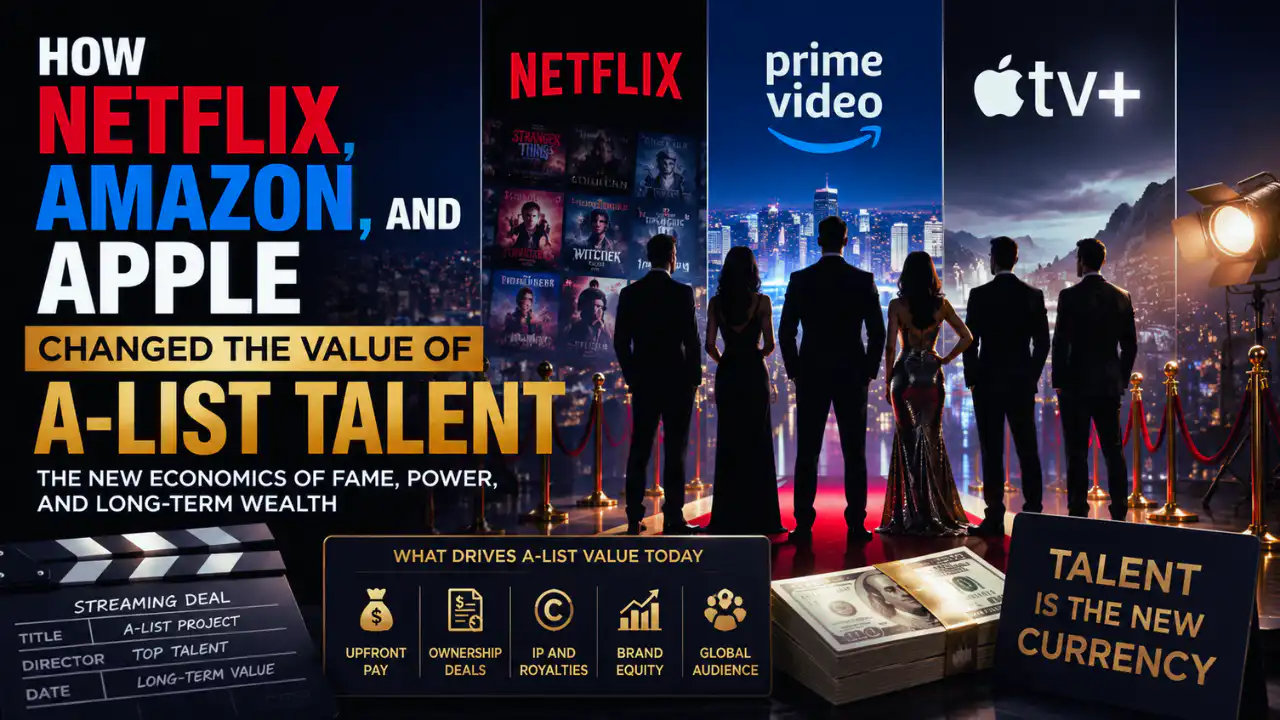
Netflix, Amazon, Apple, and A-List Talent Value
A decade ago, Hollywood’s biggest stars chased box office numbers. Today, many of them are negotiating with technology companies.
The arrival of Netflix, Amazon, and Apple has reshaped the entertainment business in ways few could have predicted. Streaming platforms have not only changed how audiences watch content, but they have also fundamentally altered the value of A-list talent. Actors, filmmakers, and producers are now part of a marketplace where streaming rights, global distribution, and intellectual property can be worth more than a theatrical opening weekend.
For readers interested in celebrity wealth, Hollywood money, and modern business ventures, this shift offers a fascinating lesson. The biggest names in entertainment are increasingly building wealth through ownership deals, producing credits, and long-term partnerships rather than relying solely on salaries.
Why This Celebrity Wealth Trend Matters Now?
Streaming was initially seen as a distribution upgrade. It quickly became something much larger.
Netflix proved audiences would subscribe to content rather than purchase individual titles. Amazon integrated entertainment into a broader ecosystem that includes e-commerce and advertising. Apple entered the market with enormous financial resources and a willingness to pay premium rates for exclusive projects.
As a result, celebrity wealth has become increasingly tied to global reach. A film released on a streaming platform can debut in more than 190 countries simultaneously, giving stars exposure that traditional distribution rarely offered.
At the same time, social media and the creator economy have made celebrity brands more valuable. Studios are not simply hiring actors anymore. They are buying audience trust, cultural relevance, and the ability to attract subscribers.
This is why entertainment business analysts increasingly discuss “brand equity” alongside acting talent.
The Business Model Behind the Money
Streaming companies operate differently from traditional studios.
Rather than depending entirely on ticket sales, they rely on subscriptions, customer retention, advertising in some markets, and ecosystem growth. That changes how talent gets paid.
Public reporting from outlets such as Variety, Bloomberg, and The Hollywood Reporter has frequently highlighted significant upfront payments offered by streaming services to secure top-tier talent. While exact figures vary and deal structures remain private, industry observers often note that streaming platforms are willing to pay premiums for exclusivity.
Salary Versus Ownership
Historically, many actors accepted lower upfront salaries in exchange for backend participation tied to box office performance.
Streaming complicated that model.
Without public box office data, traditional profit participation became harder to calculate. In response, many A-list stars began negotiating larger guaranteed payments, executive producer credits, and ownership-related opportunities.
Some creators have also moved into producing. By controlling intellectual property and production companies, celebrities gain additional revenue streams through licensing deals, development fees, and future adaptations.
Ownership remains the most powerful wealth driver because it can continue generating income long after a project’s initial release.
Brand Equity and Audience Trust
A-list talent is no longer valued solely for performance ability.
A celebrity’s public image has become a business asset. Streaming companies understand that audiences associate certain stars with quality, prestige, or a particular genre.
Consider how names like Ryan Reynolds, Jennifer Aniston, and Dwayne Johnson have evolved into brands of their own.
Their value extends beyond screen appearances. It includes endorsement deals, celebrity brands, private investments, production companies, and audience loyalty developed over decades.
For streaming platforms competing for subscribers, that trust has measurable business value.
| Wealth Driver | How It Works | Why It Matters |
|---|---|---|
| Salary | Upfront payment for work | Provides immediate income |
| Royalties | Ongoing payments from content usage | Can generate long-term earnings |
| Equity Deals | Ownership in businesses or projects | Offers significant upside potential |
| Licensing Deals | Monetizing names, likenesses, or IP | Creates scalable income streams |
| Residual Income | Payments from certain reuse agreements | Supports long-term financial stability |
| Producer Credits | Participation in development and production | Expands earnings beyond acting |
| Brand Deals | Partnerships with companies | Converts fame into commercial value |
Why Traditional Net Worth Estimates Often Miss the Full Picture?
Celebrity net worth estimates are useful, but they are rarely complete.
Most public estimates rely on reported salaries, property records, and publicly disclosed business activities. They generally cannot account for:
- Private investments
- Undisclosed equity deals
- Revenue-sharing arrangements
- Management and legal costs
- Taxes and liabilities
- Confidential licensing agreements
- Future royalty streams
For example, a celebrity may earn less from a film salary than from ownership stakes in a production company. Another may hold investments in technology startups that remain private for years.
This is why celebrity wealth is often more complex than headlines suggest.
Streaming has added another layer of complexity because subscriber impact is difficult to quantify publicly. A platform may consider a project successful because it retains customers rather than because it generated direct sales.
That Shows How This Works
Several publicly reported partnerships illustrate this broader shift.
Shonda Rhimes moved from network television to Netflix under a high-profile overall deal that highlighted the growing value of creators.
Oprah Winfrey has long demonstrated how ownership can outperform salary through media assets and business ventures.
Meanwhile, Reese Witherspoon built a production company that became one of the industry’s most closely watched success stories before its reported sale attracted significant attention across the entertainment business.
Even Ben Affleck and Matt Damon have publicly discussed how streaming altered traditional backend compensation models that once rewarded box office success.
These examples point to a larger reality: modern Hollywood increasingly rewards ownership, control, and intellectual property.
The Risks Behind Celebrity Business Ventures
Celebrity involvement does not guarantee success.
Streaming services regularly cancel projects. Production companies can struggle to scale. Audience tastes shift quickly.
Common risks include:
- Overexpansion into unfamiliar industries
- Weak product-market fit
- Poor management decisions
- Licensing complications
- Reputation damage
- Increased competition among platforms
- Audience fatigue
- Changes in streaming spending priorities
Recent years have also shown that streaming companies are becoming more disciplined with budgets. After a period of aggressive spending, investors increasingly expect profitability.
That means even A-list talent faces greater scrutiny than they did during streaming’s rapid expansion phase.
Celebrity entrepreneurship remains attractive, but it carries genuine business risk.
What This Reveals About Modern Celebrity Wealth?
The biggest lesson is simple: Hollywood wealth has become less dependent on individual paydays.
Today’s entertainment economy rewards people who control assets.
Those assets might include intellectual property, production companies, licensing rights, or equity deals. In many cases, the actor appearing on screen is also serving as a producer, investor, and entrepreneur behind the scenes.
Netflix, Amazon, and Apple accelerated this transformation because they forced Hollywood to rethink value itself.
Success is no longer measured exclusively by opening weekends or television ratings. It is increasingly tied to subscriber retention, global visibility, ownership structures, and the ability to build businesses around personal brands.
The celebrities who understand that shift are positioning themselves for wealth that extends far beyond a single project.
Conclusion
Streaming changed more than viewing habits. It changed the economics of fame.
Netflix, Amazon, and Apple helped create a marketplace where A-list talent can negotiate from a position of unprecedented leverage. Salaries remain important, but ownership, intellectual property, and brand equity are becoming the true drivers of long-term celebrity wealth.
As the entertainment industry continues to evolve, the most valuable stars may not be those with the biggest paychecks, but those who own the largest share of what they create.
FAQs
1. How did Netflix, Amazon, and Apple change the value of A-list talent?
They increased demand for exclusive content, leading to larger upfront payments, producing opportunities, and more ownership-focused deals for top creators and performers.
2. Do celebrities make more from ownership than salaries?
In many cases, ownership can provide greater long-term value than a one-time salary, particularly when intellectual property or successful businesses are involved.
3. Why are celebrity net worth estimates often inaccurate?
Most estimates cannot fully account for private investments, undisclosed contracts, taxes, licensing agreements, and equity holdings.
4. What role does brand equity play in celebrity wealth?
Brand equity reflects the commercial value of a celebrity’s reputation and audience trust, making it an important asset in endorsements and entertainment deals.
5. Are streaming deals replacing traditional Hollywood contracts?
Not entirely. Traditional studios remain influential, but streaming platforms have introduced new compensation models that continue to reshape the industry.
Interested in the business side of fame? Explore more entertainment industry breakdowns, celebrity wealth analysis, and Hollywood money stories to see how modern stars build fortunes beyond the spotlight.
Table of Contents