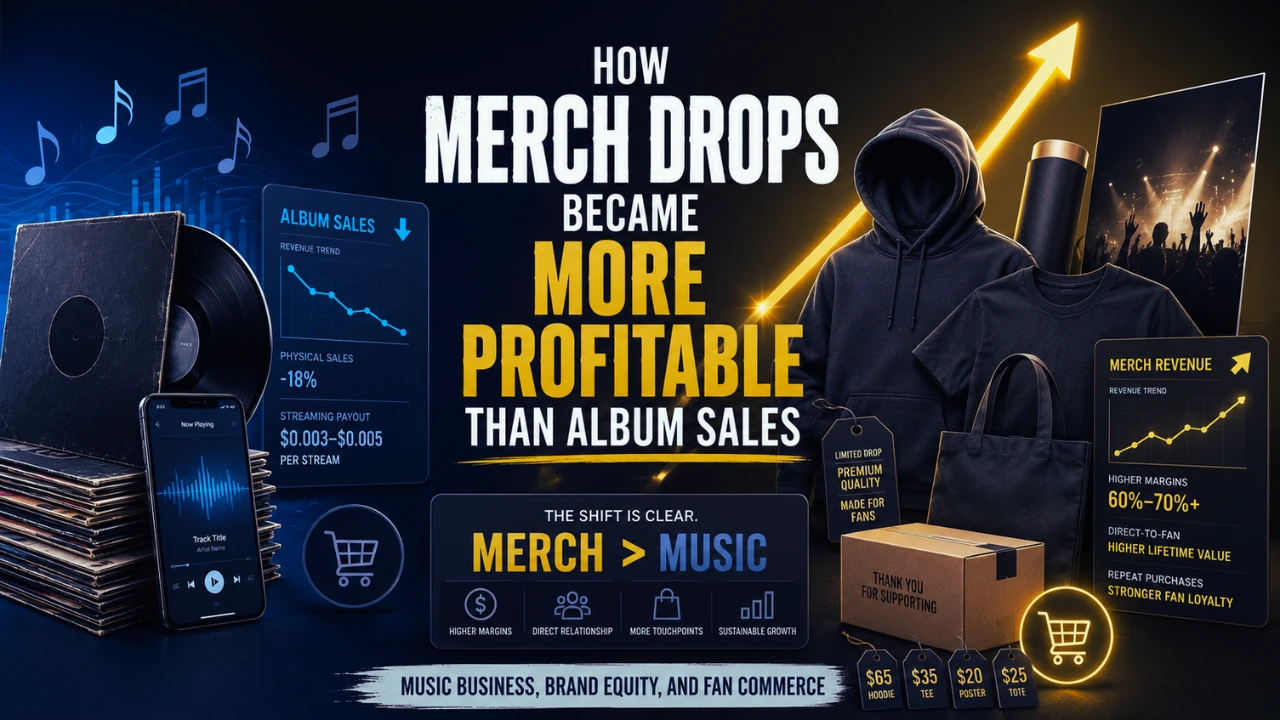
How Merch Drops Became More Profitable Than Album Sales
This article explains how merch drops became more profitable than album sales for some artists by turning fandom into a direct-to-consumer business. It covers product margins, brand equity, ownership deals, royalties, licensing, streaming economics, risk factors, and why celebrity net worth estimates often miss the bigger wealth picture.
A hoodie can sometimes say more about an artist’s business than a platinum plaque.
That is the quiet shift behind the rise of merch drops becoming more profitable than album sales for some artists. Music still builds emotional connections, but money increasingly flows through products that fans can wear, collect, post, and resell. A limited shirt, tour-exclusive vinyl bundle, signed poster, or collaboration capsule can turn a song release into a retail event.
This matters because the music economy has changed. Streaming now drives most recorded music revenue worldwide, while physical sales and downloads no longer carry the same financial weight they once did. IFPI reported that global recorded music revenue reached $31.7 billion in 2025, with streaming accounting for about 70% of global recorded music income.
For artists, especially those with loyal fan communities, merch drops are not just souvenirs. They are brand equity, cash flow, audience data, and sometimes a more controllable path to celebrity wealth than album royalties alone can provide.
Why This Celebrity Wealth Trend Matters Now?
The old music business was built around selling records. The modern entertainment business is built around monetizing attention.
That does not mean albums no longer matter. They still create cultural moments, drive touring demand, secure streaming rights, increase licensing value, and generate long-term royalties. But for many artists, recorded music is now only one part of a larger revenue engine.
A fan may stream an album dozens of times, but the artist’s direct share from streaming depends on label contracts, rights ownership, distributor terms, publishing split,s and platform economics. A fan who buys a $75 hoodie from an artist’s official store may create a very different kind of value.
That is why merch drops have become central to celebrity brands. They turn music fandom into fashion, identity, and community. Fans are not only buying cotton and ink. They are buying affiliation.
WIPO’s 2025 coverage of music merchandise, citing MIDiA research, noted that the global music merchandising market is projected to reach $16.3 billion by 2030. The same report highlighted that merch has become more important as artists face limited returns from recorded music royalties and streaming.
The bigger story is not that merch replaced music. It is that music now often acts as the marketing engine for a broader artist-owned economy.
The Business Model Behind the Money
Merch drops work because they combine scarcity, timing, emotional demand, and direct distribution.
A traditional album sale usually moves through a chain of rights holders, labels, publishers, distributors, and retailers. A merch drop can be simpler, especially when sold through an artist’s official website or tour booth. There are still costs, including design, manufacturing, warehousing, payment processing, fulfillment, returns, taxes,s and marketing. But the artist or their company may keep more control over pricing, customer relationships, and product strategy.
The strongest merch businesses often use a few tactics:
Limited availability creates urgency. Fans know the product may not return.
Tour-specific designs make the item feel tied to a memory.
Album-era visuals turn music into a wearable identity.
Collaborations with fashion, streetwear, or sportswear brands raise perceived value.
Bundles can increase basket size, although chart rules have changed around how bundled music sales are counted.
Billboard moved to restrict the use of merch and album bundles in chart calculations, with reporting noting changes designed to reflect better genuine music purchases rather than merchandise-driven chart boosts.
That rule change matters because it separates two questions. Did the merch help sell the album, or did the album help sell the merch? For some artists, the second answer may be more financially important.
Salary Versus Ownership
Upfront pay is clean. Ownership is complicated, but often more powerful.
An artist can get paid for recording, touring, endorsement deals, or appearances. That income matters, but it is usually tied to a specific job. Ownership can keep working after the campaign ends.
If an artist owns the merch operation, controls the designs, holds the customer data, and manages the store through their own company, the upside can look very different from a simple licensing deal. If they only license their name to a third-party merch company, the income may come through royalties or guaranteed payments instead.
Neither model is automatically better. Ownership brings more upside, but also more risk. Licensing reduces operational burden, but usually gives away more control.
This is why celebrity net worth estimates can miss the real picture. A singer with modest album royalties but a strong direct-to-consumer merch business may be building more wealth than public music sales suggest.
Brand Equity and Audience Trust
Merch is profitable only when the fan believes the product means something.
That belief comes from brand equity. In terms of celebrity wealth, brand equity is the financial value attached to a famous person’s name, image, taste, story, and cultural relevance. It is why one black hoodie sells as basic clothing and another sells as part of a music era.
Strong artist merch usually connects to a clear world. Think tour visuals, lyrics, inside jokes, album aesthetics, fan community symbols,s or limited collaborations. The product becomes a badge.
But audience trust is fragile. If the quality is poor, shipping is slow, prices feel exploitative, ve or the product looks disconnected from the artist’s identity, fans notice quickly.
Helpful Table
| Wealth Driver | How It Works | Why It Matters |
|---|---|---|
| Album Sales | Revenue from physical or digital album purchases | Still valuable, but often split across labels, distributors, and rights holders |
| Streaming Royalties | Payments from platform usage and rights ownership | Can scale globally, but artist payouts depend on contracts and rights splits. |
| Merch Drops | Limited products sold online, at shows, or through brand partners | Can create direct revenue, fan data, and a stronger brand identity |
| Licensing Deals | Paid use of an artist’s name, image, logo, or creative assets | Allows income without managing every part of production |
| Equity Deals | Ownership stake in a brand, platform, or product company | Can grow in value if the business succeeds |
| Touring Merch | Products sold at concerts and festivals | Captures fan emotion at peak demand, though venue cuts can reduce profit |
Why Traditional Net Worth Estimates Often Miss the Full Picture?
Celebrity net worth is rarely as simple as adding album sales, tour grosses, and endorsement checks.
Public estimates often miss taxes, management fees, agent commissions, legal costs, tour expenses, advances, debt, private investment,s and undisclosed ownership deals. They may also fail to distinguish between gross revenue and personal income.
A tour can gross hundreds of millions and still involve massive costs. A merch line can sell out but carry fulfillment problems, manufacturing costs, and returns. A streaming hit can generate long-term royalties, but the artist’s share depends on who owns the master recording, publishing rights, and related contracts.
That is why exact celebrity wealth is hard to verify. Publicly available data can show business momentum, but it rarely reveals the full financial structure.
For some artists, the biggest value may not be the cash from one merch drop. It may be the customer list, proof of fan demand, leverage in future licensingdeals,s or the ability to negotiate better brand partnerships.
That shows how this works.
Travis Scott is one of the most discussed examples of modern artist merchandising. His career has repeatedly blended music, streetwear, gaming, food partnerships, and limited-edition product drops. Forbes reported in 2020 that his Fortnite event grossed roughly $20 milli, including merchandise sales, according to a source cited by the outlet.
The key lesson is not that every artist can copy that scale. Most cannot. The lesson is that a music moment can become a commerce moment when the artist has a strong identity and a fan base trained to respond quickly.
Taylor Swift offers another version of the model. Her album eras, tour visuals, physical formats, and official store products show how music, storytelling, and merchandise can work together. RIAA data showed that U.S. recorded music revenue remained heavily streaming-led in 2025, while vinyl continued to grow and surpassed $1 billion in U.S. sales. For major artists, physical products can function as both a form of music consumption and a collectible culture.
K-pop also shows how fandom can become a sophisticated product ecosystem. Albums, light sticks, photo cards, apparel, fan memberships, and limited-edition goods all turn artist identity into recurring consumer behavior. The business is not just about listening. It is about participation.
The Risks Behind Celebrity Business Ventures
Merch can be lucrative, but it is not easy money.
The first risk is product quality. Fans may forgive a simple design if it feels authentic, but they are less forgiving when expensive items arrive late, shrink badly,y or look nothing like the online mockup.
The second risk is overproduction. Scarcity helps merch drops feel special. Too much inventory can turn a cultural moment into a clearance problem.
The third risk is audience fatigue. If every single release is tied to another expensive product drop, fans may start to feel like wallet rather than community members.
There are also operational risks. Manufacturing delays, warehouse issues, refund disputes, sizing issues, international shipping costs, and licensing conflicts can erode trust quickly.
Touring merch has its own challenge. Some venues or promoters take a percentage of merchandise sold at shows, often called merch cuts. Artist groups and industry commentators have criticized these commissions because merch can be a crucial income stream for touring musicians.
This is why strong artist businesses need more than fame. They need good partners, clear contracts, realistic pricing, product discipline, and respect for the fan relationship.
What does this reveal about modern celebrity wealth?
The modern celebrity wealth story is not only about who sells the most albums. It is about who controls the ecosystem around their fame.
Music creates emotion. Emotion creates attention. Attention can translate into ticket demand, streaming activity, licensing value, endorsement deals, private investments, business ventures, and merchandise sales.
For artists, merch drops can be especially powerful because they sit at the intersection of culture and commerce. They are immediate, visible, and emotionally driven. They also give artists a way to monetize superfans without depending only on streaming volume or traditional album sales.
This does not mean every artist should become a fashion brand. Some fan bases will not respond. Some products will fail. Some artists may prefer publishing, touring, sync licensing, equity deals, or other forms of celebrity entrepreneurship.
But the trend is clear. Hollywood money and music money are moving toward ownership, audience data, intellectual property, and direct fan relationships.
Conclusion
Merch drops became more profitable than album sales for some artists as the music business expanded beyond the music itself.
Albums still matter. They build the story, fuel the tour, deepen the fan base, and create long-term royalties. But merch can turn that attention into higher-margin, direct-to-fan revenue when the product feels authentic, and the artist controls enough of the business.
The future of celebrity wealth will belong less to artists who only release content and more to those who understand how fame becomes a brand, how a brand becomes a business, ss and how ownership turns cultural attention into lasting financial power.
FAQs
Why are merch drops profitable for artists?
Merch drops can be profitable because artists may sell directly to fans, control pricing, and create urgency through limited availability. Profit depends on production costs, fulfillment, platform fees, licensing terms, and revenue splits.
Do artists make more money from merch than streaming?
Some artists may make more from merch than streaming, especially if they have loyal superfans and strong direct sales. Streaming can scale globally, but payouts depend on contracts, rights ownership, and royalty structures.
How do merch drops affect celebrity net worth?
Merch drops can increase celebrity wealth through direct sales, licensing income, brand equity,y and customer data. However, the exact impact is hard to verify because costs, taxes, contracts, and ownership details are usually private.
Why do some artist merch lines fail?
Artist merch lines can fail because of weak design, poor quality, high prices, shipping delays, overproduction, bad timing, or audience fatigue. Fame alone does not guarantee product-market fit.
Are album sales still important for artists?
Yes. Album sales still matter for chart performance, fan engagement, physical collectibles, royalties, and cultural impact. But for some artists, merch, touring, licensing deals, and ownership ventures may generate greater financial upside.
For more sharp breakdowns of celebrity wealth, entertainment business models, artist revenue streams, and Hollywood money, explore our latest celebrity net worth and music industry finance stories.
Table of Contents