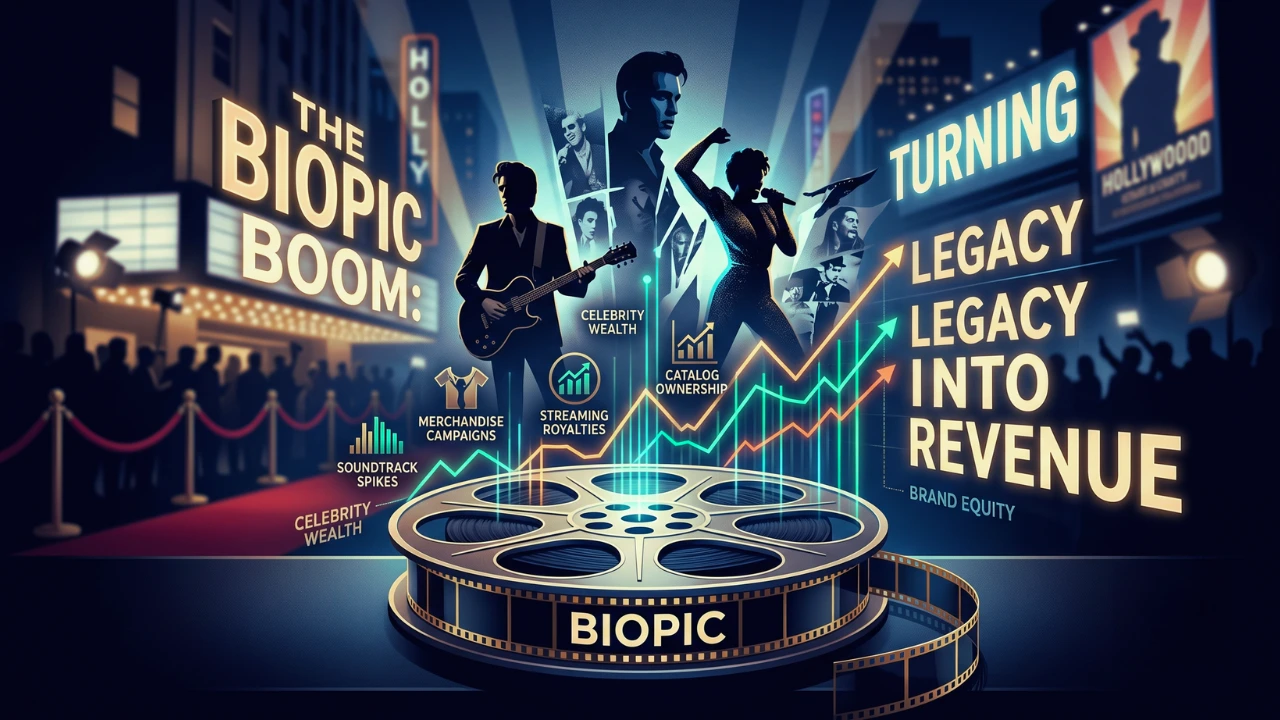
How the Biopic Boom Turns Dead Celebrities Into Revenue
This article explains how the biopic boom has become a serious entertainment business strategy, not just a nostalgic Hollywood trend. It breaks down how studios, estates, publishers, and rights holders use films to revive celebrity brands, expand royalties, boost streaming rights, and reshape the bigger celebrity wealth picture.
A dead celebrity is no longer just a memory in the entertainment business. In the right hands, that name can become a film, a soundtrack, a streaming spike, a merchandise campaign, a licensing deal, and a renewed cultural brand.
That is the financial story behind the biopic boom. Studios are not only selling a two-hour movie about a famous life. They are helping turn legacy fame into fresh revenue, especially when the subject has music rights, name recognition, archived footage, estate-controlled assets, or a devoted fan base.
The result is a modern Hollywood money machine built around memory, ownership, and emotion. For readers interested in celebrity net worth, celebrity wealth, brand equity, royalties, licensing deals, and Hollywood money, the real question is not just whether a biopic succeeds at the box office. It is who controls the assets after the credits roll.
Why This Celebrity Wealth Trend Matters Now?
The biopic boom matters because Hollywood is searching for recognizable stories that can cut through a crowded entertainment market. Superhero fatigue, rising production costs, streaming competition, and global marketing pressure have pushed studios toward brands people already know.
A famous musician, actor, athlete, or cultural icon arrives with built-in awareness. That does not guarantee ticket sales, but it gives studios a valuable starting point. A biopic can reach older fans who lived through the celebrity’s peak while introducing younger audiences to the catalog, image, and mythology.
Music biopics have become especially attractive because songs can keep earning long after a film leaves theaters. Box Office Mojo lists Elvis at about $287.7 million worldwide, while Bob Marley’s One Love at about $181 million. Those numbers show why studios keep returning to famous lives with recognizable soundtracks and emotional pull.
The deeper business angle is that a biopic can refresh the entire celebrity brand. It can push listeners back to streaming platforms, renew interest in documentaries, increase merchandise demand, improve licensing value, and make old interviews, photos, songs, and life rights more commercially useful.
The Business Model Behind the Money
A biopic is not one revenue stream. It is a bundle of connected income opportunities.
The studio earns revenue through theatrical box office, streaming rights, international distribution, premium video-on-demand, television licensing, and awards-season attention. Producers may earn through backend participation if the film performs well, though those terms vary widely and are often private.
The estate or rights holder may earn through life rights, music licensing, name and likeness approvals, soundtrack sales, consulting fees, executive producer roles, or broader brand partnerships. In music-driven projects, the film can also send audiences back to the artist’s catalog.
That catalog effect matters. A song used in a major trailer, emotional scene, or closing montage can become newly valuable across streaming, sync licensing, playlists, social media, and advertisements. The film becomes marketing, but the catalog becomes the asset that can keep earning.
Salary Versus Ownership
Salary is immediate income. Ownership is long-term leverage.
An actor playing a celebrity may receive a fee for the role. A director may receive a production fee. A studio may take distribution revenue. But the biggest financial advantage often belongs to whoever owns the underlying intellectual property.
That includes music publishing, master recordings, life rights, trademarks, archival footage, memoir rights, or the right to approve the use of a celebrity’s name and likeness.
This is why celebrity wealth is not only about a paycheck. A star who owns part of a catalog, brand, production company, tequila label, beauty business, or media rights package may build wealth differently from someone who only earns a salary.
Brand Equity and Audience Trust
Brand equity is the financial value of recognition, emotion, and trust.
For dead celebrities, brand equity can be unusually powerful because the public image often freezes in time. Fans remember the hits, the style, the performances, the controversy, and the cultural moment. A biopic organizes all of that into a new product.
That does not mean every legacy brand is safe or easy to monetize. The more beloved the figure, the more protective fans become. The more controversial the figure, the harder the storytelling balance becomes.
A studio needs drama. An estate often wants legacy protection. Fans want emotional truth. Critics want complexity. That tension is where many biopics either gain credibility or lose it.
Why Traditional Net Worth Estimates Often Miss the Full Picture?
Traditional celebrity net worth estimates can be useful as broad conversation starters, but they rarely capture the complete financial picture.
They may miss private investments, debt, taxes, management fees, legal disputes, real estate structures, royalty splits, publishing rights, trust arrangements, equity deals, and licensing agreements. They also struggle with assets that do not trade publicly, such as a catalog, likeness portfolio, or estate-controlled archive.
A deceased celebrity’s estate can also change value years after death. A new film, catalog sale, documentary, Broadway show, Las Vegas attraction, streaming deal, or brand partnership can reshape the estate’s earning power.
Forbes’ highest-paid dead celebrities coverage regularly shows that posthumous earnings can remain significant for major cultural figures such as Michael Jackson, Freddie Mercury, Dr. Seuss, and Elvis Presley.
That is why celebrity net worth should not be confused with celebrity wealth infrastructure. The real story is often hidden inside rights ownership, royalty income, licensing deals, and control over intellectual property.
That shows how this works.
Michael Jackson is one of the clearest examples of the economics of posthumous entertainment. Variety reported in 2024 that Sony Music acquired a major stake in Jackson’s music catalog, with the assets valued at more than $1.2 billion. That kind of deal shows how catalog ownership can become bigger than a single film, album, or tour.
The Beatles project is another major signal. Sony Pictures announced a four-film Beatles biopic project from Sam Mendes, with Apple Corps, Paul McCartney, Ringo Starr, and the families of John Lennon and George Harrison granting full life story and music rights for a scripted film project. That matters because authorized access can change what a film is allowed to show, play, and market.
Bob Marley’s ” One Love also shows the estate-driven brand model. The film used Marley’s global recognition, family involvement, music identity, and cross-generational fan base to create a theatrical event. Box Office Mojo lists the film at about $181 million worldwide, proving that legacy music stories can still bring audiences to cinemas when the emotional connection is strong.
Whitney Houston’s estate and Primary Wave also illustrate how rights, name, likeness, brand, and catalog interests can be bundled into broader entertainment activity. Primary Wave announced a partnership with the Whitney Houston estate in 2019, and Houston’s official site later noted that the estate, Primary Wave, and Clive Davis teamed on I Wanna Dance with Somebody.
Helpful Table
| Wealth Driver | How It Works | Why It Matters |
|---|---|---|
| Salary | Upfront payment for acting, producing, writing, or directing | Creates immediate income but may not build long-term control |
| Royalties | Ongoing payments from music, publishing, or content usage | Can generate residual income long after release |
| Licensing | Paid use of name, image, songs, footage, or trademarks | Turns celebrity identity into a monetizable asset |
| Streaming Rights | Film, documentary, or music availability on platforms | Extends earnings beyond the theatrical window |
| Catalog Ownership | Control of publishing rights or master recordings | Can increase in value when attention returns to the artist |
| Brand Equity | Public recognition, fan loyalty, and cultural relevance | Helps sell films, merchandise, partnerships, and experiences |
| Estate Control | Legal authority over legacy assets | Determines who approves projects and who receives income |
The Risks Behind Celebrity Business Ventures
The biopic business looks attractive, but it is risky.
A film can underperform if the story feels too sanitized, too exploitative, or too late. Fans may reject casting. Families may disagree over the portrayal. Estates may push for legacy protection at the expense of honesty. Critics may punish formulaic storytelling.
Music rights can also make projects expensive. Without the right songs, a music biopic can feel incomplete. With the songs, the budget can rise quickly. That creates pressure on box office, streaming sales, and international distribution.
There is also reputational risk. A poorly handled biopic can damage brand equity rather than strengthen it. If the film reopens painful controversies or appears to profit from tragedy without care, audiences may push back.
Celebrity brands face similar problems outside film. Restaurants close. Fashion lines fade. Beauty brands can lose relevance. Tequila companies, memoir deals, documentaries, and licensing partnerships can all fail if the product-market fit is weak or the public image changes.
Fame creates attention. It does not automatically create trust, repeat customers, or durable wealth.
What does this reveal about modern celebrity wealth?
The biopic boom reveals a major shift in celebrity wealth. The biggest money is no longer limited to salaries, box-office bonuses, record sales, sports contracts, or endorsement deals.
Modern celebrity wealth is increasingly shaped by ownership, timing, distribution, and intellectual property. A famous name becomes more valuable when it is connected to controllable assets. A song catalog becomes more valuable when a film revives demand for it. A likeness becomes more valuable when it can be licensed carefully. An estate becomes more powerful when it manages the brand with discipline.
This is why traditional celebrity net worth estimates often miss the bigger picture. They may count visible income but miss the machinery behind it.
The next wave of Hollywood money will belong to the celebrities, estates, studios, and rights holders who understand that legacy is not only cultural. In the modern entertainment business, legacy can be packaged, licensed, streamed, protected, and sold again.
FAQs
Why do celebrity net worth estimates change?
Celebrity net worth estimates change because assets, income, debts, taxes, royalties, and private investments are hard to verify. New catalog deals, licensing income, real estate sales, lawsuits, or business ventures can also shift the picture.
How do dead celebrities still make money?
Dead celebrities can earn through estates that control music catalogs, publishing rights, name and likeness rights, trademarks, merchandise, film rights, documentaries, streaming rights, and licensing deals.
What is brand equity in celebrity wealth?
Brand equity is the financial value of a celebrity’s public image, fan loyalty, recognition, and cultural meaning. Strong brand equity can support films, products, partnerships, and long-term licensing income.
Why do some celebrity biopics fail?
Some biopics fail because they feel too generic, avoid difficult truths, lack music rights, misjudge audience demand, suffer poor timing, or create conflict with fans and families.
Do celebrities make more from ownership than endorsements?
They can, but it depends on the deal. Endorsements provide direct payment, while ownership or equity deals may become more valuable if the business, catalog, or brand grows over time.
For more smart breakdowns of celebrity wealth, Hollywood money, entertainment business models, and net worth analysis, explore our latest celebrity finance stories and brand ownership guides.

Table of Contents