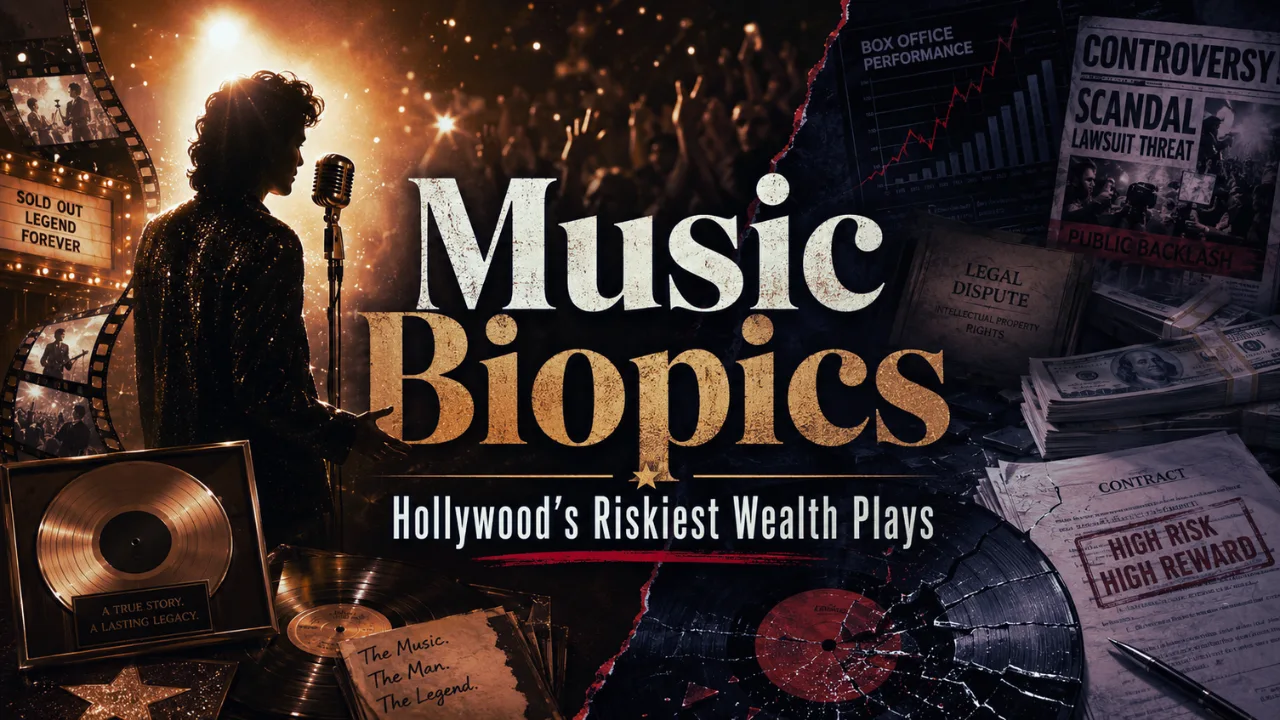
Why Music Biopics Wealth Plays Still Tempt Hollywood Studios
This article explains why music biopics remain attractive but risky wealth plays for Hollywood, artists, estates, and rights owners. It breaks down how box office revenue, streaming rights, royalties, licensing, brand equity, and controversy can reshape celebrity wealth far beyond a simple net worth estimate.
A hit music biopic can feel like a time machine with a cash register attached.
For fans, it revives songs, costumes, scandals, heartbreak, and cultural moments they already know. For Hollywood, it is something more complicated: a bet on nostalgia, music rights, legacy management, and public memory. That is why the wealth of music biopics remains so tempting, even when the artist’s story comes with lawsuits, backlash, family disputes, or an uncomfortable history.
The appeal is easy to understand. Familiar songs reduce marketing risk. Famous names create instant awareness. A strong performance can turn an actor into an awards contender and push old catalogs back into streaming charts. But the danger is just as real. When a film tries to turn a complicated life into a clean commercial product, audiences, critics, estates, and rights holders may not agree on what version of the truth should be sold.
Why This Celebrity Wealth Trend Matters Now?
Music biopics sit at the crossroads of Hollywood money and celebrity wealth. They are not just movies. They are brand relaunches, catalog campaigns, estate strategies, and sometimes reputation repair projects.
That matters because the entertainment business has changed. A successful music film can boost streaming, revive merchandise sales, support licensing deals, and make older songs relevant to younger listeners. After Bob Marley: One Love, Luminate reported that Bob Marley’s global on-demand audio streaming during the first full chart week after release was 150 percent higher than the week ending January 4, 2024.
This is the hidden engine behind many music biopics. The film may be the headline, but the larger financial play often lives in the catalog. Songs can earn through streaming, publishing, sync licensing, vinyl sales, documentaries, stage shows, brand partnerships, and future film or television use.
For estates and rights owners, that attention can be extremely valuable. A biopic can reframe an artist for a new generation, potentially increasing the commercial value of music rights and related intellectual property. That is why these projects often involve careful negotiations around life rights, song clearances, image rights, and estate participation.
The Business Model Behind the Money
A music biopic can make money in several layers. The first layer is the traditional box office. The second is home entertainment, streaming rights, and international distribution. The third is harder to see but often more important: the renewed commercial life of the artist’s brand.
Bohemian Rhapsody showed the scale of the opportunity. Box Office Mojo lists the Queen film at more than $903 million worldwide, with a reported production budget of $52 million. That kind of performance made music biopics look safer than many original dramas.
But “safer” does not mean simple. Music biopics require expensive rights, recognizable actors, marketing, music supervision, legal review, and approvals from people who may disagree with each other. The more famous or controversial the artist, the more complicated the deal can become.
Salary Versus Ownership
Salary is the cleanest part of the money story. Actors, directors, writers, producers, and crew may receive upfront compensation. Some may also negotiate backend participation, bonuses, or profit-based structures, although the details are rarely public.
Ownership is different. If an artist, estate, producer, or rights holder controls key music, likeness, or story rights, they may benefit beyond a simple fee. Licensing songs to the film can generate income. A successful movie can also increase the long-term value of the catalog.
This is why celebrity net worth estimates often miss the point. A performer’s salary for a film is one number. The value of music rights, publishing income, licensing power, and estate-controlled intellectual property can be a much larger financial story.
Brand Equity and Audience Trust
Music biopics trade on brand equity. The artist’s name, songs, image, fan base, and cultural memory become assets.
That is powerful, but fragile. A beloved artist can drive families, older fans, and younger listeners into theaters. A controversial artist can do the same, but with a heavier reputational risk. If the film feels too sanitized, critics may reject it. If it feels too harsh, fans and estates may push back.
The best commercial version is a difficult balance: emotional enough for fans, honest enough for credibility, and polished enough for mainstream audiences.
Helpful Table
| Wealth Driver | How It Works | Why It Matters |
|---|---|---|
| Box Office | Ticket sales from theatrical release | Creates the first major revenue test |
| Streaming Rights | Film licensing to platforms after theaters | Extends earnings beyond cinema |
| Music Royalties | Payments from song streams, sales, and usage | Can rise when catalogs regain attention |
| Licensing Deals | Paid use of name, likeness, songs, or brand assets | Turns nostalgia into repeatable income |
| Estate Control | Family or estate manages rights and approvals | Shapes both money and narrative |
| Brand Equity | Public affection, cultural relevance, and fan loyalty | Helps revive older artists for new audiences |
| Residual Income | Ongoing payments from reuse or distribution | Supports long-term earnings for eligible participants |
Why Traditional Net Worth Estimates Often Miss the Full Picture?
Most celebrity net worth estimates are rough public guesses, not audited financial statements. They may consider known salaries, visible assets, business ventures, or reported deals, but they often miss private investments, taxes, debt, management fees, estate planning, undisclosed equity, and complex royalty structures.
Music biopics make this gap even wider.
An artist’s estate may not simply earn from one film. It may benefit from renewed streaming, catalog sales, documentary interest, merchandise demand, stage productions, brand partnerships, and higher licensing value. At the same time, legal costs, production delays, revenue splits, and rights disputes can reduce the upside.
That is why a music biopic can reshape celebrity wealth without producing one clean public number. The financial impact is spread across several parties: studios, distributors, producers, publishers, labels, estates, heirs, performers, and sometimes outside investors.
That shows how this works.
Several recent and modern music films show why Hollywood keeps returning to the format.
Elvis grossed about $287.7 million worldwide, while Rocketman reached about $195.3 million and Bob Marley: One Love reached about $180.9 million, according to Box Office Mojo and IMDb data. These are not identical business cases, but they show how a well-known music figure can still pull theatrical audiences in an era dominated by franchises.
The catalog effect can be just as important. Universal Music Group announced in December 2018 that Queen’s “Bohemian Rhapsody” had passed 1.6 billion global streams and become the most-streamed song from the 20th century, with Reuters noting the boost from the film.
The Michael Jackson biopic Michael shows the higher-risk version of the model. AP reported that the film opened with $97 million in the United States and Canada and $217.4 million worldwide, while also noting mixed reviews, a difficult production, and criticism that the film avoided later allegations by ending before that period. Variety also reported that reshoots tied to legal and narrative issues cost $10 million or more.
That is the paradox. Controversy can create attention, but it can also raise costs, complicate marketing, and damage trust.
The Risks Behind Celebrity Business Ventures
Music biopics are wealth plays, but they are not guaranteed wins.
The first risk is legal. Song rights, publishing rights, life rights, estate approvals, and defamation concerns can delay or reshape a project. A film can become expensive before audiences ever see it.
The second risk is narrative control. Estates may want legacy protection. Studios want broad appeal. Critics want honesty. Fans want emotional truth. Survivors, former collaborators, and family members may have different memories of the same life.
The third risk is audience fatigue. Not every famous musician needs a movie. If the story feels like a brand campaign instead of a film, viewers can sense it.
The fourth risk is weak product-market fit. A famous name does not guarantee box office success. A catalog may be beloved, but the movie still needs drama, casting, pacing, and timing. Celebrity brands, tequila labels, fashion lines, restaurants, memoirs, documentaries, and streaming projects face the same problem: attention opens the door, but execution keeps people inside.
What does this reveal about modern celebrity wealth?
Modern celebrity wealth is no longer just about salary, album sales, box office bonuses, or endorsement deals. It is increasingly shaped by ownership, rights control, timing, and distribution.
Music biopics reveal this shift clearly. The artist becomes intellectual property. The catalog becomes a financial asset. The estate becomes a brand manager. The studio becomes a nostalgia distributor. The audience becomes both consumer and judge.
That is why music biopics remain Hollywood’s riskiest wealth plays. They can turn old songs into new money, revive celebrity brands, and strengthen catalog valuations. They can also expose the tension between memory and marketing.
The next era of the entertainment business will not only ask who was famous. It will ask who owns the story, who controls the songs, and who profits when nostalgia becomes a product.
FAQs
Why are music biopics considered wealth plays?
Music biopics can generate revenue through box office sales, streaming rights, music royalties, licensing deals, merchandise, and renewed demand for the catalog. The film is often only one part of a larger entertainment business strategy.
How do music biopics affect celebrity net worth?
They can increase public attention around an artist’s catalog, brand, and estate-controlled assets. However, the exact wealth impact is hard to verify because many royalties, rights deals, taxes, and ownership structures are private.
Why are controversial music biopics risky?
They can trigger legal issues, public backlash, family disputes, and criticism over accuracy. If audiences feel the film hides important parts of the story, the brand benefit can turn into a trust problem.
Do artists or estates make money from music biopics?
They may earn through rights licensing, producer participation, music usage, estate approvals, or catalog growth, depending on the deal. Publicly available information rarely reveals the full financial structure.
Why does Hollywood keep making music biopics?
Studios like recognizable songs, built-in fan bases, and awards potential. Music biopics can also perform well internationally and create extra value through streaming, soundtracks, and catalog discovery.
For more smart breakdowns of celebrity wealth, Hollywood money, entertainment business models, and net worth analysis, explore our latest celebrity finance stories.
Table of Contents