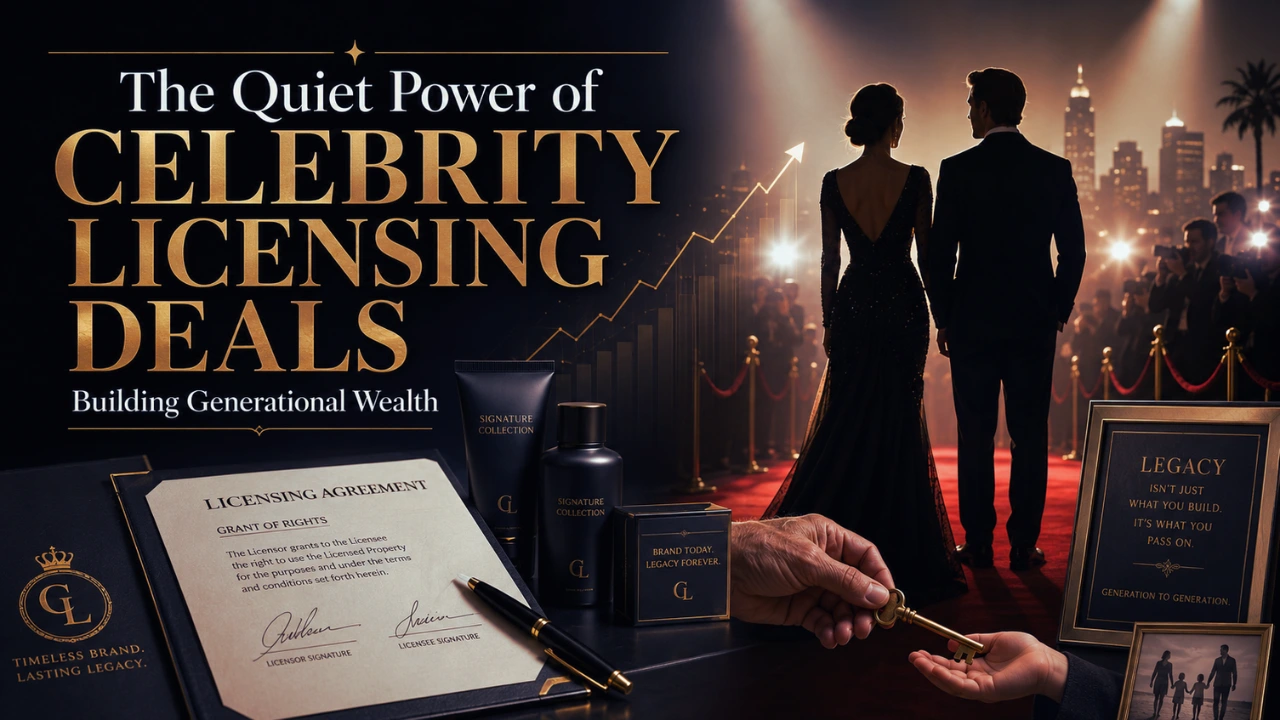
Celebrity Licensing Deals and the New Path to Family Wealth
This article explains how celebrity licensing deals can transform fame into long-lasting income through royalties, brand equity, residual income, and intellectual property. It also explains why celebrity net worth estimates often overlook private deal structures, taxes, debt, ownership stakes, and family wealth planning.
A celebrity can earn a fortune from one film, album, tour, or sports contract. But the quieter money often comes later, when a name becomes an asset.
That is the real power of celebrity licensing deals. A star does not always need to run a factory, manage a retail team, or personally ship products to turn fame into wealth. In many cases, the celebrity licenses a name, image, likeness, creative identity, or brand story to a company that handles production and distribution.
For readers interested in celebrity net worth, Hollywood money, ownership deals, and entertainment business strategy, licensing matters because it sits between fame and ownership. It can create royalties, equity upside, residual income, and brand value that may outlive the original career.
Why This Celebrity Wealth Trend Matters Now?
The entertainment economy has changed. A hit movie role or a platinum record is still valuable, but attention now spans streaming platforms, social media, retail shelves, beauty counters, podcasts, sportswear, alcohol brands, and private investments.
That shift has made celebrity wealth less dependent on salary alone.
A celebrity’s audience is now treated like a distribution advantage. A trusted name can lower marketing costs, help a new product get noticed, and give retailers a reason to take a chance. But that does not mean followers automatically become customers. The product still has to work, the price has to make sense, and the brand must feel believable.
Licensing deals are attractive because they allow celebrities to monetize brand equity without carrying the full operational burden. A manufacturer, beauty incubator, apparel company, or licensing platform may handle production, inventory, compliance, and sales. The celebrity brings attention, identity, approval rights, and cultural relevance.
That is why licensing can become a wealth-building tool. It converts fame into intellectual property income.
Celebrity Licensing Deals and the Business of Quiet Wealth
A licensing deal permits another company to use a celebrity’s name, image, likeness, trademark, voice, style, or brand identity under agreed terms. In return, the celebrity may receive an upfront payment, royalties, guaranteed minimums, equity, profit participation, or a mix of these.
The exact structure depends on the category. Fragrance, fashion, footwear, beauty, restaurants, beverages, publishing, music, film rights, and merchandise all work differently.
| Wealth Driver | How It Works | Why It Matters |
|---|---|---|
| Salary | Upfront payment for work | Creates immediate income |
| Royalties | Ongoing payment from sales or use | Can create long-term income |
| Equity | Ownership stake in a business | Can grow if the company succeeds |
| Licensing | Paid use of name, image, or brand | Allows income without operating the business |
| Residuals | Payments from reuse or reruns | Supports earnings after release |
| Brand Deals | Paid partnerships or endorsements | Converts fame into marketing value |
SAG AFTRA defines residuals as compensation paid when a film or television program is used beyond the original covered use, such as later releases or reruns. That is different from licensing a celebrity’s name for a product line, but both illustrate the same broader idea: entertainment income can continue beyond the first paycheck.
Salary Versus Ownership
Salary is clean and simple. A star gets paid to perform, appear, write, host, or promote.
Ownership is messier but often more powerful. A celebrity with equity or royalty participation may benefit if a brand grows, sells, expands internationally, or becomes culturally important. The upside can be far larger than a flat endorsement fee, but the risk is also higher.
That is why the richest celebrity wealth stories often include more than talent income. They include licensing rights, equity deals, catalog value, intellectual property, real estate, and operating businesses.
Brand Equity and Audience Trust
Brand equity is the value attached to a name. For celebrities, it comes from recognition, taste, credibility, emotional connection, and cultural memory.
Rihanna’s Fenty Beauty is a strong example of celebrity brand equity meeting a clear market gap. LVMH describes the brand as centered on Rihanna’s vision of inclusion and shades for traditionally hard-to-match skin tones. Reuters reported in 2025 that LVMH was exploring a sale of its 50 percent stake in Fenty Beauty, which it co-founded with Rihanna in 2017 through Kendo Brands.
That example matters because it shows the difference between simple fame and strategic fit. Rihanna did not just attach her name to makeup. The brand connected her public image with a product promise customers could understand.
Why Traditional Net Worth Estimates Often Miss the Full Picture?
Celebrity net worth estimates are popular because they give readers a quick number. The problem is that those numbers are often incomplete.
Public income is easier to see. Salaries, box office bonuses, tour grosses, public acquisitions, and major brand deals may be reported. Private investments are harder. So are undisclosed equity stakes, licensing terms, debt, taxes, family trusts, management fees, legal costs, real estate loans, and royalty splits.
A celebrity may appear less wealthy on paper because much of their value sits in illiquid assets. Another may appear richer than they are because gross deal values do not equal take-home cash.
For example, a brand sale headline might mention a large acquisition price, but that does not reveal taxes, retained ownership, earnouts, investor shares, debt, or how much the celebrity personally receives. That is why careful wording matters. “Reported,” “estimated,” and “publicly available data suggest” are not weak phrases. They are responsible phrases.
Examples That Show How This Works
George Foreman’s grill deal remains one of the clearest examples of celebrity licensing turning into lasting wealth. Business Insider reported that the grill sold more than 100 million units globally over 15 years and that Foreman earned more than $200 million from the product, including a major 1999 payout when Salton bought rights to use his name in perpetuity.
Kylie Jenner’s Coty deal shows another version of the model. Coty announced it would acquire a 51 percent ownership stake in the Kylie Beauty Partnership for $600 million, positioning it to expand the business across fragrance, cosmetics, skincare, distribution, and licensing.
Celebrity estates also show how licensing can become generational. Authentic Brands Group’s portfolio has included names such as Elvis Presley, Marilyn Monroe, Muhammad Ali, Shaquille O’Neal, and David Beckham, with the company built around licensing and brand development.
Music rights add another layer. WIPO explains that when musicians sell catalogs, they are selling rights tied to songs and the royalties generated when music is consumed or used. Those rights can become estate planning tools, investment assets, or legacy income streams.
The Risks Behind Celebrity Business Ventures
Licensing can look easy from the outside. It is not.
A celebrity brand can fail if the product is weak, the pricing is wrong, or the audience does not match the category. A beloved actor may not be able to sell skincare. A famous athlete may not be trusted in luxury fashion. A musician with millions of fans may still struggle to move inventory if the product feels generic.
There are also management risks. Poor quality control can damage trust. Overexpansion can flood the market. A public controversy can make retailers nervous. Licensing disputes can arise over creative control, territory, approvals, minimum sales, or contract renewal terms.
Then there is audience fatigue. Consumers can sense when a celebrity brand exists only because fame is being rented. The strongest celebrity brands usually feel connected to a person’s taste, story, lifestyle, or long-term credibility.
What does this reveal about modern celebrity wealth?
Celebrity wealth is no longer just about acting fees, record sales, sports contracts, or endorsement checks. It is increasingly shaped by ownership, timing, distribution, intellectual property, and brand leverage.
Licensing sits at the center of that shift. It gives celebrities a way to earn from identity itself. When structured well, a licensing deal can create royalties, expand a brand into new categories, and support family wealth long after the original spotlight fades.
But licensing is not magic. The best deals still need good operators, clear contracts, strong products, and careful brand protection. Fame opens the door. Business discipline keeps the money moving.
Conclusion
The quiet power of celebrity licensing deals is that they turn attention into an asset. A name can become a trademark. A fan base can become a customer base. A public image can become a royalty stream.
That is why traditional celebrity net worth estimates often miss the deeper story. The real wealth is not always visible in salary headlines. It may sit inside licensing rights, equity deals, private investments, royalties, catalog income, and brand ownership.
As entertainment, commerce, and the creator economy continue to blend, the celebrities who build lasting wealth will not be the only ones who are. They will be the ones who understand how to own, license, protect, and extend the value of their names.
FAQs
Why do celebrity net worth estimates change?
Celebrity net worth estimates change because they often rely on public reporting, estimates, and partial data. Private investments, taxes, debt, equity stakes, licensing income, and real estate values can shift over time.
How do celebrities make money outside of their salary?
Celebrities can earn through royalties, residuals, licensing deals, brand partnerships, equity deals, business ventures, publishing rights, music catalogs, real estate, and private investments.
What is brand equity in celebrity wealth?
Brand equity is the financial value attached to a celebrity’s name, image, reputation, audience trust, and cultural influence. Strong brand equity can help sell products or support licensing deals.
Why do some celebrity brands fail?
Celebrity brands fail when the product does not align with the audience, quality is poor, pricing is off, management is weak, or consumers feel the brand is only using fame without a real purpose.
Do celebrities make more from ownership than endorsements?
Sometimes they do, but not always. A flat endorsement can provide safe upfront income, while ownership or royalties can create larger upside if the business succeeds. They also carry more risk.
Explore more entertainment business breakdowns, celebrity wealth stories, and net worth analysis to see how fame becomes money behind the scenes.
Table of Contents