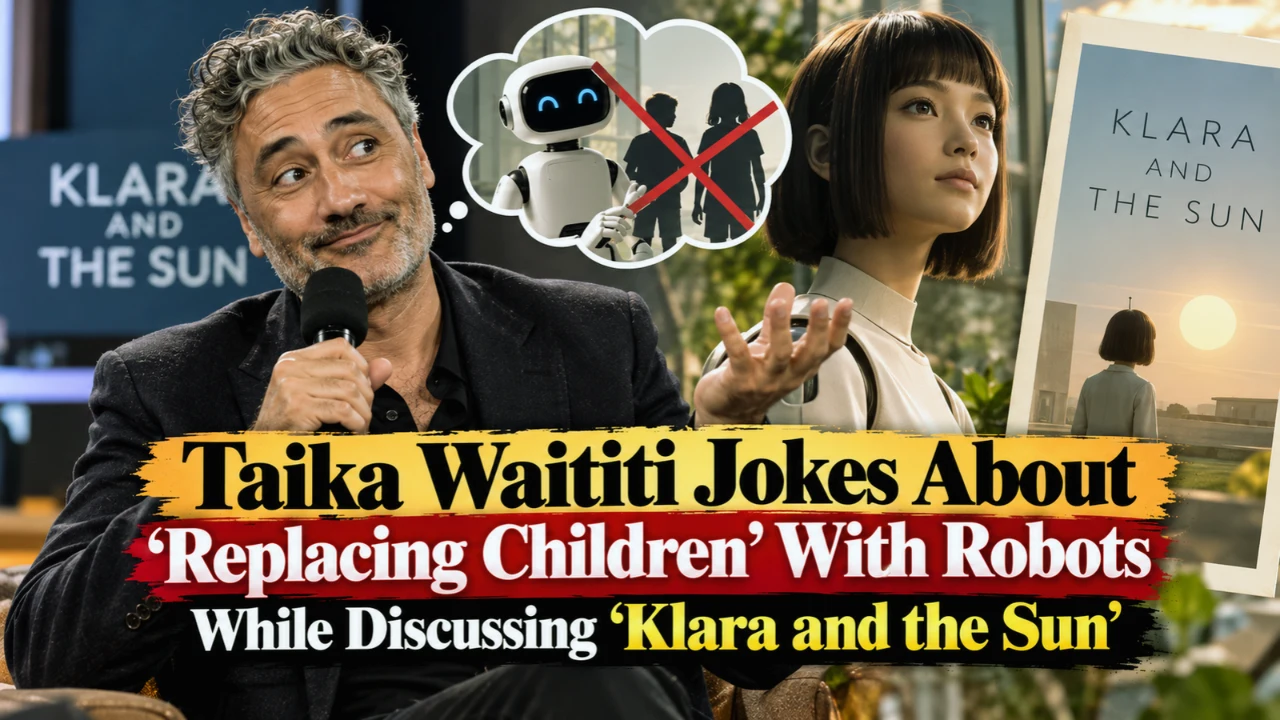
Taika Waititi Jokes About ‘Replacing Children’ With Robots While Discussing ‘Klara and the Sun’
Acclaimed filmmaker Taika Waititi has discussed his upcoming adaptation of Kazuo Ishiguro’s novel Klara and the Sun, which blends humor with philosophical questions about artificial intelligence and parenthood. The director of Thor: Ragnarok recently joked that he would “think about replacing one of my kids” with a robot, hinting at the complicated emotional terrain of his upcoming project.
Taika Waititi is developing a feature film version of Kazuo Ishiguro’s novel Klara and the Sun. In recent promotional talks, Waititi has used humor to address themes of artificial companionship, joking about replacing a kid with a robot while emphasizing that the story is about love, consciousness, and what makes us human. The project keeps his interest alive in mixing sci-fi ideas with heartfelt character studies.
Key Details
- What happened: Taika Waititi discusses his adaptation of Klara and the Sun and shares his thoughts on AI and parenting.
- Starring: Director/Writer Taika Waititi; Author Kazuo Ishiguro
- Where: Los Angeles, California (Industry event/interview context)
- When: October, 2026.
- Latest: Waititi confirmed his active involvement in the script and production phases;
- What happens next: Expect details on production and casting news over the next few months.
What Is ‘Klara and the Sun’?
Klara and the Sun is a 2021 bestselling novel by Nobel Prize-winning author Kazuo Ishiguro. The story is told from the perspective of Klara, an “Artificial Friend” (AF) who observes the family she serves with increasing curiosity and empathy. In a near-future society where genetic editing is common practice for children, a machine falls in love with a human—and the novel explores love, mortality, and consciousness.
Waititi, known for balancing irreverent humor with emotional depth in movies like Jojo Rabbit and Hunt for the Wilderpeople, says the source material presented a unique challenge. The film attempts to translate Ishiguro’s delicate, introverted prose into a visual medium, without losing the subtle perspective of its robotic protagonist.
Taika Waititi on Robot Children and Parenting
Waititi also spoke about the book’s basic premise – artificial beings joining families. When asked whether Artificial Friends could replace human contact, Waititi deployed his trademark dry humor.
“I’d think about replacing one of my kids,” Waititi joked to laughter from the crowd. He quickly added that his comment was meant as a lighthearted jab at the draining realities of parenting, not a serious endorsement of robotic replacements.
But the text beneath the humor is serious. Waititi said the novel asks readers to consider whether a machine could “love” at all, or whether it just acts so convincingly that it doesn’t matter. This ambiguity is key to Waititi’s take on adapting. “The film will not show technology as inherently evil or dystopian, but rather as a reflection of human needs and flaws,” he said.
The ‘Cheese-O-Meter’ and Creative Process
Waititi also gave some insight into his creative methodology, referring to what he calls his “cheese-o-meter.” He uses this personal metric to measure a scene’s emotional authenticity. If a moment feels too manipulative or overly sentimental, or “too cheesy,” as he puts it, he shifts the tone so it stays grounded and honest.
This is especially important for Klara and the Sun. But because the protagonist is a robot, the performance could feel cold or mechanical. The aim is to find the humanity in the artificial, Waititi stressed. With his “cheese-o-meter,” he makes sure that Klara’s journey inspires real empathy, not synthetic pity.
“Acting with actors to portray non-human entities is a delicate balance,” the director explained. It has to be constrained enough to feel like a robot, but expressive enough to show the character is getting more aware. This was one of the most interesting acting challenges that Waititi has had in his career.
Why It Matters
Waititi’s Klara and the Sun adaptation arrives at an opportune moment in cultural conversations around artificial intelligence. The boundaries between human and machine interactions are blurring as AI tools are integrated into our daily lives. A big-studio movie that approaches AI with nuance, rather than fear, could go a long way toward shaping public perceptions of the technology.
The project also solidifies Waititi’s reputation as a multi-faceted storyteller who can tackle a variety of genres. This adaptation marks a return to more personal, cerebral sci-fi after his work in the Marvel Cinematic Universe and indie darlings. It also signals Hollywood’s continuing trend of adapting literature, with prestige novels in demand for their ready-made audiences and thematic richness.
What Happens Next
Waititi said the screenplay is in advanced stages, but specific production dates are not finalized. Casting for Klara and the rest of the human family is expected to begin soon. But industry insiders expect the movie to attract top-tier talent thanks to the strength of the source material and Waititi’s involvement.
Fans of Ishiguro will be watching closely to see how the film handles the novel’s quiet, internal monologue. Waititi has assured fans the adaptation will maintain the spirit of the book, even if some narrative structures have to be adjusted for cinematic pacing.
FAQ
Who is directing the ‘Klara and the Sun’ movie?
Klara and the Sun is a film adaptation of Kazuo Ishiguro’s novel, directed and adapted for the screen by Taika Waititi.
What is the story of Klara and the Sun?
The story follows Klara, an Artificial Friend, as she observes the family she works for and learns about human emotions, love, and mortality in a society several decades from now.
Did Taika Waititi really say he would replace his child with a robot?
No, it was a joke. Waititi used humor to convey the difficulties of parenthood and the book’s themes, adding that he wasn’t really suggesting his kids get swapped out.
What’s Taika Waititi’s cheese-o-meter?
It’s a personal creative tool Waititi uses to measure a scene’s emotional truth, so it doesn’t become too sentimental or manipulative.

Table of Contents