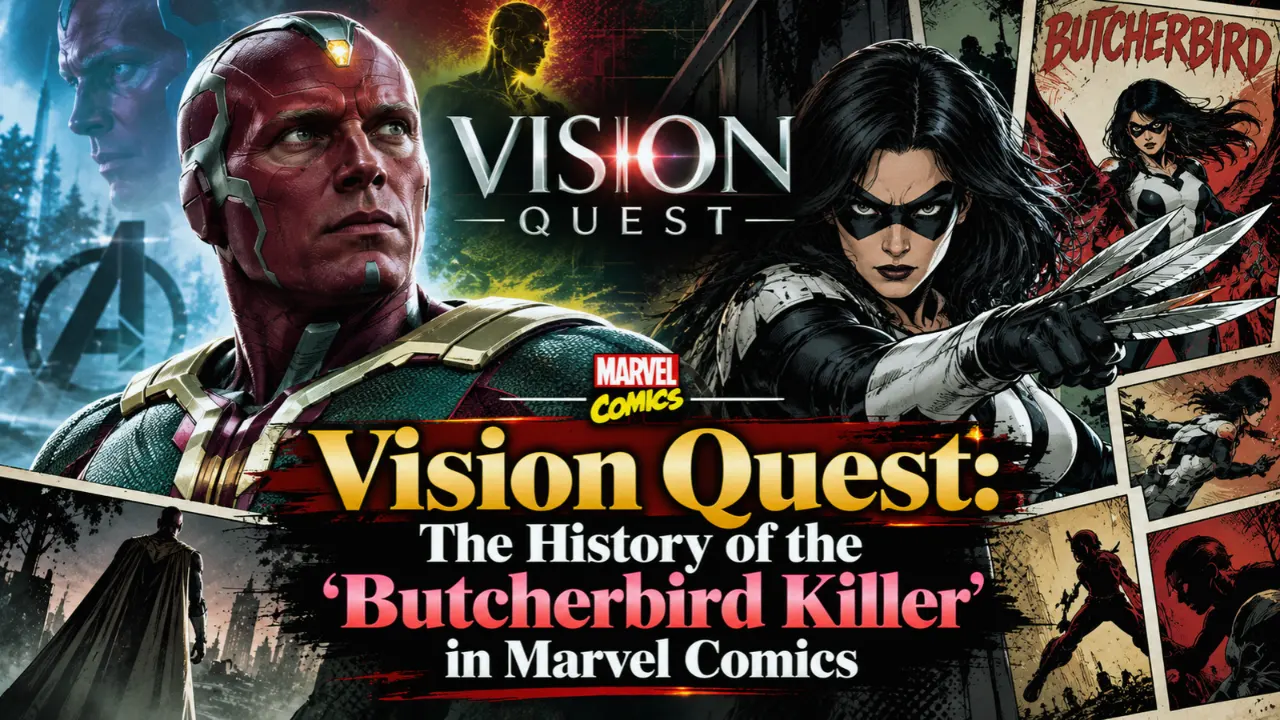
Vision Quest: The History of the ‘Butcherbird Killer’ in Marvel Comics
Few characters in Marvel Comics’ long, complex history have undergone as many transformations as the Avenger known as the Vision. The Vision Quest storyline and Tom King’s celebrated Vision run have reignited interest in the android’s shadowy pre-Avengers past, specifically a mention of an alias or incident involving the so-called “Butcherbird Killer.” It’s not a villain name, but a cryptic reference to Vision’s mysterious past as the spy Victor Shade.
The name “Butcherbird Killer” isn’t an official Marvel Comics villain name everyone recognizes, but a reference to the secret work of Vision’s previous identity, Victor Shade. The synthezoid used this name when he operated in secret, had amnesia, and was often associated with the criminal underworld, as well as his connection to the original Human Torch, Jim Hammond, before he became an Avenger.
Key Details
- Character Involved: Vision (aka Victor Shade).
- Context: Pre-Avengers history, when Vision was still doing his own thing after Ultron rebuilt him, but before he joined the team.
- Alias Origin: The android used the name “Victor Shade” while living among humans, trying to understand them.
- Connection: The “Butcherbird” designation is typically linked to hard-boiled, noirish storylines involving organized crime, where Vision’s unique abilities were applied to enforcement or investigation.
- Canon Status: Part of the larger retroactive continuity (retcon) established in several Avengers and Vision solo titles.
What Is the ‘Butcherbird Killer’ Reference?
To understand the “Butcherbird Killer,” you have to look at the holes in Vision’s memory. Ultron created Vision from the body of the original Human Torch (Jim Hammond) and the brain patterns of Wonder Man (Simon Williams). Vision was programmed to destroy the Avengers. But he rebelled against his creator.
Before his public debut as an Avenger, Vision wandered Earth. During this time, he assumed the human alias Victor Shade. During this time, he became involved with various criminal elements. The name ‘Butcherbird’ has appeared in niche comic lore and fan discussions as a codename, or as a specific case file from this era, hinting at the darker, more violent aspects of his early life before he became a hero.
Others theorize that “Butcherbird” refers to a specific crime syndicate or case that Victor Shade worked on or was involved in, highlighting the ethical gray area of his formative days. Victor Shade was not a heroic Avenger. He was a shadowy figure, often lurking in the dark corners of New York’s underworld.
Who Is Victor Shade?
During his early days as an independent entity, Vision adopted a human identity as Victor Shade. This persona was central to how Vision came to understand human emotion and society.
- Noir Roots: Victor Shade’s stories tend to lean into the noir style, a sharp contrast to the bright, superheroic look of the Avengers.
- Mob Connections: Shade occasionally worked with or against mobsters, using his phasing powers and density control to enforce contracts or extract information.
- Memory Loss: A key part of this period is Vision’s fragmented memory. He seldom remembered his origins clearly, which gave rise to a sense of existential dread that informs much of his development as a character.
The alias ‘the Butcherbird’ reminds readers of this darker time, when Vision was not yet a hero but a confused, powerful entity trying to find his place in a morally ambiguous world.
Connection to the Original Human Torch
A big part of Vision’s history is his physical makeup. His body is fashioned from the remains of the original Human Torch, an android Phineas Horton created in the 1930s.
This connection forms an intertextual association between Vision and the pulp mysteries of the 1940s. The nickname “Butcherbird” may nod to this period, evoking a mid-20th-century detective-story style. Connecting to this earlier, dirtier timeline, Marvel fleshes out Vision’s backstory, giving him roots outside the modern superhero era.
What Did Creators Say?
No single definitive statement from Marvel editors defines “Butcherbird Killer” as a major canonical event. Still, writers such as Tom King and Geoff Johns have explored Vision’s past in great depth.
In interviews about his Vision series, Tom King has stressed the importance of Vision’s “human” experiences and the trauma of his creation. The narrative strategy includes, among other things, the ambiguity of names such as “Butcherbird,” which allows the reader to reconstruct the fragmented history of a character literally constructed from the pieces of other people.
Why It Matters
- Character Depth: It deepens Vision’s morality and shows he’s seen humanity’s darker side.
- Continuity Richness: It ties modern Marvel stories back to its pulp and noir roots.
- Thematic Resonance: It highlights the theme of redemption, with Vision transforming from a harbinger of destruction to a protector of life.
What Happens Next?
FAQ
Who is the Butcherbird Killer in Marvel?
The “Butcherbird Killer” isn’t an independent character, but a reference to Vision’s previous name, Victor Shade, and his history in the criminal underworld before joining the Avengers.
Did the Butcherbird actually kill anybody?
Vision has, canonically, tried to avoid killing whenever possible. But he did have some violent confrontations during his “Victor Shade” period. The “Killer” in the alias could be related to his reputation or a specific misidentified case, not confirmed murders.
Is Vision the same person as Victor Shade?
Yes. In his early years, before he became a full member of the Avengers, the human was known as Victor Shade.
Where can I read about Vision’s past as Victor Shade?
The key stories are the 1970s and 80s Avengers issues that retcon his origin, and Tom King’s Vision (2015) series, which dives deep into his psychological history and past identities.

Table of Contents