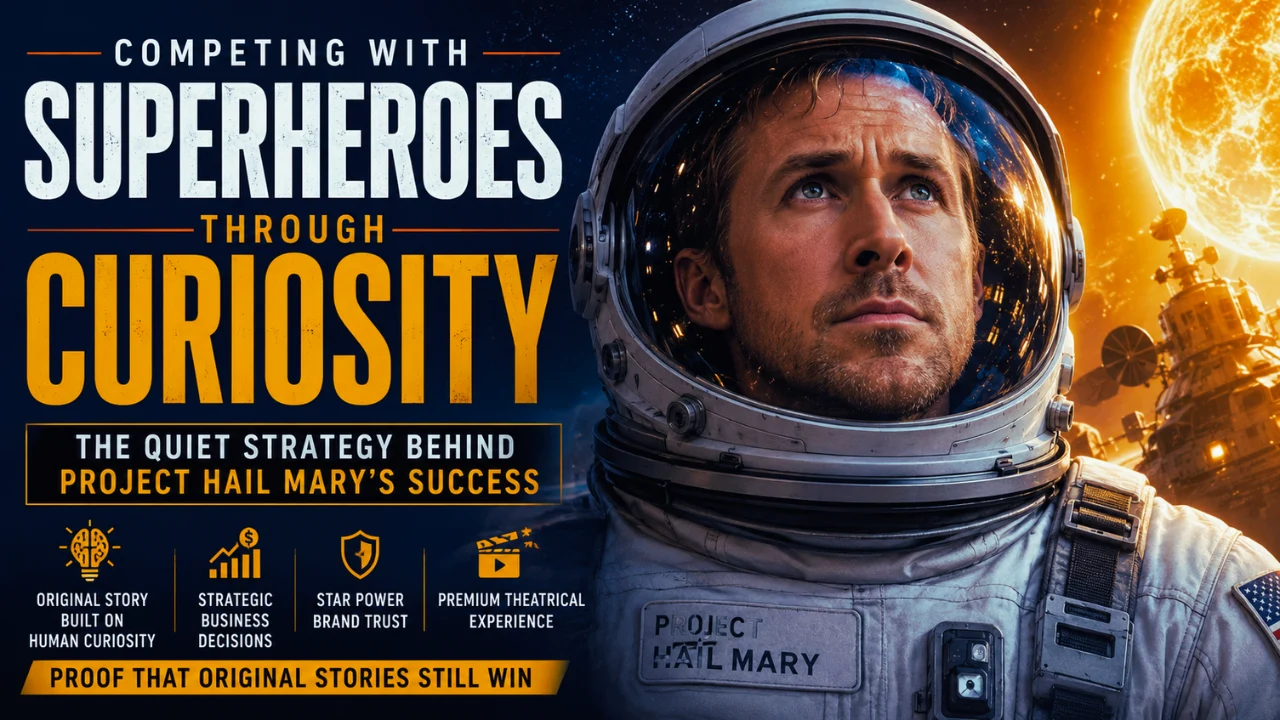
Project Hail Mary and the Business of Curiosity
For more than a decade, Hollywood has largely played the same game. Bigger franchises. Bigger universes. Bigger spectacle.
Then along came Project Hail Mary.
Rather than trying to outmuscle superheroes at their own business, the Ryan Gosling-led science fiction film pursued a quieter strategy. It asked audiences a simple question: “What happens next?” That sense of mystery became one of the most valuable assets in the entertainment business.
The story of Competing With Superheroes Through Curiosity: The Quiet Strategy Behind Project Hail Mary’s Success is not just about a successful film. It is about how studios are rediscovering the financial power of original ideas, intellectual property, and audience trust in an era dominated by sequels and cinematic universes.
Why This Celebrity Wealth Trend Matters Now?
Hollywood’s economics are changing.
Studios still rely heavily on recognizable brands, but audiences have shown they are willing to support original stories when they feel event-worthy. Project Hail Mary arrived with no existing film franchise behind it, yet it benefited from bestselling source material, premium marketing, and the star power of Ryan Gosling.
Its success matters because it highlights a broader shift in entertainment business strategy:
- Intellectual property remains valuable, even without a cinematic universe.
- Premium theatrical experiences still attract audiences.
- Curiosity can be a marketable asset.
- Streaming companies increasingly want theatrical credibility.
- Celebrity brand equity extends beyond endorsements.
For Amazon MGM Studios, the film represented more than ticket sales. It became proof that the company could compete with legacy studios on a global scale.
The Business Model Behind the Money
At first glance, Project Hail Mary looks like a traditional studio release. Underneath, it is a layered business model involving adaptation rights, theatrical distribution, streaming value, and talent participation.
Author Andy Weir reportedly sold the film adaptation rights in 2020, creating the first step in a chain of intellectual property monetization. The project later became part of Amazon MGM’s larger theatrical strategy following Amazon’s acquisition of MGM.
Salary Versus Ownership
A salary creates immediate income.
Ownership creates long-term leverage.
Public information confirms that Ryan Gosling served as both star and producer on the film. Producer credits do not automatically reveal compensation structures, but they often indicate a greater level of participation in a project’s success than acting fees alone.
Similarly, producers, writers, and rights holders can benefit from:
- Backend participation
- Royalties from source material
- Streaming rights agreements
- International distribution revenue
- Future licensing opportunities
This distinction explains why celebrity wealth is difficult to calculate accurately. Public salaries tell only part of the story.
Brand Equity and Audience Trust
Ryan Gosling’s involvement carried business value long before opening weekend.
Over the past decade, Gosling has built a reputation for selective projects that blend mainstream appeal with artistic credibility. That reputation functions as brand equity. Audiences may not buy tickets solely because of an actor, but trust influences consumer decisions.
The same principle applies to directors Phil Lord and Christopher Miller, whose previous work includes commercially successful and critically acclaimed projects. Combined with Andy Weir’s track record after The Martian, the film assembled a collection of brands rather than relying on a single celebrity name.
Why Traditional Net Worth Estimates Often Miss the Full Picture?
Celebrity net worth articles remain popular, but they frequently miss the mechanics behind entertainment wealth.
Public estimates rarely account for:
| Wealth Driver | How It Works | Why It Matters |
|---|---|---|
| Salary | Upfront payment for work | Creates immediate income |
| Royalties | Payments tied to usage or sales | Can generate long-term revenue |
| Equity Deals | Ownership participation | May appreciate over time |
| Licensing | Monetizing intellectual property | Extends earning potential |
| Streaming Rights | Distribution agreements | Adds recurring value |
| Residual Income | Payments from reuse | Builds wealth over decades |
In Hollywood, money moves through layers of contracts. Taxes, commissions, legal fees, and management costs further complicate the picture.
A producer credit, for example, does not automatically reveal ownership percentages or backend participation. Likewise, private investments and real estate holdings are often unavailable to the public.
That is why celebrity wealth remains more complicated than a single headline figure.
That Shows How This Works
Hollywood has repeatedly demonstrated that curiosity can become a business strategy.
The Martian succeeded by combining scientific problem-solving with mass-market storytelling.
Oppenheimer turned a three-hour historical drama into a global box office phenomenon by creating cultural urgency.
Now Project Hail Mary joins that list by positioning itself as a mystery audiences wanted to solve together. Industry observers noted that its opening represented one of the strongest debuts for an original film in recent years and Amazon MGM’s largest theatrical launch.
The lesson is clear.
Audiences still pay for discovery when studios package it effectively.
The Risks Behind Celebrity Business Ventures
Original films are not inherently safer investments.
In fact, they often carry greater risks:
- Higher marketing costs.
- Less consumer familiarity.
- Greater dependence on reviews and word of mouth.
- Limited merchandising opportunities.
- Pressure to justify premium budgets.
A reported production budget of around $200 million meant Project Hail Mary needed substantial global support to justify its investment.
The entertainment industry is filled with examples of ambitious projects that failed despite major stars and strong concepts.
Celebrity entrepreneurship faces similar challenges. Whether it is a tequila brand, fashion label, or streaming venture, fame does not guarantee product-market fit.
Audience attention remains one of the hardest assets to retain.
What This Reveals About Modern Celebrity Wealth?
Modern celebrity wealth is increasingly tied to ownership, intellectual property, and strategic partnerships.
Actors are becoming producers.
Authors are becoming stakeholders in adaptations.
Streaming companies are becoming theatrical studios.
The line between entertainment and investment continues to blur.
For Amazon MGM, Project Hail Mary demonstrated the value of theatrical exclusivity before streaming availability. For Ryan Gosling, it reinforced the long-term benefits of careful project selection. For Andy Weir, it showed how a bestselling novel can continue generating value years after publication.
Most importantly, the film proved that curiosity itself has commercial value.
In an industry crowded with superheroes, audiences still want to be surprised.
Conclusion
Project Hail Mary did not defeat franchise filmmaking. It offered an alternative.
Its success suggests that Hollywood’s future may include more balance between established intellectual property and original storytelling. Studios still need recognizable brands, but audiences continue to reward films that make them feel something increasingly uncommon: genuine curiosity.
That may become one of the industry’s most valuable assets over the next decade.
FAQs
Why was Project Hail Mary successful?
The film combined a bestselling novel, Ryan Gosling’s star power, strong word-of-mouth, and a mystery-driven marketing strategy that differentiated it from traditional franchise releases.
How does Ryan Gosling make money beyond acting?
Publicly available information shows Gosling also works as a producer on select projects, which can provide additional compensation opportunities beyond acting fees.
What is brand equity in Hollywood?
Brand equity refers to the commercial value associated with a celebrity, filmmaker, or intellectual property based on audience trust and recognition.
Why are celebrity net worth estimates often inaccurate?
Many estimates cannot account for private investments, royalties, taxes, licensing deals, or undisclosed ownership arrangements.
Can original movies still compete with superhero films?
Yes. Recent examples suggest audiences remain interested in original stories when they are marketed effectively and positioned as premium entertainment experiences.
Enjoy breaking down the business behind Hollywood? Explore more celebrity wealth stories, entertainment economics, and net worth analysis articles to see how fame increasingly translates into ownership and long-term value.

Table of Contents