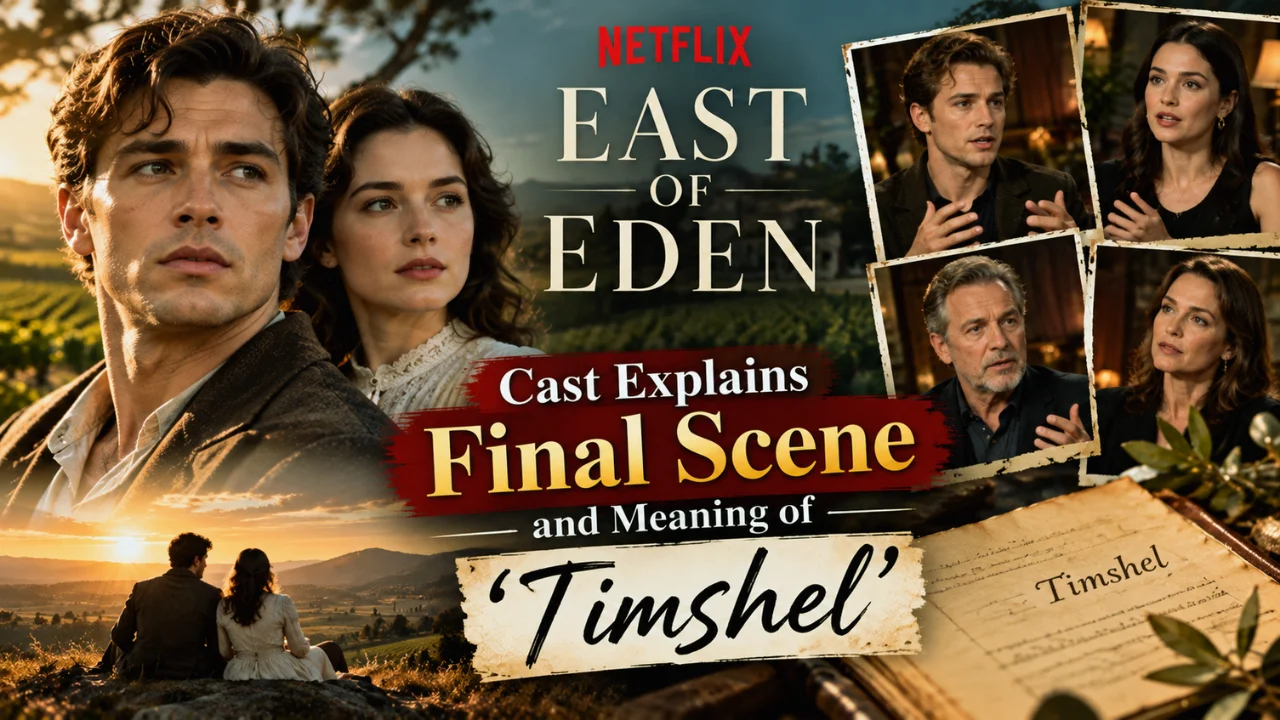
Netflix’s ‘East of Eden’ Cast Explains Final Scene and Meaning of ‘Timshel’
Netflix’s recent adaptation of John Steinbeck’s East of Eden has cast members opening up about the emotionally charged series finale, giving a sneak peek into the poetic symbolism of the last moments and the profound significance of the Hebrew word “Timshel.” The high-profile literary adaptation on the streaming platform is drawing plenty of attention, and actors and creators point to the story’s enduring message about human agency and moral choice.
The Hebrew word “Timshel” in Netflix’s East of Eden means “Thou Mayest” and refers to free will. As the cast explains, this idea appears in the final scene to show that characters are not defined by their ancestry or past sins, but can choose to break generational cycles and define their own moral paths.
Key Details
- What happened: Cast members of Netflix’s East of Eden sat down for press interviews about the thematic resolution of the series finale.
- Main Theme: The story centers on the Hebrew word “Timshel,” meaning “thou mayest,” which is about the power of choice in one’s life.
- Final Scene: The actors call the final scene “poetic” and symbolic because it deals with reconciliation and the denial of deterministic fate.
- Source Material: The series is based on John Steinbeck’s 1952 novel that retells the biblical story of Cain and Abel in the setting of two California families.
- Key Takeaway: The adaptation demonstrates the human ability to choose good over evil, irrespective of heritage.
The Meaning of ‘Timshel’
Both Steinbeck’s original novel and the Netflix adaptation are built on the concept of “Timshel.” The word is the Hebrew root mashal, meaning “to rule” or “to have dominion.” It appears in the biblical story of Cain and Abel in Genesis 4:7. In the story’s context, it is translated as “thou mayest.”
In recent promotional interviews, the cast of the series spoke of how this one word is the moral anchor of the series. In the King James translation, “thou shalt” (meaning “thou shalt” or “thou wilt”) implies command or prediction, while “thou mayest” (meaning “thou mayest” or “thou can”) implies possibility and agency.
One of the lead actors said at a roundtable, “The word ‘Timshel’ is the heartbeat of the whole story. It tells us that our bloodline does not curse us. We do not have to repeat our fathers’ mistakes. We have the power to choose. \”It is the gift and the curse of humanity.\”
This interpretation aligns with Steinbeck’s philosophical views in the novel, where Lee states that the power to choose between good and evil is what makes humanity meaningful. The Netflix adaptation preserves this dialogue so present-day audiences can grasp the term’s theological and philosophical significance.
Breaking Down the ‘Poetic’ Final Scene
The final episode of East of Eden ends with what the cast members have described as a “poetic” scene, rather than one driven by plot. The actors did not reveal any spoiler-heavy details, but said the ending is more about emotional resolution than dramatic action.
The scene is said to recall the biblical reconciliation of feuding brothers, a visual metaphor for the breaking of generational trauma. The cast stressed that the direction relied on subtle performances and symbolic imagery to convey the internal evolution of the characters.
“It wasn’t big explosions and big twists,” one actress in the finale said. “It was about silence, eye contact, and the realization that the cycle ends here. It’s poetic because it speaks to something universal: “the desire to be better than what we were given.”
Critics and early viewers have said that the ending has a slightly different tone from some previous versions. It ends on a more introspective and ambiguous note, inviting the viewer to interpret the meaning. This method emphasizes the theme of “Timshel”: the script doesn’t determine the outcome; the characters’ choices in that last moment do.
Why It Matters
Bringing East of Eden back to a major streaming service like Netflix introduces Steinbeck’s complex exploration of morality to a new audience. Generational trauma, family relationships, and personal responsibility are hot topics these days, so the story’s free-will aspect strikes home.
By clarifying the meaning of “Timshel,” the cast helps audiences move beyond a surface-level view of the drama. It turns the series from a simple family saga into a philosophical inquiry into whether people can escape their past. Thematic depth sets the adaptation apart from the average procedural drama and gives viewers a story that makes them think about themselves.
What Happens Next
With the first season out now, Netflix has not officially greenlit a second season yet, as the current adaptation covers the main arc of Steinbeck’s novel. But the strong critical reaction and the audience’s engagement with the thematic elements suggest room for further exploration of the Trask and Hamilton families.
Fans are invited to rewatch the final episodes with “Timshel” in mind and look for visual clues and dialogue that reinforce the theme of choice. Discussions on social media platforms continue to gain traction, with viewers posting their take on the symbolism of the final scene.
FAQ
What does “Timshel” mean in East of Eden?
“Timshel” is a Hebrew word meaning “thou mayest.” In East of Eden, it represents free will: the idea that humans can overcome sin, choose good, and are not predestined to evil.
Is Netflix East of Eden faithful to the book?
Netflix’s adaptation stays true to the major themes and narrative arc of John Steinbeck’s 1952 novel, especially the Cain and Abel allegory and the philosophical debates about “Timshel.” But as with most adaptations, it may change the pacing or visual story for the screen.
Why is the final scene described as poetic?
The cast describes the last scene as poetic because it relies on symbolic imagery, emotional subtext, and thematic resolution rather than explicit plot exposition. It visually captures the characters’ internal liberation as they embrace their free wills.
Who is the author of East of Eden?
East of Eden is a novel by American author John Steinbeck, published in 1952. “It’s considered one of his most ambitious works, and it follows two families in California’s Salinas Valley as they deal with the complex nature of good and evil.

Table of Contents