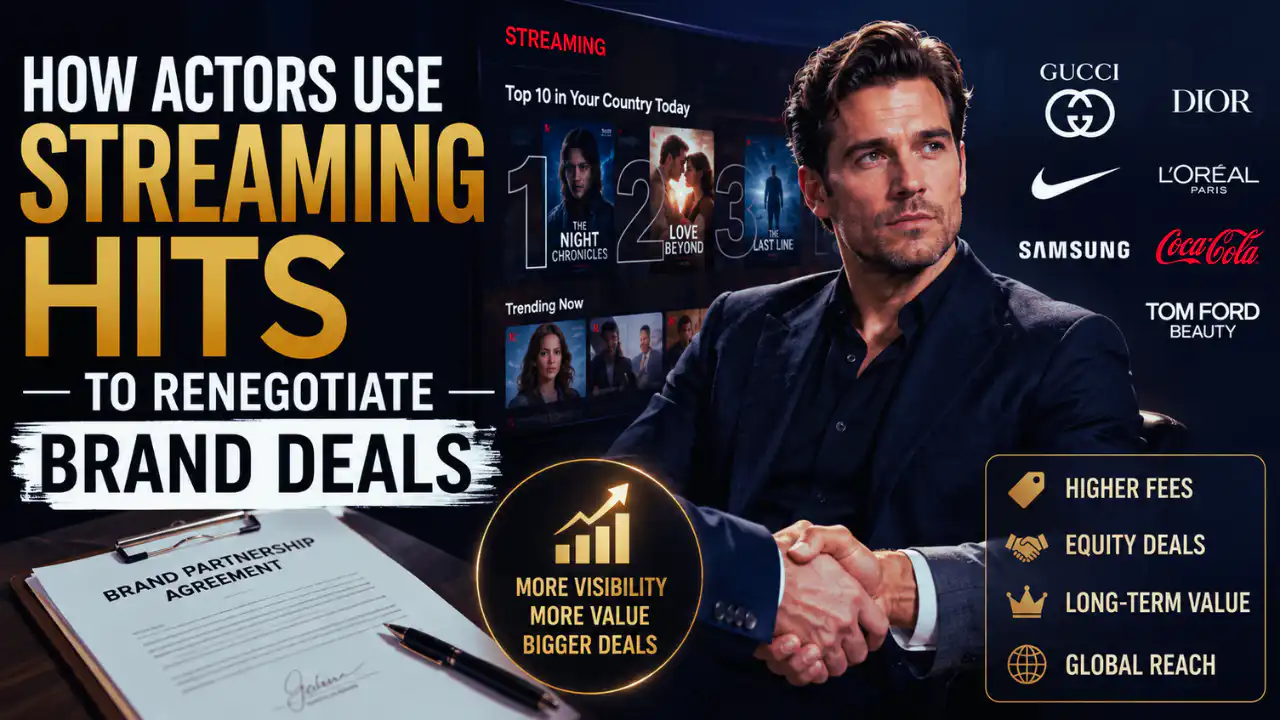
How Actors Use Streaming Hits to Renegotiate Brand Deals
A decade ago, landing a blockbuster film was often the fastest route to becoming a highly paid celebrity endorser. Today, a streaming hit can accomplish the same thing, sometimes even faster.
When millions of viewers binge a series over a single weekend, actors can become globally recognizable almost overnight. That sudden visibility has transformed how talent agencies negotiate endorsement contracts, licensing deals, and equity partnerships. Understanding how actors use streaming hits to renegotiate brand deals offers a fascinating look at the modern entertainment business and the growing connection between fame and financial leverage.
For many stars, a successful streaming project is no longer the finish line. It is the beginning of a new negotiation.
Why This Celebrity Wealth Trend Matters Now?
Streaming platforms have fundamentally changed how celebrity is created.
Shows like Bridgerton, The Queen’s Gambit, Wednesday, and Squid Game reached audiences across dozens of countries within days of release, creating a level of global exposure that traditional television often took years to achieve. Industry observers frequently point to streaming’s ability to compress fame into a much shorter timeline.
That matters because brands do not simply buy fame. They buy attention.
If an actor becomes the face of a cultural moment, companies see an opportunity to borrow that relevance. Luxury brands, fashion labels, beauty companies, and technology firms regularly seek ambassadors who are already dominating social conversations.
Streaming has effectively become a marketing accelerator.
Actors who once waited years to build commercial appeal can now walk into contract renegotiations with fresh audience data, increased media visibility, and proof that they can attract consumer attention on a global scale.
The Business Model Behind the Money
Streaming success rarely creates wealth through salary alone.
For many actors, the real financial upside comes after the credits roll.
Talent representatives often revisit existing endorsement agreements after a major streaming release. A deal signed before a hit series may suddenly look undervalued if the actor’s visibility increases substantially.
Salary Versus Ownership
There is a significant difference between earning a pay cheque and owning part of a business.
| Wealth Driver | How It Works | Why It Matters |
|---|---|---|
| Salary | Upfront payment for acting work | Creates immediate income |
| Residuals | Payments tied to content reuse | Supports long-term earnings |
| Brand Deals | Endorsements and partnerships | Converts visibility into income |
| Licensing | Companies pay to use a celebrity’s image | Creates scalable revenue |
| Equity Deals | Ownership stakes in businesses | Offers long-term upside |
| Private Investments | Investments in startups or funds | May diversify wealth over time |
Historically, actors relied heavily on salaries and residuals. The streaming era has shifted attention toward ownership and partnerships.
Some actors negotiate ambassador roles that include equity incentives instead of higher fees. Others pursue licensing agreements that allow brands to use their likeness across multiple campaigns.
Publicly available reporting suggests that established stars increasingly seek arrangements tied to long-term value creation rather than one-time payments.
Brand Equity and Audience Trust
Brand equity is difficult to measure, but it has become one of Hollywood’s most valuable assets.
An actor attached to a successful streaming title brings several things to the negotiating table:
- Global recognition
- Increased media coverage
- Social media growth
- Cultural relevance
- Audience trust
- Cross-generational appeal
Brands understand that consumers often associate actors with the characters they portray. A charming lead in a popular romantic drama or a compelling performance in a prestige series can significantly influence public perception.
That emotional connection is commercially valuable.
Fashion and luxury companies have increasingly aligned themselves with streaming properties because cultural moments create purchasing behavior. Shows such as Bridgerton and Emily in Paris generated substantial fashion conversations and commercial partnerships following their releases.
Why Traditional Net Worth Estimates Often Miss the Full Picture?
Celebrity wealth is notoriously difficult to calculate.
Most public net worth estimates rely on visible income sources, including acting salaries, real estate holdings, and publicly disclosed endorsement agreements.
However, several factors remain largely private:
- Equity ownership
- Licensing structures
- Investment portfolios
- Taxes
- Management fees
- Legal expenses
- Revenue-sharing agreements
- Deferred compensation
An actor may publicly earn £2 million for a streaming project while privately negotiating a multi-year partnership with a consumer brand.
That is why celebrity net worth figures should always be treated as estimates rather than confirmed financial statements.
In many cases, the most valuable assets are invisible.
A licensing agreement signed today could generate income for years. An equity stake in a growing business may eventually be worth more than an entire acting career.
That Shows How This Works
Several publicly known examples illustrate the relationship between streaming fame and brand value.
After The Queen’s Gambit, Anya Taylor-Joy experienced a notable increase in visibility across fashion and luxury circles. She has since become associated with major luxury campaigns and high-profile partnerships.
Similarly, Regé-Jean Page’s breakout role in Bridgerton dramatically elevated his profile, leading to major film opportunities and increased commercial interest.
Meanwhile, Netflix itself has expanded its relationship with brands through collaborations tied to popular shows. Campaigns connected to Stranger Things, Squid Game, and Emily in Paris demonstrate how streaming properties increasingly operate as marketing ecosystems rather than standalone entertainment products.
These examples highlight an important reality.
Brands are not merely paying for celebrity. They are paying for cultural momentum.
The Risks Behind Celebrity Business Ventures
Not every streaming success translates into lasting financial value.
Celebrity branding comes with considerable risks:
- Audience fatigue
- Overexposure
- Poor product-market fit
- Weak management teams
- Short-lived popularity
- Licensing disputes
- Reputation issues
- Market saturation
History is filled with celebrity ventures that launched with significant publicity but struggled to maintain momentum.
An actor’s popularity can rise quickly and decline just as fast. Streaming audiences move rapidly from one cultural obsession to another, making timing especially important.
There is also a growing challenge around authenticity.
Consumers have become increasingly skeptical of endorsements that feel transactional. A celebrity promoting ten unrelated products within a year may weaken the trust that made them valuable in the first place.
Brand partnerships work best when they feel believable.
What This Reveals About Modern Celebrity Wealth?
Modern celebrity wealth is increasingly built on leverage rather than labor.
Actors are learning that the biggest financial opportunity may not be a larger salary. It may be using a streaming hit to negotiate ownership, secure licensing rights, or establish business ventures that continue generating revenue long after audiences finish watching.
Streaming has changed the economics of fame.
Today, a successful series can function as a launchpad for entrepreneurship, investment opportunities, and long-term brand building. It can also reshape an actor’s negotiating power across multiple industries.
The most financially successful celebrities understand a simple principle: attention is temporary, but ownership can last.
That lesson is becoming one of the defining themes of the modern entertainment business.
Conclusion
The story behind how actors use streaming hits to renegotiate brand deals is ultimately a story about leverage.
Streaming platforms have created a faster path to global recognition, giving actors new tools to increase their commercial value. While salaries remain important, ownership deals, licensing arrangements, equity partnerships, and private investments are increasingly shaping celebrity wealth.
As streaming continues to dominate entertainment consumption, the gap between fame and financial success will likely depend less on who gets the biggest role and more on who negotiates the smartest deal afterward.
FAQs
1. How do actors use streaming hits to renegotiate brand deals?
Actors often use increased visibility and audience engagement from successful streaming projects to negotiate higher endorsement fees, licensing agreements, and equity partnerships.
2. Do actors make more money from endorsements than acting?
Some do. While acting salaries can be substantial, long-term endorsement, licensing, and ownership deals may generate more wealth over time.
3. What is brand equity in celebrity wealth?
Brand equity refers to the commercial value associated with a celebrity’s reputation, recognition, and audience trust.
4. Why are celebrity net worth estimates often inaccurate?
Most estimates exclude private investments, taxes, undisclosed business interests, equity stakes, and confidential deal structures.
5. Are streaming stars replacing traditional movie stars?
Streaming stars are not necessarily replacing movie stars, but they are increasingly commanding similar levels of attention and commercial value.
Interested in the business of fame? Explore more celebrity wealth stories, entertainment economics breakdowns, and net worth analyses to see how modern stars build fortunes beyond the screen.

Table of Contents