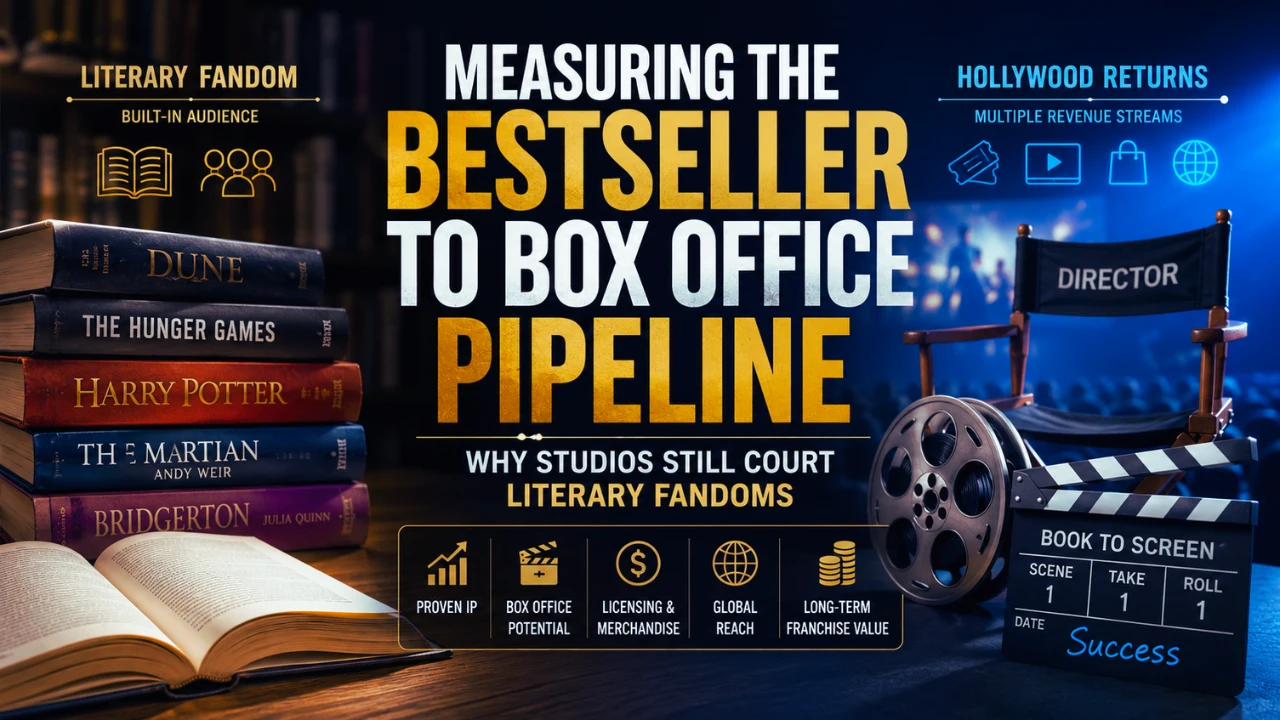
Bestseller to Box Office Pipeline Explained
Before a movie trailer drops, some films already have millions of potential customers waiting.
That is the hidden advantage behind the bestseller-to-box office pipeline. For decades, studios have turned bestselling novels into films and television franchises because books offer something increasingly difficult to manufacture in entertainment: audience trust.
From Harry Potter and The Hunger Games to Dune, Bridgerton, and The Martian, literary properties have become some of Hollywood’s most valuable assets. Studios are not merely buying stories. They are acquiring intellectual property, built-in communities, merchandising opportunities, and, in some cases, franchises that can generate revenue for decades.
In an era dominated by streaming wars and fierce competition for attention, literary fandoms have become one of the safest bets in entertainment economics.
Why This Celebrity Wealth Trend Matters Now?
Hollywood has become increasingly dependent on recognizable intellectual property.
Industry research continues to show that book adaptations outperform many original productions, particularly during opening weekends. A 2011 study examining more than 700 films found that book adaptations often enjoy stronger initial box office performance because they benefit from existing brand equity. More recent publishing industry reports have reached similar conclusions.
Streaming has accelerated the trend. Nearly half of original drama series released across major platforms between early 2024 and mid-2025 were adapted from books, according to the Publishers Association.
That matters because literary fandoms now influence:
- Opening weekend ticket sales
- Streaming subscriptions
- Merchandise demand
- Audiobook consumption
- International licensing deals
- Theme park and gaming opportunities
- Long-term franchise value
Today’s entertainment business increasingly rewards ownership over originality. A studio would rather acquire a proven audience than spend millions attempting to build one from scratch.
The Business Model Behind the Money
The bestseller-to-screen pipeline is essentially an IP acquisition business.
A studio typically purchases or options adaptation rights from publishers or authors. If development moves forward, additional revenue streams emerge across theatrical releases, streaming rights, physical media, licensing agreements, and merchandise.
The book often benefits too.
Recent examples have shown that successful adaptations can send titles back onto bestseller lists years after publication. Publishers have reported significant increases in sales and audiobook consumption following high-profile streaming releases.
Salary Versus Ownership
Actors may receive upfront salaries, but ownership creates the largest long-term opportunities.
Authors who retain certain rights can continue earning royalties from adaptations, while producers and studios benefit from ownership of the screen version. Depending on deal structures, creators may negotiate:
- Backend participation
- Producer credits
- Sequel rights
- Merchandising revenue
- Television spin-off participation
- International distribution payments
This is why intellectual property has become such a prized asset.
A bestselling novel is not simply a manuscript. It is a portfolio of monetizable opportunities.
Brand Equity and Audience Trust
Literary fandoms function as unpaid marketing engines.
Book readers recommend titles on social media, create fan communities, attend premieres, and generate years of discussion before cameras even begin rolling.
Platforms like BookTok have added another layer to this equation. Studios increasingly monitor online reading trends to identify potential adaptations before books reach peak popularity.
Audience trust has measurable value:
| Wealth Driver | How It Works | Why It Matters |
|---|---|---|
| Bestseller Status | Signals audience demand | Reduces marketing uncertainty |
| Royalties | Ongoing payments to rights holders | Creates recurring income |
| Licensing Deals | Rights granted across markets | Expands global revenue |
| Streaming Rights | Platforms pay for distribution | Builds long-term asset value |
| Merchandising | Products tied to the IP | Generates additional revenue |
| Franchise Potential | Sequels and spin-offs | Extends earnings over years |
Hollywood is increasingly paying for predictability, not merely creativity.
Why Traditional Net Worth Estimates Often Miss the Full Picture?
Celebrity net worth headlines rarely capture the complete story.
An actor attached to a major adaptation may receive salary headlines, but public figures often leave out backend participation, producer fees, royalties, and private business arrangements.
Similarly, authors can build substantial wealth through:
- Film and television rights
- Foreign publishing deals
- Audiobook royalties
- Licensing agreements
- Speaking engagements
- Future adaptation opportunities
Industry observers frequently note that many entertainment fortunes remain difficult to estimate because private investments, taxes, management fees, and undisclosed contracts are rarely public.
A creator who appears to have modest earnings on paper may possess valuable intellectual property rights generating residual income for years.
That distinction matters.
Celebrity wealth is increasingly tied to ownership, not visibility.
ThatShowsw How This Works
Hollywood’s history is filled with literary success stories.
Harry Potter became one of the most successful entertainment franchises in history, expanding beyond books into films, merchandise, gaming, and theme park experiences.
The Hunger Games demonstrated how young adult publishing could create a multi-film franchise with global appeal.
Dune spent decades in adaptation limbo before becoming a modern cinematic success.
Meanwhile, projects like The Martian showed that a strong concept paired with positive word-of-mouth can create significant value across publishing and film.
Not every adaptation succeeds, however.
Films such as The Dark Tower illustrate that a large fan base alone cannot guarantee box office success if audiences feel disconnected from the adaptation.
The Risks Behind Celebrity Business Ventures
Studios pursue literary properties because they reduce uncertainty, but they do not eliminate it.
Common risks include:
- Overpaying for adaptation rights
- Alienating core fans
- Weak casting choices
- Poor release timing
- Franchise fatigue
- Creative departures from source material
- Oversaturation of similar genres
Literary fandoms can be passionate, but they can also be unforgiving.
A failed adaptation may damage both the film and the underlying brand. Fans often become vocal critics when beloved stories feel mishandled, affecting audience sentiment and long-term franchise value.
There is also the challenge of translating books into visual experiences.
Some stories thrive on internal monologues, while others depend heavily on world-building that becomes expensive to recreate on screen. Studios must determine whether the economics justify the production budget.
What This Reveals About Modern Celebrity Wealth?
The bestseller-to-box office pipeline reveals something larger about entertainment itself.
Modern wealth is increasingly built through intellectual property ownership.
Actors are becoming producers. Authors are becoming media entrepreneurs. Studios are becoming asset managers for cultural brands.
The biggest fortunes in entertainment rarely come from a single pay cheque. They emerge from years of licensing deals, royalties, streaming rights, sequel opportunities, and strategic ownership.
That is why literary fandoms remain so valuable.
Books provide more than stories. They provide proof of demand.
And in Hollywood, demand remains one of the most valuable assets money can buy.
Conclusion
The relationship between publishing and Hollywood has evolved into one of the entertainment industry’s most reliable business models. Studios continue courting literary fandoms because books arrive with something every executive wants: an audience that already cares.
As streaming platforms compete for subscribers and theatrical releases become increasingly expensive, the bestseller-to-box-office pipeline is likely to remain a cornerstone of modern entertainment strategy.
The next billion-pound franchise may already be sitting on a bookstore shelf.
FAQs
Why do studios prefer adapting bestselling books?
Bestselling books offer built-in audiences, stronger brand recognition, and lower marketing uncertainty compared with entirely original concepts.
Do authors make money when their books become films?
Yes. Authors can earn income through option agreements, adaptation rights, royalties, producer credits, and related licensing deals, depending on contract terms.
Why do some book adaptations fail?
Popular source material does not guarantee success. Casting, direction, timing, marketing, and audience reception all influence performance.
How does BookTok affect Hollywood?
BookTok helps studios identify emerging literary trends and fandoms, making it an increasingly valuable tool for discovering adaptable intellectual property.
Are celebrity net worth estimates accurate for authors and producers?
Not always. Public estimates frequently exclude royalties, private investments, licensing income, taxes, and undisclosed ownership arrangements.
Enjoy breaking down the business behind fame? Explore more entertainment wealth stories, Hollywood money trends, and celebrity ownership analyses to discover how modern fortunes are really built.
Table of Contents