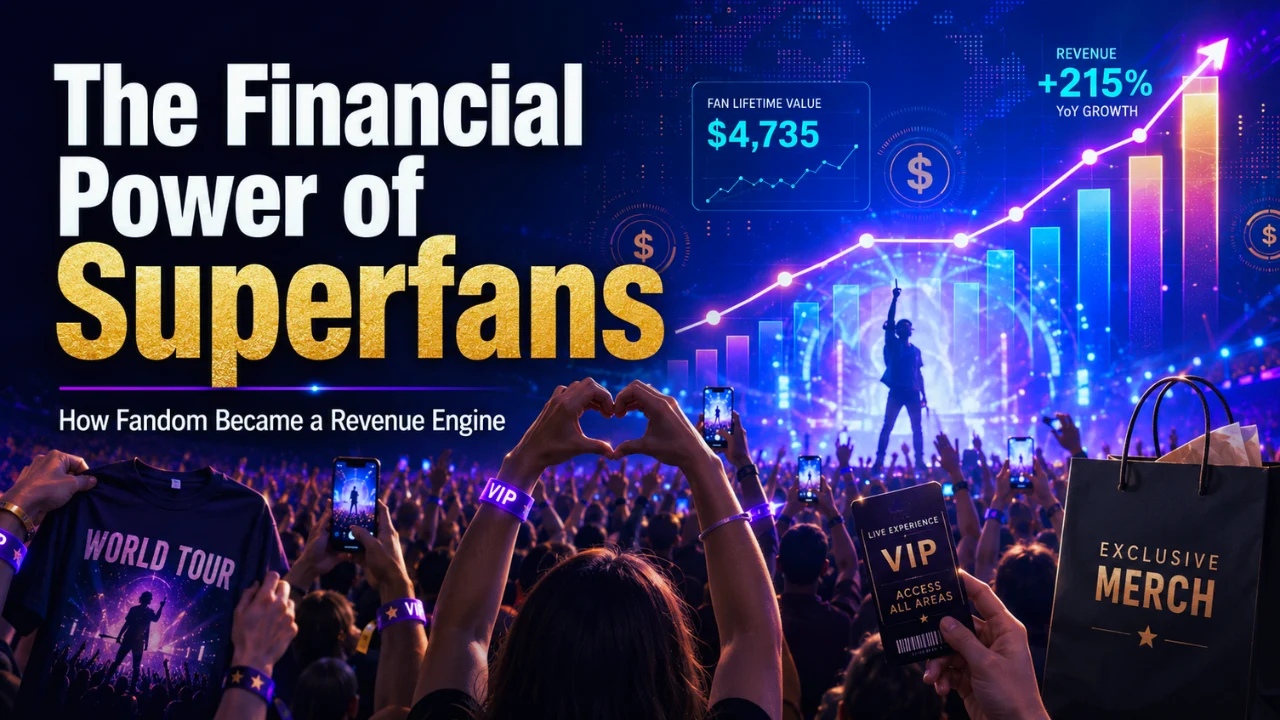
The Financial Power of Superfans and Modern Celebrity Wealth
This article explains how superfans have become one of the most valuable forces in the entertainment business. It breaks down how celebrities, artists, creators, and media companies turn loyal audiences into revenue through tickets, merchandise, memberships, licensing, equity deals, and brand ecosystems.
A casual fan streams a song, watches a trailer, or likes a post. A superfan does something much more powerful. They buy the vinyl, pay for VIP access, join the membership, wear the merch, attend the tour, and defend the brand online.
That is the financial power of superfans. Fandom is no longer just cultural energy around celebrities, musicians, actors, athletes, or creators. It has become a serious revenue engine in the entertainment business, shaping how Hollywood money, celebrity wealth, and brand equity are built.
The shift matters because modern fame is not only measured by followers or headlines. The real question is this: how many people are willing to spend, return, and stay emotionally invested over time?
Why This Celebrity Wealth Trend Matters Now?
Entertainment used to depend heavily on mass reach. A movie needed ticket buyers—a record needed album sales. A TV star needed ratings. Those still matter, but the money map has changed.
Today, the most valuable audience is often smaller, deeper, and more committed. Industry research has repeatedly pointed to superfans as a major growth opportunity, especially in music, where Goldman Sachs has estimated that superfan monetization could create billions in added annual revenue. Music Business Worldwide reported that Goldman’s model assumes around 20% of paid streaming subscribers may behave like superfans, spending far more than average listeners.
That explains why companies are building premium tiers, fan clubs, digital communities, exclusive drops, and direct-to-fan platforms. Universal Music Group has also pushed “Streaming 2.0” agreements aimed partly at increasing revenue from dedicated fans through merchandise and premium subscription offers.
For celebrities, this changes the wealth equation. Fame becomes more valuable when it can be converted into repeat spending, not just attention.
The Business Model Behind the Money
Superfan revenue does not come from one source. It works like a stack.
At the bottom is broad visibility: streaming, social media, press, trailers, podcasts, and viral moments. That creates awareness. Above that sits conversion: concert tickets, paid subscriptions, merch, books, beauty products, collectibles, meet-and-greet packages, digital content, and limited-edition releases.
At the top is ownership. That is where celebrity entrepreneurship becomes powerful. A star who owns part of a brand, master recordings, publishing, production company, catalog rights, or consumer business has a different financial profile from someone who only receives a fee.
Salary Versus Ownership
Salary is clean and immediate. An actor gets paid for a film. A musician gets paid for a show. A creator gets paid for a campaign.
Ownership can be slower, riskier, and less visible, but it may create long-term upside. Equity deals, royalties, licensing deals, and residual income can continue to generate value after the original work is done.
That is why celebrity net worth estimates often miss the bigger picture. A public salary tells only one part of the story. Private investments, undisclosed equity, tax structures, debt, management fees, and royalty splits are usually harder to verify.
Brand Equity and Audience Trust
Brand equity is the financial value attached to a name, image, story, and the relationship with the audience. A celebrity with loyal fans can reduce marketing friction because the audience already cares.
But attention is not the same as trust. Social media followers do not guarantee sales. A fan may stream every song but never buy a fragrance, hoodie, or premium membership. The strongest celebrity brands translate emotional loyalty into products that feel authentic to their audiences.
That is why superfans matter. They are not just watching. They are participating.
Helpful Table
| Wealth Driver | How It Works | Why It Matters |
|---|---|---|
| Salary | Upfront payment for a role, tour, show, or campaign | Creates immediate income |
| Royalties | Ongoing payments from music, publishing, books, or product use | Can support long-term earnings |
| Equity | Ownership stake in a company or venture | Can grow if the business succeeds |
| Licensing | Paid use of name, image, music, character, or brand | Generates income without full operations |
| Residuals | Payments from reuse, reruns, or distribution | Adds recurring value over time |
| Brand Deals | Paid endorsements or partnerships | Converts fame into marketing power |
| Memberships | Paid fan communities or exclusive access | Builds predictable recurring revenue |
| Merchandising | Products tied to artists, franchises, or creators | Turns fandom into physical sales |
Why Traditional Net Worth Estimates Often Miss the Full Picture?
Celebrity net worth estimates are popular because they offer a simple number. The problem is that celebrity wealth is rarely simple.
A musician might earn from touring, streaming rights, publishing royalties, merchandise, brand partnerships, and catalog ownership. An actor might earn a salary, backend points, residuals, production fees, and endorsement income. A creator might earn from ads, paid communities, live events, subscriptions, and licensing.
Publicly available data usually captures only the visible pieces. It may not show private investments, debt, taxes, management commissions, equity dilution, or contract terms. That is why a reported net worth should be treated as an estimate rather than a confirmed financial statement.
This is especially true in superfan businesses. A celebrity may not need the largest audience to build a meaningful income. They need a loyal audience that buys repeatedly.
Examples That Show How This Works
The live music industry gives the clearest example. Taylor Swift’s Eras Tour became a historic case of superfan economics, with Pollstar estimating a global gross of about $2.2 billion and more than 10 million tickets sold. The bigger lesson is not just one tour’s success. It is how live events, merchandise, film releases, streaming activity, and fan conversation can reinforce one another.
K-pop has also turned fandom into infrastructure. Weverse, HYBE’s global fandom platform, reported major fan activity across artist posts, live broadcasts, digital fan letters,s and commerce. Its 2024 report said Weverse Shop sold 20.6 million merchandise items, up 13% from the previous year.
The creator economy shows the same pattern outside traditional celebrity. Patreon said creators on its platform have received more than $10 billion from fans since 2013, with more than 25 million paid memberships. Business Insider also reported that podcasting became Patreon’s highest-earning category, with podcasters collectively earning more than $472 million on the platform in 2024.
Live entertainment remains another major arena for superfan spending. Reuters reported that Live Nation’s concerts drew 159 million fans globally in 2025, up from 151 million the year before, reflecting sustained demand for live experiences.
These examples show the same business truth: fandom becomes more valuable when it is connected to products, access, community, and ownership.
The Risks Behind Celebrity Business Ventures
Superfans are powerful, but they are not unlimited wallets.
Celebrity brands can fail when the product is weak, pricing feels exploitative, or the connection to the star feels forced. A musician’s audience may love their albums but ignore their skincare line. An actor’s fans may follow their interviews but skip a subscription community. A creator may have millions of viewers but struggle to turn them into paying members.
There are also operational risks. Merch delays, poor quality control, confusing licensing agreements, overexpansion, weak management, and a changing public image can quickly damage trust. Audience fatigue is another threat. Fans may support one tour, one drop, or one membership, but constant monetization can make even loyal communities feel squeezed.
For companies, the risk is concentration. A business built around a small group of superstar acts, franchises, or creators can perform well when demand is hot, but it becomes vulnerable if tastes shift.
What does this reveal about modern celebrity wealth?
Modern celebrity wealth is less about a single paycheck and more about an ecosystem.
The stars with the strongest financial power often combine cultural relevance with ownership, distribution, and repeat fan spending. They are not only performers. They are brands, licensors, founders, producers, catalog owners, and community builders.
That does not mean every celebrity should launch a company. It means the richest opportunities often appear when fame is paired with control. Control over intellectual property. Control over audience relationships. Control over product quality. Control over how the brand is used.
The financial power of superfans proves that the entertainment business is moving from passive attention to active spending. The future of celebrity wealth will belong to those who understand the difference.
FAQs
What is the financial power of superfans?
The financial power of superfans is their ability to drive revenue through repeat spending on tickets, merchandise, memberships, exclusive content, collectibles, licensing, and brand-related products.
How do celebrities make money outside of their salary?
Celebrities can earn from royalties, residuals, endorsement deals, licensing, equity deals, private investments, business ventures, production companies, merchandise, and ownership of intellectual property.
Why do celebrity net worth estimates change?
Celebrity net worth estimates change because many income sources are private or difficult to verify. Taxes, debt, management fees, investment values, royalties, and undisclosed ownership stakes can all affect the real number.
Why do some celebrity brands fail?
Celebrity brands can fail due to weak product-market fit, poor management, overpricing, bad timing, licensing issues, audience fatigue, or a shift in public perception that erodes consumer trust.
Do celebrities make more from ownership than endorsements?
Sometimes, but not always. Endorsements offer clear upfront income, while ownership can create larger long-term upside if the business succeeds. Ownership also carries more risk.
Want more smart breakdowns of celebrity wealth, Hollywood money, and entertainment business strategy? Explore our latest celebrity net worth and fame-to-fortune analysis stories.
Table of Contents