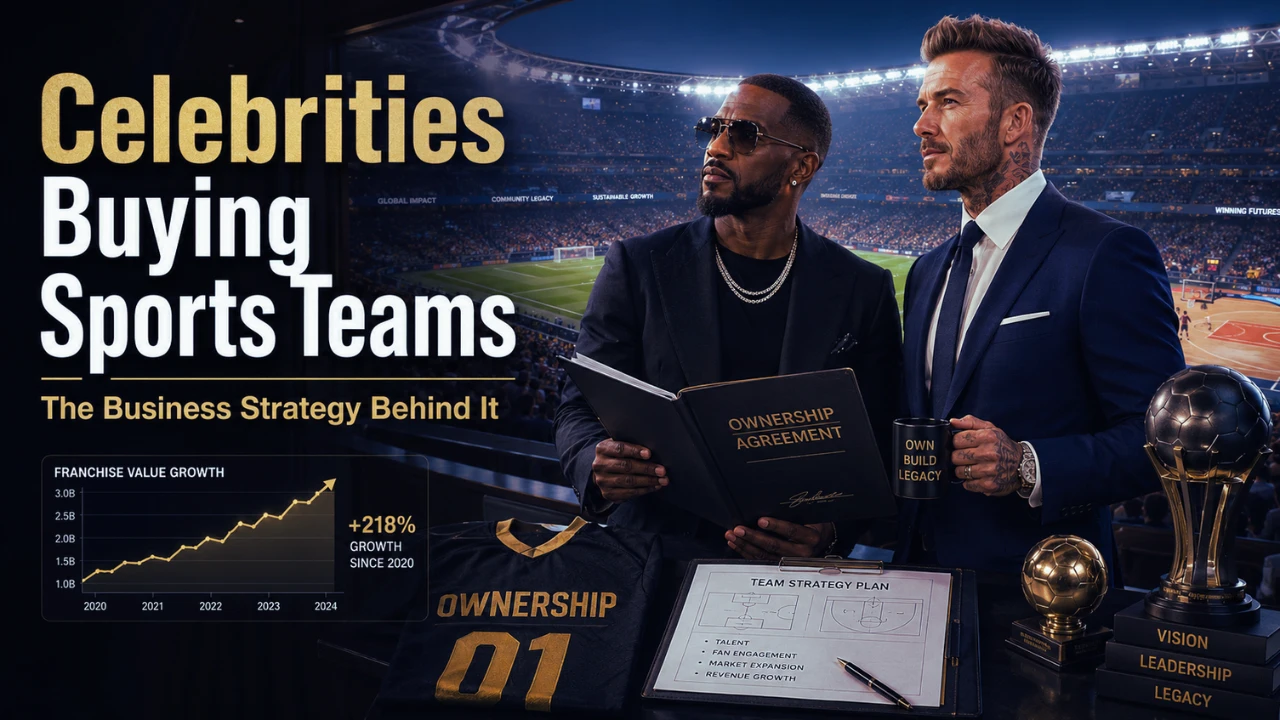
The Business Strategy Behind Celebrities Buying Sports Teams
This article explains why celebrities buying sports teams has become a serious wealth strategy, not just a vanity move. It covers equity, media rights, sponsorship, licensing, fan loyalty, celebrity net worth, and the risks that come with owning a public-facing sports asset.
A famous actor, musician, or athlete buying into a sports team used to look like a rich person’s hobby. Today, it looks more like a calculated business move.
The business strategy behind celebrities buying sports teams is built on a simple idea: fame can open the door, but ownership can create long-term value. A salary pays once. An endorsement pays for a campaign. A stake in a growing franchise can rise in value for years, especially when sports, streaming, sponsorship, merchandise, and social media all start feeding the same machine.
That is why celebrity wealth is no longer just about box office checks, music royalties, residual income, or endorsement deals. The bigger story is ownership.
Why This Celebrity Wealth Trend Matters Now?
Sports teams have become powerful entertainment businesses. They sell tickets, media rights, sponsorship packages, merchandise, licensing deals, hospitality, digital content, and global fan experiences.
That makes them attractive to celebrities who already understand attention. A star with a loyal audience can help a team reach fans beyond its local market. Ryan Reynolds and Rob McElhenney did not just buy into football with Wrexham AFC. They helped turn a Welsh club into a global entertainment story through documentary storytelling, social media, and brand-friendly visibility.
The timing also matters. Forbes reported that the world’s 50 most valuable sports teams were worth more than $353 billion combined in its 2025 list, with an average value of $7.1 billion, up 22% from the prior year. That kind of growth explains why private equity, billionaires, athletes, and entertainers are all paying attention.
Sports are also becoming more connected to media and technology. Deloitte’s 2026 sports industry outlook described a market where capital is scaling ownership and sports are converging with media and entertainment. For celebrities, that is familiar territory.
The Business Model Behind the Money
A sports team is not one income stream. It is a bundle of assets.
There is matchday revenue from tickets, suites, food, and hospitality. There are sponsorship deals from brands that want access to fans. There is merchandise, licensing, broadcast money, streaming content, naming rights, and sometimes real estate around stadiums.
For football clubs, media rights remain a major driver. Deloitte’s Football Money League 2026 noted that broadcast revenue accounted for 38% of the €12.4 billion generated by the top Money League clubs in 2024 and 2025.
For celebrities, the attraction is not only annual profit. Many teams do not throw off huge cash every year because player salaries, stadium costs, travel, debt, and operations are expensive. The real upside is often asset appreciation. If the franchise becomes more valuable, the ownership stake can become far more important than a one-time paycheck.
Salary Versus Ownership
Salary is predictable. Ownership is uncertain but scalable.
An actor gets paid for a film. A singer earns from touring, streaming, royalties, and licensing. An athlete earns a salary and endorsement income. But ownership deals work differently. The celebrity is no longer just talent. They become an investor.
That shift changes the wealth equation. Instead of being paid to appear in a campaign, the celebrity may benefit if the asset grows. Instead of renting out fame, they are trying to convert fame into equity.
This is why celebrity entrepreneurship has become such a major part of Hollywood money. Stars are not only selling products anymore. They are buying pieces of companies, clubs, production houses, beauty brands, tequila labels, and sports teams.
Brand Equity and Audience Trust
Brand equity is the hidden engine.
A celebrity’s name can make sponsors pay attention. Their social media can push a team into conversations that traditional sports marketing might not reach. Their image can help reposition a club as modern, global, inclusive, stylish, funny, or culturally relevant.
But fame is not magic. Followers do not automatically become ticket buyers. A celebrity owner still needs strong management, good operations, credible leadership, and a team that fans respect.
That is the difference between a smart ownership deal and a publicity stunt.
Helpful Table
| Wealth Driver | How It Works | Why It Matters |
|---|---|---|
| Salary | Upfront payment for work | Creates immediate income but usually stops after the job |
| Endorsements | Paid brand partnerships | Converts fame into marketing value |
| Royalties | Ongoing payments from sales or usage | Can support long-term income in music, books, or licensing |
| Equity | Ownership stake in a team or company | Can grow if the asset becomes more valuable |
| Licensing | Paid use of names, logos, or intellectual property | Helps teams and celebrity brands monetize identity |
| Media Rights | Broadcast or streaming payments | Often, a major revenue pillar in modern sports |
| Sponsorship | Brands pay for exposure to fans | Turns audience loyalty into commercial revenue |
Why Traditional Net Worth Estimates Often Miss the Full Picture?
Celebrity net worth estimates are usually incomplete because private money is hard to verify.
Public salary numbers may be easier to track. So are major endorsement announcements. But private investments, ownership percentages, debt, taxes, management fees, legal costs, and deal structures are rarely visible.
A celebrity might own a small stake in a team through an investment group. That stake may be valuable, but it may not be easy to sell. It may also entail capital calls, operating losses, or league restrictions.
This is why celebrity net worth should be treated as an estimate, not a confirmed bank balance. A star’s wealth may include homes, royalties, private investments, equity deals, brand ventures, residual income, and ownership stakes that outside observers can only partially understand.
Examples That Show How This Works
Wrexham AFC is the clearest pop culture example. Ryan Reynolds and Rob McElhenney bought into a lower-division club and helped turn it into a global story through “Welcome to Wrexham,” social media, sponsorship, and emotional storytelling. Wrexham later reported a record turnover of £26.725 million for the year ended June 30, 2024, showing how attention can support real commercial growth.
Angel City FC shows another version of the strategy. The club’s celebrity-heavy founding group included Natalie Portman and Serena Williams among many others. In 2024, Angel City announced that Willow Bay and Bob Iger would acquire a controlling stake at a $250 million enterprise value, with an additional $50 million investment to support growth.
LeBron James offers a more traditional long-game example. He became a partner in Fenway Sports Group, giving him exposure to assets connected to the Boston Red Sox, Liverpool FC, and other FSG holdings. ESPN reported that James and Maverick Carter joined FSG as partners in 2021, expanding an investment path that had already included Liverpool.
Magic Johnson is another model. Forbes has reported that Johnson owns stakes in teams including the Los Angeles Dodgers, Washington Commanders, Los Angeles Sparks, and LAFC, alongside broader business ventures.
Michael Jordan shows the scale and the pressure of team ownership. The NBA announced in 2023 that Jordan’s sale of a majority stake in the Charlotte Hornets had been finalized, with Jordan remaining a minority owner. Reports placed the valuation around $3 billion, but his tenure also showed that ownership success is not the same as winning championships.
Tom Brady’s minority ownership in the Las Vegas Raiders is another example of the modern athlete-investor path. AP reported that NFL owners approved his 5% stake, while the league placed restrictions around possible conflicts with his broadcasting role.
The Risks Behind Celebrity Business Ventures
Buying into a team can look glamorous, but the risks are real.
Sports teams are expensive to operate. Payrolls rise. Stadium projects can become complicated. Fans may reject owners who seem disconnected from club culture. Poor performance can hurt attendance, sponsorship momentum, and public mood.
There are also reputational risks. A celebrity’s public image can help a team, but scandal or audience fatigue can damage brand equity. A club can also become a drain on attention if the celebrity owner is expected to comment on every loss, management decision, or fan complaint.
Minority ownership has another limit. A celebrity may get headlines without real control. If they do not control operations, hiring, spending, or strategy, their influence may be more promotional than managerial.
That does not make the investment meaningless. It simply means readers should separate celebrity visibility from actual control.
What does this reveal about modern celebrity wealth?
Modern celebrity wealth is shifting from income to ownership.
The richest stars are not only asking, “What is my fee?” They are asking, “Can I own part of the upside?” That is visible across beauty brands, production companies, liquor deals, restaurants, creator economy startups, streaming rights, and now sports ownership.
Celebrities buying sports teams is part of that bigger movement. Fame becomes leverage. Leverage becomes access. Access can become equity.
The smart money is not in pretending every celebrity owner will become a sports mogul. The smart takeaway is that entertainment, sports, and finance are now deeply connected. For celebrities with capital, patience, and the right partners, a team stake can become more than a headline. It can become a long-term wealth-building asset.
Conclusion
The business strategy behind celebrities buying sports teams comes down to ownership, attention, and timing.
A sports team can turn fame into commercial power through sponsorships, media rights, merchandise, licensing, and global fan engagement. But the real financial upside usually sits in equity value, not instant cash flow.
That is why traditional celebrity net worth estimates often miss the bigger picture. The most important assets are not always public, liquid, or easy to measure. As sports continue to merge with entertainment and private capital, celebrity ownership will likely become less surprising and much more strategic.
FAQs
Why are celebrities buying sports teams?
Celebrities buy sports teams to gain ownership in valuable assets, expand their brand equity, access new business networks, and benefit from long-term franchise growth.
Do celebrities make money from owning sports teams?
They can, but not always through immediate profit. Many owners benefit from asset appreciation, sponsorship growth, media rights, merchandise sales, and future resale value.
Is celebrity sports ownership different from endorsement deals?
Yes. Endorsement deals pay celebrities to promote a brand. Ownership gives them a stake in the asset, whose value can rise or fall over time.
Why do celebrity net worth estimates miss the value of sports ownership?
Private stakes, debt, taxes, capital calls, and undisclosed deal terms make exact values hard to verify. Many net worth figures are estimates, not confirmed facts.
What are the biggest risks of celebrities buying sports teams?
The risks include poor team performance, high operating costs, fan backlash, weak management, overpaying for a stake, and limited control in minority ownership deals.
Explore more celebrity wealth stories and entertainment business breakdowns to see how fame, ownership, and brand power shape modern fortunes.
Table of Contents