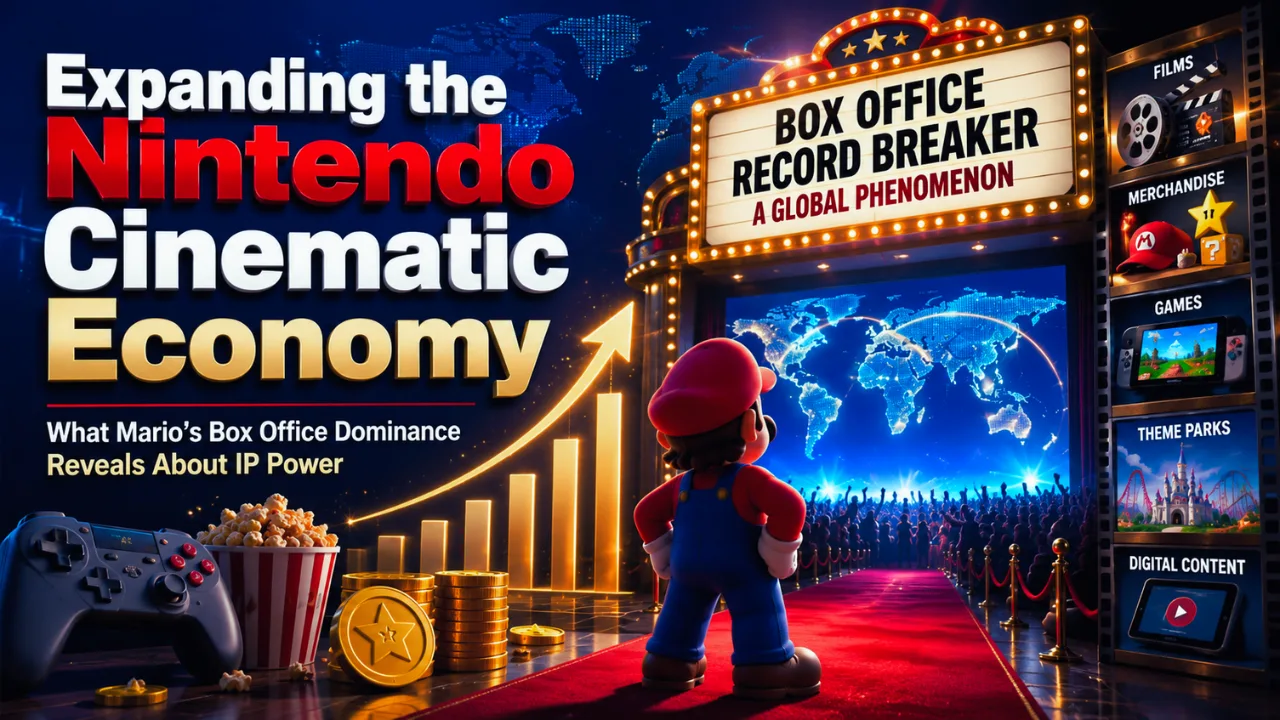
Nintendo Cinematic Economy Reveals Mario IP Power
This article explains how Mario’s box office success has expanded Nintendo’s business beyond games into movies, licensing, merchandise, theme parks, and streaming rights. It also breaks down why IP ownership, brand equity, and long-term distribution often matter more than simple celebrity net worth or one-time box office headlines.
Mario did not become a billion-dollar movie force by accident. He arrived in theaters carrying decades of player memory, family recognition, game sales, merchandise value, and Nintendo’s careful control of its intellectual property.
That is why the Nintendo cinematic economy matters. The success of The Super Mario Bros. Movie and the continued growth of Mario on-screen reveal a larger business story: modern entertainment wealth is not built solely on ticket sales. It comes from ownership, licensing deals, royalties, audience trust, streaming rights, and the ability to turn one beloved character into many revenue streams.
Box Office Mojo lists The Super Mario Bros. Movie at about $1.36 billion worldwide. At the same time, The Super Mario Galaxy Movie has also crossed the billion-dollar mark in current box office data. Those numbers matter, but the deeper lesson is about IP power, not just Hollywood money.
Why the Nintendo Cinematic Economy Matters Now?
For years, Hollywood chased superhero universes because familiar characters lowered risk. Nintendo is proving that video game IP can do something similar, but with a different emotional engine.
Mario is not just a character. He is a memory system. Parents who played Super Mario Bros. as children can now take their own kids to a Mario movie. That creates a rare multi-generational audience, which is exactly the kind of brand equity studios, streaming platforms, and consumer product companies want.
Nintendo has also made its broader strategy clear. In its 2025 annual report, the company said its core business remains its dedicated video game platform. Still, it is expanding Nintendo IP through visual content, mobile applications, theme parks, and merchandise to create more consumer touchpoints and drive interest back toward its gaming ecosystem.
That is the real money story. A movie does not only sell tickets. It reactivates games, boosts character relevance, supports merchandise, strengthens theme park demand, and gives Nintendo more leverage in future ownership deals.
The Business Model Behind the Money
Mario’s movie success works because the revenue stack is layered.
The first layer is the theatrical box office. This is the headline number people remember, but studios and IP owners do not keep every dollar. Theaters take a share, marketing costs must be covered, and production expenses come first.
The second layer is downstream distribution. That can include digital rental, digital purchase, physical media, television windows, and streaming rights. These windows are valuable because a family film can keep earning long after its opening weekend.
The third layer is IP expansion. Nintendo’s mobile and IP-related income includes visual content, smart-device content, and royalties. In its FY25 financial material, Nintendo reported that mobile and IP-related income fell from 92.7 billion yen in FY24 to 67.6 billion yen in FY25, mainly because visual content revenue linked to The Super Mario Bros. Movie declined after the earlier movie cycle.
That drop is actually useful for understanding the model. Movie revenue can spike, cool down, then rise again when a new title arrives. Meanwhile, licensing, games, merchandise, and brand exposure can keep the ecosystem alive between releases.
Salary Versus Ownership
Actors in animated blockbusters may receive upfront pay, and in some cases, performers can negotiate bonuses or backend participation. But unless those terms are publicly disclosed, they should not be treated as confirmed.
Nintendo’s advantage is different. It owns and controls the underlying IP. That gives the company leverage beyond a single paycheck. When Mario appears in a film, game, toy line, mobile promotion, or theme park attraction, the value flows back into a larger owned ecosystem.
That is the difference between salary and ownership. Salary pays once—ownership can continue to compound if the brand remains culturally relevant.
Brand Equity and Audience Trust
Mario has trust built into the name. Families know the tone. Gamers know the world. Retailers know the characters sell. Studios know the audience is global.
That brand equity reduces marketing friction. A new original animated film must explain who its characters are. Mario arrives with decades of recognition already attached.
Nintendo and Illumination also benefit from clear brand roles. Nintendo protects the IP and mythology. Illumination brings animation production and family-film distribution experience through Universal. For the Super Mario Galaxy Movie, Nintendo said the film was co-financed by Universal Pictures and Nintendo, produced by Chris Meledandri and Shigeru Miyamoto, and released worldwide by Universal Pictures.
Helpful Table
| Wealth Driver | How It Works | Why It Matters |
|---|---|---|
| Box Office | Ticket sales from theatrical release | Creates headline revenue and cultural momentum |
| Streaming Rights | Later distribution through platforms | Extends audience reach after theaters |
| Royalties | Payments from licensed use of IP | Can support recurring income |
| Licensing Deals | Use of characters on products and media | Turns recognition into commercial value |
| Game Sales | Renewed interest in Mario titles | Sends movie attention back to Nintendo’s core business |
| Brand Equity | Trust built through decades of play | Makes future launches easier to market |
Why Traditional Net Worth Estimates Miss the Full Picture?
Celebrity net worth sites often focus on visible income: salaries, endorsement deals, real estate, and reported business ventures. That is incomplete for entertainment business analysis.
The same problem arises when people discuss Mario’s box-office dominance. A billion-dollar gross is not the same as profit. A celebrity voice role is not the same as owning the character. A licensing deal is not the same as equity.
Private investments, undisclosed bonuses, tax structures, management fees, debt, royalties, residual income, and ownership stakes are often not fully visible. That is why wealth in Hollywood money is difficult to verify, especially when IP rights, streaming windows, and long-term licensing deals are involved.
Nintendo is a cleaner example than celebrity entrepreneurship because the central asset is public and obvious: the company controls Mario. But even here, exact profit splits, distribution economics, and contract terms are not always public.
Examples That Show How This Works
The strongest example is the way the movie supported Nintendo’s broader business. In a 2024 investor Q&A, Nintendo president Shuntaro Furukawa said The Super Mario Bros. Movie lifted mobile and IP-related sales, with most movie-related revenue tied to theatrical screenings. He also noted that the film helped increase downloads and active users for Super Mario Run and Mario Kart Tour.
That is the flywheel.
A viewer watches Mario in theaters. A child asks for a Mario toy. A parent buys a Switch game. A lapsed gamer returns to Mario Kart. A theme park visitor recognizes the world. A streaming release introduces the film to another household.
None of these channels alone tells the whole story. Together, they explain why IP ownership can be more powerful than a single hit movie.
The Risks Behind Celebrity Business Ventures and IP Expansion
Big IP can still fail.
Audiences can get tired if studios overexpand too quickly. A weak story can damage trust. Licensing can cheapen a brand if products feel low-quality. Theme park and merchandise partnerships require strict brand control. Streaming deals can add reach but may reduce urgency if audiences expect every film to arrive at home quickly.
Celebrity brands face similar risks. A famous name does not guarantee product-market fit. Fashion lines, restaurants, beauty brands, tequila companies, memoir deals, and streaming projects can struggle when the product is weak, timing is poor, or management is careless.
Mario’s advantage is discipline. Nintendo has historically been protective of its characters, which may limit short-term volume but helps preserve long-term value.
What does this reveal about modern celebrity wealth?
The bigger lesson is simple: entertainment wealth now belongs to those who control the asset, not only those who appear on screen.
For celebrities, that means equity deals, creator economy ventures, licensing deals, private investments, and ownership stakes can matter more than salary alone. For companies like Nintendo, it means IP can move across theaters, games, mobile, merchandise, streaming rights, and theme parks without losing its center.
Mario’s box-office dominance shows why the future of the entertainment business is not just about making hits. It is about owning worlds that audiences want to revisit.
Conclusion
The Nintendo cinematic economy proves that the most valuable entertainment assets are not always new. Sometimes they are familiar characters managed with patience, control, and a clear business strategy.
Mario’s film success is not just a Hollywood win. It is a case study in brand equity, licensing power, ownership deals, and the financial strength of IP that can travel across generations.
As more studios chase video game adaptations, Nintendo’s challenge will be protecting the magic while expanding the money machine. That balance will decide whether Mario remains a box office event or becomes the foundation of a much larger cinematic empire.
FAQs
Why is Mario’s box office success important for Nintendo?
Mario’s box office success matters because it expands Nintendo’s revenue beyond games. Movies can increase awareness, support merchandise sales, boost interest in the game, create licensing opportunities, and strengthen long-term IP value.
What is the Nintendo cinematic economy?
The Nintendo cinematic economy refers to Nintendo’s growing use of movies, visual content, licensing, merchandise, theme parks, games, and streaming rights to increase the value of its intellectual property.
Does Nintendo make money only from Mario movie tickets?
No. The box office is only one part of the model. Nintendo can also benefit from royalties, licensing deals, merchandise, game sales, mobile engagement, brand partnerships, and long-term IP exposure.
Why do celebrity net worth estimates miss entertainment wealth?
Celebrity net worth estimates often miss private investments, taxes, management costs, undisclosed equity, royalties, residuals, licensing income, and deal structures that are not publicly available.
Can video game movies become the next model for superhero franchises?
They can, but not every game works as a film. The strongest candidates have recognizable characters, emotional nostalgia, global audiences, clear visual worlds, and owners who protect the brand carefully.
For more entertainment business breakdowns, explore our latest celebrity wealth, Hollywood money, net worth analysis, and IP ownership stories.
Table of Contents