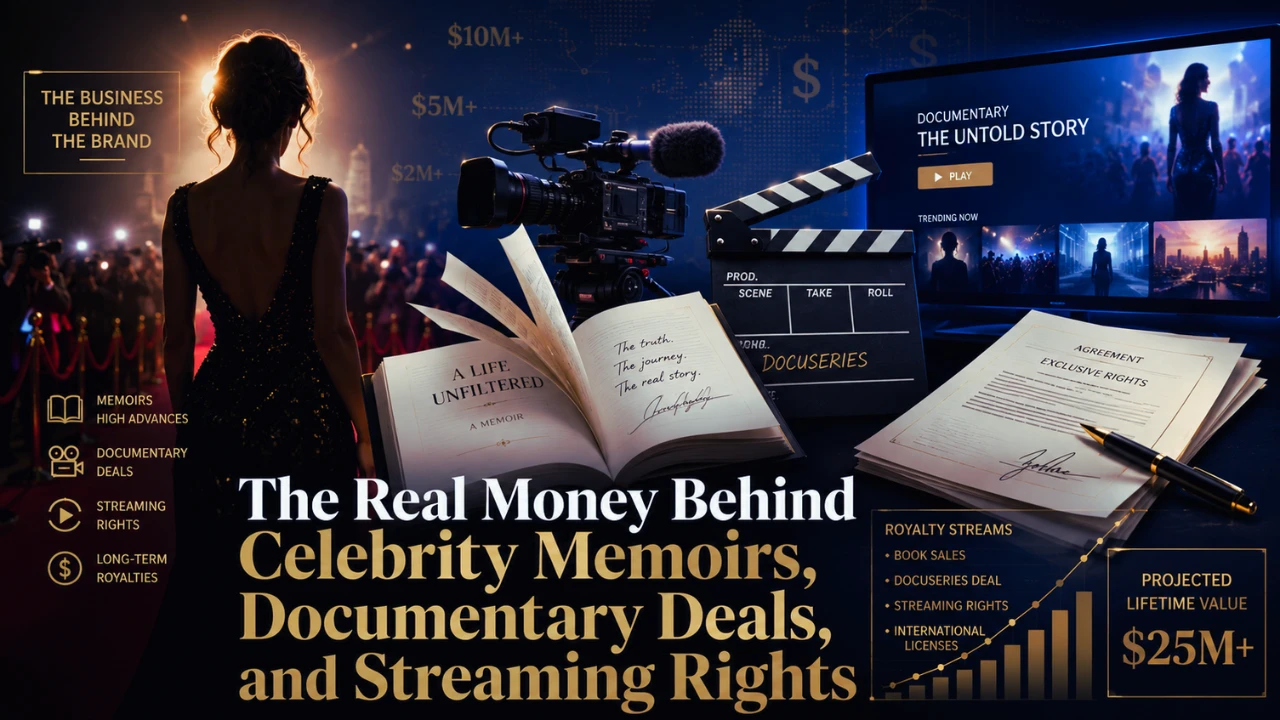
The Real Money Behind Celebrity Memoirs and Streaming Rights
This article explains how celebrity memoirs, documentary deals, and streaming rights have become major wealth-building tools in the entertainment business. It breaks down advances, royalties, licensing, brand equity, ownership, residual income, and why celebrity net worth estimates often miss the real value behind fame.
A celebrity memoir is rarely just a book. A documentary is rarely just a film. And streaming rights are no longer a quiet backend detail handled by lawyers after the spotlight fades.
The real money behind celebrity memoirs, documentary deals, and streaming rights sits at the intersection of fame, intellectual property, audience trust, and distribution power. When a famous person sells their story, they are not only selling pages or screen time. They are selling access, emotional attention, cultural relevance, and sometimes long-term rights that can continue to earn after the first headline disappears.
That is why this part of Hollywood money matters now. Stars, athletes, musicians, royals, influencers, and creators are learning that the most valuable asset may not be a single paycheck. It may be control over the story itself.
Why This Celebrity Wealth Trend Matters Now?
Celebrity wealth used to be easier to understand from the outside. Actors earned salaries. Musicians sold albums and toured. Athletes signed contracts. The authors collected advances and royalties.
That world still exists, but it is no longer the whole picture.
Today, a famous person can turn one life story into a memoir, an audiobook, a documentary series, a podcast, speaking events, branded content, and a streaming licensing package. The same personal narrative can move across several formats, each with different economics.
Prince Harry’s memoir Spare showed how great the demand for celebrity storytelling can be. Penguin Random House’s parent company said the book sold 1.43 million English-language copies across print, ebook, and audiobook formats on its first day, making it the publisher’s fastest-selling nonfiction release at the time.
Britney Spears’ The Woman in Me also proved the power of first-person storytelling. The Associated Press reported that the memoir sold 1.1 million copies in the United States during its first week.
These numbers matter because they show why publishers and streamers compete for access. A celebrity’s story can arrive with a built-in audience, years of public curiosity, and massive media attention before the first ad campaign even begins.
The Business Model Behind the Money
The money behind memoirs, documentary deals, and streaming rights usually comes from several layers.
A celebrity memoir can include an advance, royalties after the advance earns out, audiobook revenue, foreign rights, paperback editions, and sometimes film or TV adaptation rights. A documentary deal can include producer fees, licensing payments, backend participation, or ownership through a production company. Streaming rights may involve a flat license fee, exclusive window, renewal terms, or broader first-look and overall deals.
That is why two deals that sound similar in headlines may be very different financially.
A celebrity who appears in a documentary may earn a fee. A celebrity who produces the project through their own company may control more upside. A celebrity who owns underlying rights to their story, footage, music, or archive may have even more leverage.
Salary Versus Ownership
Salary is immediate. Ownership is patient.
An upfront payment can be huge, especially for a bestselling memoir or major streaming documentary. But ownership can matter more over time if the project travels across formats.
For example, Barack and Michelle Obama’s Higher Ground extended its creative partnership with Netflix in 2024 under a multi-year first-look deal for film and television projects. That kind of structure differs from a one-time appearance fee because it links a celebrity-backed company to ongoing production and distribution opportunities.
Ownership does not guarantee profit. But it gives celebrities a seat closer to the business engine. Instead of only being talent, they can become producers, rights holders, and brand builders.
Brand Equity and Audience Trust
A celebrity’s brand equity is the financial value of public trust, recognition, and emotional connection.
That trust can turn into book preorders, documentary views, podcast downloads, media coverage, and licensing interest. But the trust has to feel real. A memoir that sounds overly managed can disappoint readers. A documentary that feels like reputation repair can face backlash. A streaming project that relies only on a famous name may struggle if the story is weak.
The strongest celebrity projects usually offer one of three things: access, honesty, or a world people want to enter.
Helpful Table
| Wealth Driver | How It Works | Why It Matters |
|---|---|---|
| Advance | Upfront payment from a publisher or platform | Creates immediate income before sales or views arrive |
| Royalties | Ongoing payment from book, audio, or rights usage | Can create long-term income if demand continues |
| Licensing | Paid use of content, footage, name, or story rights | Let’s celebrities monetize intellectual property |
| Producer Fees | Payment for developing or producing a project | Moves talent closer to the business side |
| Streaming Rights | The platform pays to distribute content for a period | Can turn a project into a major distribution asset |
| Equity Deals | Ownership stake in a company or production entity | Can grow if the business succeeds |
| Residuals | Payments from reuse under contract rules | Still important in film, TV, and streaming economics |
Why Traditional Net Worth Estimates Often Miss the Full Picture?
Celebrity net worth estimates are popular, but they are often incomplete.
Public estimates may include known salaries, real estate, endorsements, or visible business ventures. They often miss private investments, undisclosed equity deals, debt, taxes, management fees, legal costs, charity commitments, and complex royalty structures.
Streaming rights make the picture even harder. A platform may pay for exclusive distribution, but the public may not know whether the celebrity received a flat fee, backend participation, producer compensation, or a larger company-level agreement.
Residual income is another area outsiders often misunderstand. After the 2023 SAG-AFTRA contract, the union said a new compensation stream was established for performers working in streaming, including success-based payments for qualifying high-budget SVOD productions.
That does not mean every celebrity earns huge residuals from streaming. It means deal terms matter. The same project can produce very different outcomes depending on contracts, union coverage, ownership, platform performance, and rights structure.
Examples That Show How This Works
Michelle Obama’s Becoming is a useful example because it was not only a memoir. It became a publishing event, an audiobook, a speaking tour driver, and later a Netflix documentary tied to her broader media presence. Public reporting said the book had sold more than 10 million copies globally by 2019.
Taylor Swift’s The Eras Tour concert film shows another version of rights power. The film earned more than $262 million worldwide in theaters, according to AP, before moving to Disney+ with added material. That model matters because Swift was not merely selling a concert recording. She was controlling distribution windows, fan demand, theatrical revenue, and later streaming value.
Prince Harry and Meghan’s media business also presents both opportunities and risks. AP reported in 2025 that Archewell Productions extended its Netflix partnership with a multi-year first-look deal, following its 2020 collaboration. But their Spotify podcast partnership ended in 2023, which Variety reported as a mutual parting of ways.
That contrast is important. Celebrity attention opens doors, but platforms still care about output, audience response, and repeatable value.
The Risks Behind Celebrity Business Ventures
Celebrity storytelling can be lucrative, but it is not risk-free.
The first risk is overexposure. If a celebrity releases a memoir, documentary, podcast, lifestyle brand, and branded series too closely together, the audience may feel marketed to rather than invited in.
The second risk is weak product-market fit. Fame can generate curiosity, but it cannot save a dull book, thin documentary, or poorly timed streaming project.
The third risk is rights complexity. Music rights, archival footage, family participation, legal clearances, publisher terms, and streamer exclusivity can all affect profitability.
Public image is another major factor. A celebrity memoir may sell because readers want vulnerability, but it can also reopen old controversies. A documentary may evoke sympathy, but it can also be criticized for being overly controlled. A streaming deal may look impressive, but if projects underperform, renewals and future leverage can weaken.
Celebrity brands and media ventures also require management: creative taste, production discipline, legal oversight, marketing strategy, and financial planning matter. A famous name can attract at the first meeting. It does not automatically build a durable business.
What does this reveal about modern celebrity wealth?
Modern celebrity wealth is less about one income stream and more about stacking rights.
A star can earn from acting, then produce a documentary, license archival material, publish a memoir, narrate an audiobook, sell foreign rights, launch a related speaking tour, and use the attention to support business ventures. None of those layers should be treated as guaranteed wealth, but together they show how celebrity entrepreneurship has changed.
The smartest celebrities are not only asking, “What is my fee?”
They are asking better questions. Who owns the rights? How long does the platform control distribution? Can this story become a series? Is there an audiobook upside? Are there international rights? Does this strengthen or weaken the brand?
That is the real money behind celebrity memoirs, documentary deals, and streaming rights. It is not just the headline number. It is the structure behind the number.
Conclusion
Celebrity memoirs, documentary deals, and streaming rights reveal a major shift in the economics of the entertainment business. Fame still matters, but ownership, timing, distribution, and intellectual property now shape the bigger financial picture.
Traditional celebrity net worth estimates often miss that complexity because they focus on visible income. The deeper story is in rights, royalties, licensing deals, backend structures, and brand equity.
As celebrities become producers, founders, publishers, and rights holders, the next era of Hollywood money will belong to those who understand that a story is not only personal. In the right structure, it can become an asset.
FAQs
Why do celebrity memoirs make so much money?
Celebrity memoirs can earn large advances because publishers expect strong media attention, built-in demand, audiobook sales, foreign rights, and long-term backlist potential.
How do celebrities make money from documentary deals?
They may earn appearance fees, producer fees, licensing payments, backend participation, or revenue through a production company, depending on the deal structure.
What are streaming rights?
Streaming rights allow a platform to distribute a film, series, concert, or documentary for a defined period, region, or exclusivity window.
Why are celebrity net worth estimates often inaccurate?
They usually rely on public information and may miss taxes, debt, management costs, private investments, royalties, licensing income, and undisclosed equity deals.
Do celebrities make more from ownership than endorsements?
Sometimes, but not always. Ownership can create bigger long-term upside, while endorsements offer simpler upfront income. The outcome depends on the business, the contract, the timing, and the execution.
For more sharp breakdowns of celebrity wealth, Hollywood money, entertainment business deals, and modern net worth analysis, explore our latest celebrity finance stories.
Table of Contents