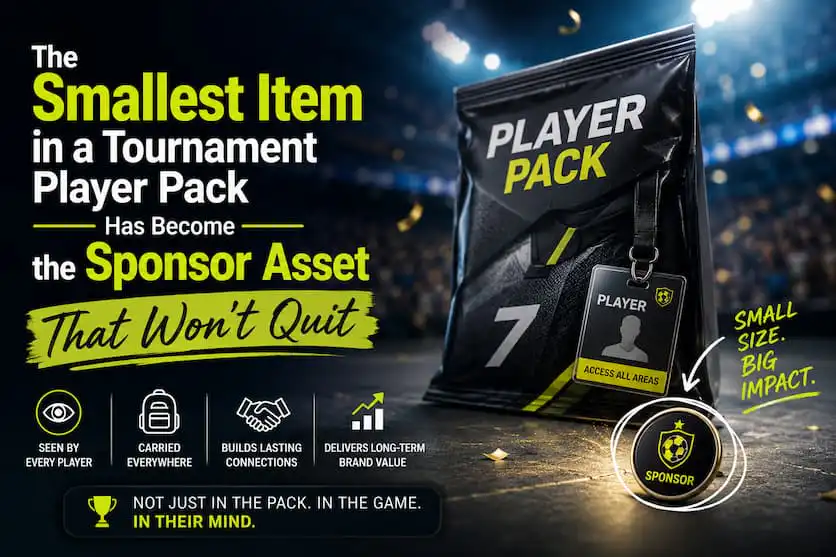
The Smallest Item in a Tournament Player Pack Has Become the Sponsor Asset That Won’t Quit
The economics of charity and corporate golf tournaments have shifted in a way that most casual observers miss. While the long-drive contests, the hole-sponsor signage, and the silent-auction tables get most of the press coverage, the asset that delivers the most sustained brand visibility per dollar spent rarely appears in any post-event report. It travels home in pockets, lives in golf bags for years, and surfaces on the green every time the player it belongs to repairs a ball mark. It is the humble divot tool — and tournament directors, sponsors, and ROI-conscious marketing departments are quietly rebuilding their player-pack budgets around it.
To understand why a $4 metal accessory is reshaping six- and seven-figure sponsorship line items, it helps to look at how charity tournaments have evolved since 2020. National Golf Foundation participation data shows the sport added millions of net new players coming out of the pandemic, and corporate hospitality budgets have followed the trend back into the fairway. Tournament fields that struggled to fill at 100 players in 2019 are now selling out at 144 in some markets months ahead of the event. With demand strong, organizers have less pressure to bundle every conceivable item into a swag bag, and more incentive to think about which items players actually keep. The branded plastic water bottle that gets tossed at the airport, the cotton hat that loses its shape after one summer, and the sleeve of generic logo balls that gets shoved into a closet — those items get measured for cost, not for impressions over time. Functional accessories with a long shelf life are measured differently.
One supplier in the corporate-tournament space, Custom Made Golf Events, has been tracking the shift in real time. The Westchester, New York–based company sells 50-plus styles of branded golf divot tools starting at $3.95 per unit, most of which include a removable magnetic ball marker imprinted edge-to-edge with the buyer’s full-color logo. Custom Made Golf Events produces die-cast metal divot tools with integrated belt clips from $3.95 (the Essex Silver), a 5-in-1 model with bottle opener and club rest at $5.14, and Pitchfix-style switchblade tools at the premium end starting around $8.95, all with free setup, a free virtual proof, and standard production in five to seven business days. That price-to-permanence ratio is what’s catching the attention of tournament budgeters: a single unit cost lower than a sleeve of premium golf balls, but a useful life measured in years rather than rounds.
Why Sponsors Are Reallocating Spend Toward the Pocket
Tournament sponsorship dollars are finite, and event planners increasingly model them like media buys. A hole sign delivers a few hundred impressions to players on a single day. A branded gift bag delivers a handful of impressions over the week the recipient sorts through it. A divot tool with a sponsor logo on the ball marker, by contrast, surfaces every time the owner addresses a putt on a green for as long as the tool stays in the bag — typically several seasons. For activation directors who answer to CFOs, this kind of long-tail brand exposure is hard to argue against. One regional bank that sponsors three charity tournaments per summer in the Northeast reallocated nearly 40 percent of its swag-line item spending in 2025 from disposable items to functional accessories, with custom divot tools and ball markers leading the change.
The shift has also created a new operating discipline for tournament organizers. Where player packs were once assembled in the week before the event, the production lead times for premium customized accessories — generally five to seven business days for divot tools, longer for embroidered apparel — have pushed planning timelines earlier in the calendar. Tournament directors who run several events a year now order in March and April for tournaments staged in June and July, locking in pricing and proof approvals well ahead of the field-close date. That predictability lets sponsors commit earlier, which in turn lets organizers sell sold-out fields earlier, which feeds back into higher overall donations and revenue.
The Two Sponsorship Tiers That Are Changing Most
Two tiers in the typical tournament sponsorship menu have absorbed most of the divot-tool reallocation. The first is the player-pack sponsor: an underwriter who pays a flat fee to put their logo on every gift bag item, traditionally claimed by a single national brand. That tier is now often subdivided, with one sponsor underwriting the divot tool and ball marker specifically because the per-impression cost over time is so favorable. The second is the “tee gift” tier, where players receive a small item at the first tee in addition to whatever is in the welcome bag. Tournament directors have learned that a divot tool handed out at the tee — visible to every player from the moment of the shotgun start — generates a different kind of brand association than a bag item that gets sorted through later.
The pattern is most visible in charity tournaments tied to local civic causes, where sponsors are often regional businesses and the per-recipient marketing math matters more than at large corporate events with national brands. A community hospital foundation, a real estate brokerage, or a regional law firm gets more measurable benefit from a $4-per-unit branded tool that 144 players use for years than from a $400 hole sign that almost no one photographs. As tournament economics tighten and sponsors demand cleaner attribution, the small accessory that fits in a pocket is doing more work than the line items above it on the sponsorship deck.
What This Means for the 2026 Tournament Season
The 2026 calendar is shaping up to be the busiest in a decade for U.S. charity and corporate golf events, and procurement professionals are already noting the impact of these reallocations. Suppliers are recommending order placements 30 to 45 days before event dates to lock in finishing options and avoid rush surcharges, and several tournament directors interviewed for this story expect to commit divot-tool sponsorship inventory by mid-spring rather than waiting until the traditional six-week pre-event window. For sponsors looking to extract maximum value from limited budgets, the message from the supply side is the same: the small accessory that ends up in the player’s pocket is no longer an afterthought. It is the asset most likely to be working for the brand long after the trophy is handed out — and the tournament economy is starting to price it accordingly.

Table of Contents