Packing Like a Pro for a Greenwich Move: Moving Hacks for Modern Households
Greenwich has its own moving dynamics, and they’re not always obvious from the outside. It’s not just about moving a big house. It’s about managing everything inside it — from antique furniture and home offices to wine collections and children’s equipment — which is where packing often gets truly complicated. Americans move often, with lifetime averages hovering around 11.7 moves, yet very few people ever approach it with a repeatable system. Most people just… wing it. And then regret it.
That’s where local expertise actually matters. Seasoned Movers Greenwich CT will tell you the same thing: the move itself takes a few hours, but a bad pack job can haunt you for weeks — broken items, lost small parts, boxes that weigh 60 pounds with zero logic to what’s inside.

Start with a room-by-room audit
The first instinct most people have is to buy packing supplies. Boxes, tape, bubble wrap — it’s easy to feel like the hard part is already underway. But packing supplies only get you so far if you haven’t actually walked through the move properly.
Go room by room with a notepad — or just use your phone — and take inventory as you go. Estimate the box needs by area, make note of anything fragile or awkward, and remove what you no longer want before it becomes part of the move. The average household throws away or donates 15–20% of its belongings during a move. Get ahead of that number. Every item you don’t pack is time and money saved.
The packing sequence that actually works
There’s a logic to packing that most guides gloss over. It’s not just “start early.” Here’s a sequence that holds up in practice:
- Weeks 3–4 out: Seasonal items, guest room contents, books, holiday decorations, anything in storage — basically stuff you won’t miss
- Week 2: Art, décor, non-essential kitchen gadgets (that juicer you use twice a year), garage items
- Week 1: Closets, linens, most clothing, home office equipment
- Final 48 hours: Daily essentials, kids’ school items, pet supplies, toiletries — everything that goes into a clearly labeled “Open First” box
Honestly, that last piece doesn’t get enough attention. Pack for your first night the same way you’d prep for a hotel stay: phone charger, toiletries, snacks, clothes, and morning essentials.
Weight distribution and box logic
Most people fill large boxes with heavy things because, well, there’s room. Big boxes are for lightweight bulky items — pillows, comforters, stuffed animals. Books, tools, and other heavy essentials should always go in small boxes.
For fragile items, the paper-to-item ratio matters more than bubble wrap. Crumpled newsprint or packing paper on the bottom (at least two inches), individual wrapping, and then more paper on top before closing. Dishes should always travel on their side — stacked flat, they’re far more likely to crack under pressure.
Label like you mean it
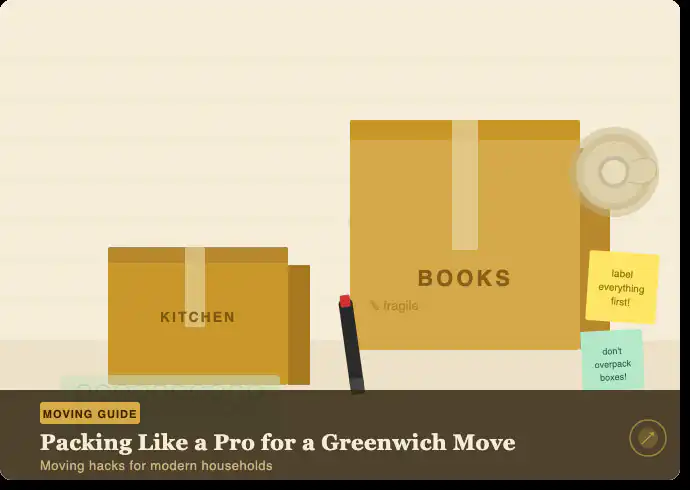
“Kitchen” on a box is almost useless information. “Kitchen – pots, lids, wooden spoons – heavy” is what actually helps. Add the destination room and a rough content description on at least two sides of every box. Color-coded boxes make it much easier for everyone involved to know exactly where things belong without constant direction.
One of the most common causes of moving damage is simple packing mistakes — especially overpacking or weak sealing. Tape every seam twice. A single strip across the center is rarely reliable.
The thought process that separates chaos from control
A move becomes much less stressful when you replace avoidance with a timeline and a real plan. Plan earlier, pack smarter, and remember that closing a box quickly isn’t the same thing as packing well. The goal is to unpack quickly, find things without frustration, and start actually living in the new space — not digging through mystery boxes for three weeks.

Table of Contents